
It was a remarkable place to go to high school in the 1970’s, Pasadena Polytechnic (Caltech’s “University High”). Today, we congratulate Bruce Beutler, classmate and new Nobel Laureate.
Finnish Light Show….
Fear of Google
From the London Review of Books, a review by Daniel Soar, here.
Money quote:
Of course, the better it gets at what it does the more money it makes, and the more money it makes the more data it gathers and the better it gets at what it does – an example of the kind of win-win feedback loop Google specialises in – but what’s surprising is that there is no obvious end to the process.
European Doctoral Students–the need for uniform support
From ScienceInsider, here. There’s no doubt in my mind that a similar situation exists on this side of the Atlantic, and that it hurts doctoral eduation.
A room with a view
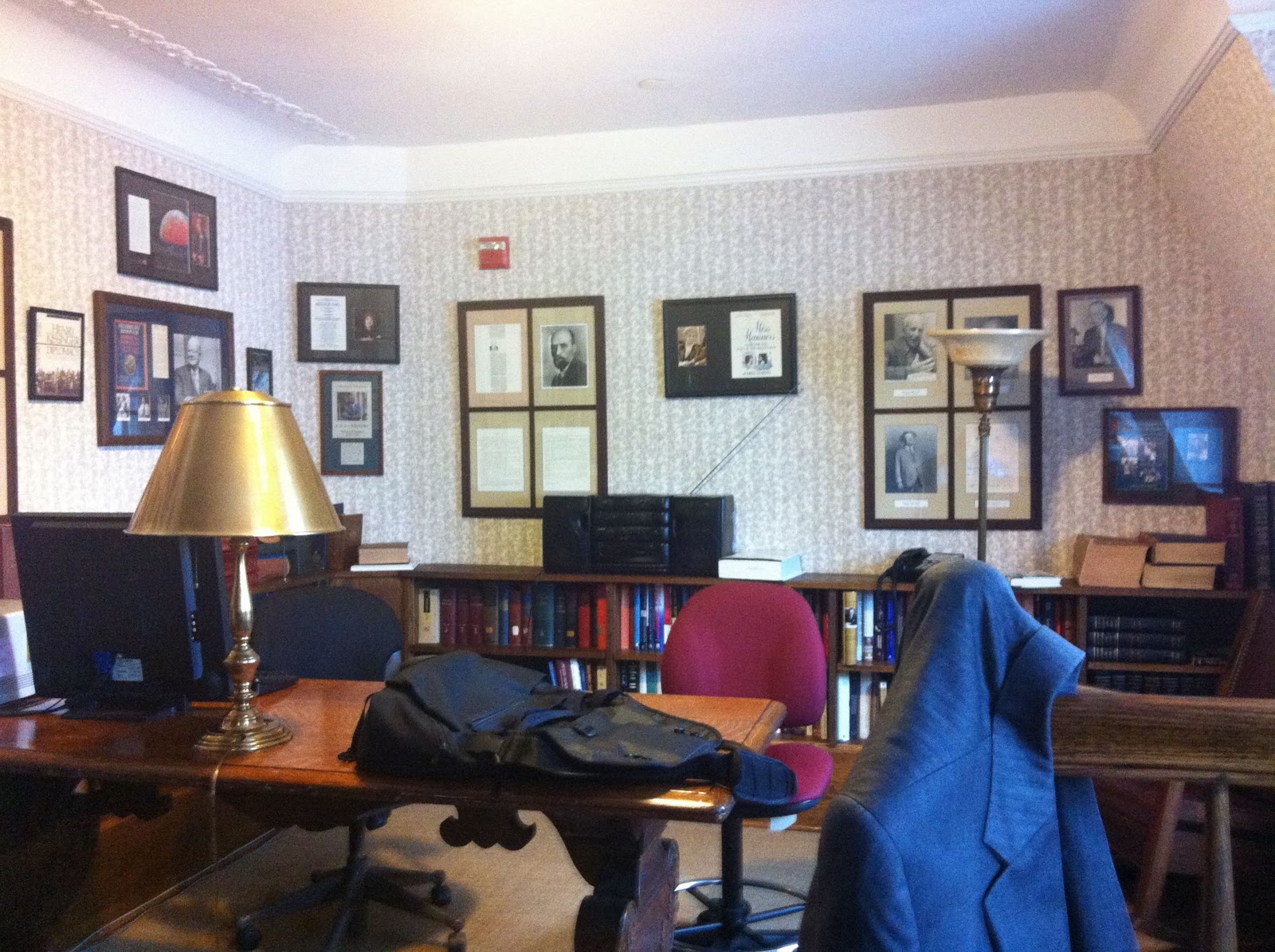
Four long stories above Massachusetts Ave NW, on embassy row, this is the Writers Room of the Cosmos Club. It’s probably my favorite place to get work done outside of my office. Today I’m catching up on an array of paperwork after finishing the NSF panel yesterday before a lunch with one of the EU science attaches here in the Garden dining room.
What strikes me most about DC these days is the sense of collective denial about the sheer size of the cuts (most likely of federal discretionary spending) that will either be imposed by the Congressional Super Committee, or, alternatively, sequestered automatically.
Running an Institute, with a large sponsored research budget, my strategic thinking has turned towards how to position Krasnow to both survive such cuts and even to thrive. My worry is that a lot of my colleagues in similar positions just aren’t thinking about this issue.
The larger questions are first: who will be supporting basic and translational science going forward, and second: how will that happen?
There are a second level of questions which center on Federal R&D:
–Which agency portfolio’s are likely to emerge relatively unscathed?
–Will there be a “despair” effect, whereby mid-ranked scientists throw in the towel, to the advantage of the very best?
Finally, how can we create new novel mechanisms for supporting international collaborations?
Born in 1981, still going strong (my HP 11c)

Purchased at Ulrich’s in Ann Arbor, it’s had one change of batteries in thirty years. It still works beautifully (although I confess to often using the emulator for it in my smart phone). And here is the article about its financial cousin from this weekend’s FT.
Faster than light?
The Opera experiment conducted by CERN is yielding data that seems to say yes for a beam of neutrinos. You can read more about it here.
It’s going to take a lot of replications for me to buy into up-ending one of Einstein’s central dogmas.
And this year’s winners are…
From ScienceInsider, the winner’s of this years MacArthur Genius awards, here.
Reviewing grants
I’m submerged at the moment in a virtual pile of grant proposals that are stored in my iPad. They are collectively very interesting, but also have a unique ability to suck up all of one’s available time. How far away are we from Strong AI to review grants?
The reason we do neuroscience
For those of my colleagues in the field who need a new reason, Su Meck’s piece in today’s NY Times Magazine provides it…here.
A really touching story of amnesia and eventual success at my Mom’s alma mater, Smith College.

