Academic Year 2011-2012: Perspectives

As we get ready this week for the return of our students and the beginning of another academic year, it’s useful to take a bit of time for some perspective on what lies ahead here at the Krasnow Institute for Advanced Study…..

In terms of research, the Institute’s full complement of wet labs are now on-line and, together with our faculty, constitute a critical mass to move the experimental aspects of our neuroscience inquiries forward. We are well-funded, we have imaginative scientists and students, and we can ask the next level of questions. This is propitious for high-risk, high-payoff experimental science.

At the same time, we are engaging with students at all levels of higher-education, through our programs. The quality and quantity of our students continues to increase. This is both a function of commitment and support for graduate education from the central administration here at Mason, but also of some recent private gifts, which ensure our ability to attract and train the very brightest.

We are also committed to enhancing undergraduate education here at Mason as part of the University’s Quality Enhancement Program, Students as Scholars. Embedding undergraduate student scholarship within an institute for advanced study represents an “out-of-the-box” approach to improving learning outcomes, particularly in STEM fields.

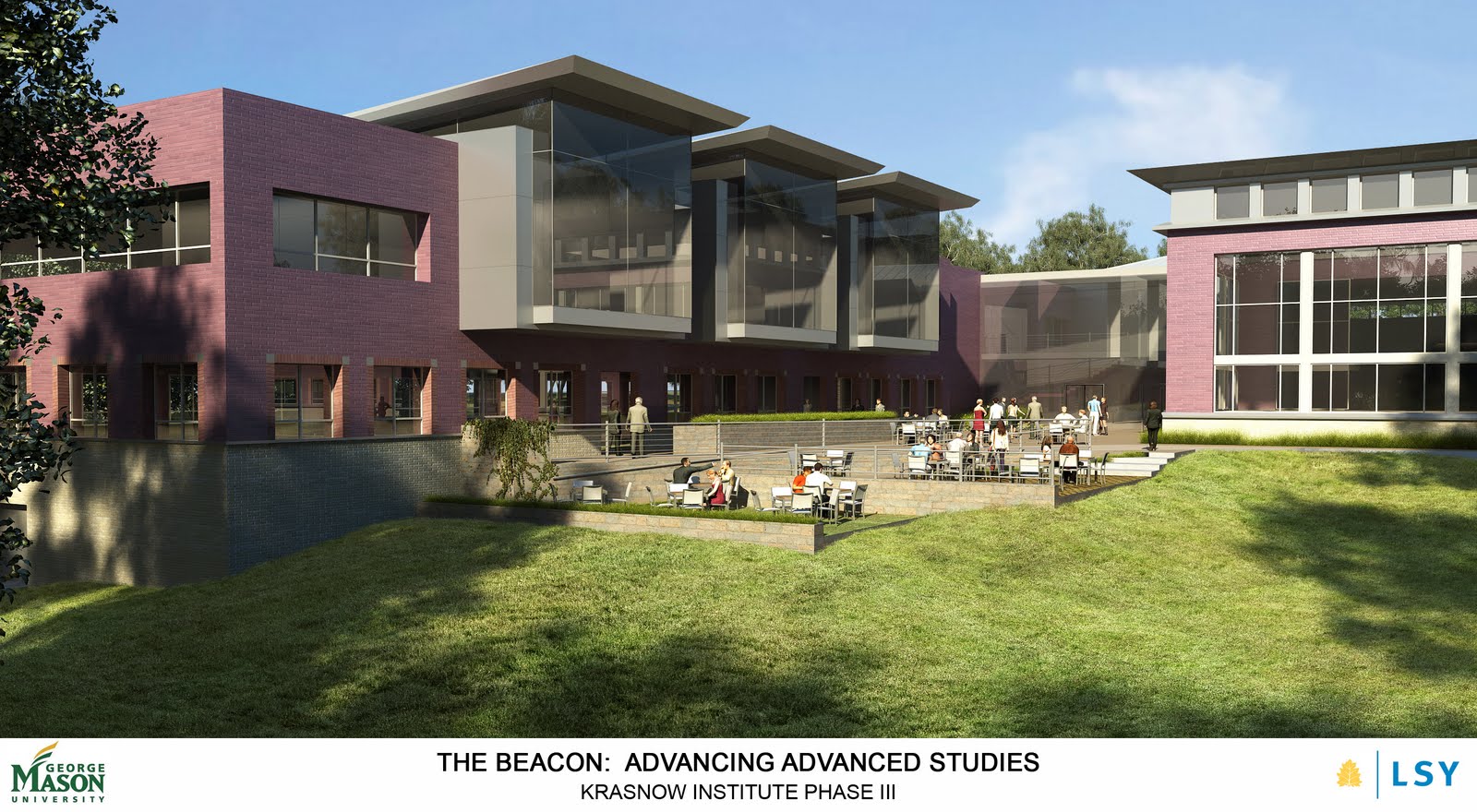
We are also getting traction on our Krasnow Phase III project (stay tuned for images) which will expand our computational social sciences programs beyond what they are now, and, at the same time, bring them under the central roof of the Krasnow Institute facility. My hope is to raise approximately $14M in new gifts over the next year or so, to bring Phase III into being.

We are also moving ahead full-speed into two new arenas for the Institute: executive education and international initiatives. In some cases, we’ll combine the two. The goal is to broaden the Institute for Advanced Study’s research and education portfolio. We’ll work closely with other academic units here at Mason and our long-term external partners in these efforts.

It’s an exciting time to be serving as institute director and chief academic unit officer. I’m looking forward to a great year.

Summer’s Over

If you are an administrator at  George Mason. I’m back in DC,  ready to focus on the new academic year. This is a particularly important one for Mason–we’re choosing a new President.

For the Institute, this year will as much about new international collaborations, as it is about our new faculty members and research space. But we’ll also be carefully watching the US science funding agencies as they deal with their own challenges.

Summer at the MBL

Here is the quad at the MBL yesterday afternoon. I had the good fortune to, on arrival, immediately run into many close colleagues and even one of our own Mason doctoral students along with her mother!

When I’m in Woods Hole I never miss getting up very early before the tourists get here for the Martha’s Vineyard ferry, to enjoy the spectacular views and to get some quiet work in before the rest of the day gears up.

The campus seems in great shape under President Gary Borisy. The annual Corporation meeting is Friday and I’m sure I’ll learn more.

I’m spending time now thinking about the subject for our 2013 virtual symposium issue for The Biological Bulletin. What can possibly top regeneration (2011) and symbiosis (2012)? I suppose this counts as a bleg….

To Woods Hole…

Tomorrow, I’m off for my annual visit to the Marine Biological Laboratory at the south western tip of Cape Cod on a narrow peninsula between Buzzard’s Bay and Vineyard Sound. It’s a place I’ve been visiting for more than thirty years and is the publisher of the 100+ year old journal I edit, The Biological Bulletin.

Our August issue, this year will be a “virtual” symposium with articles focused on the fascinating biological phenomenon of regeneration, the process by which animals recover form and function after either injury or some normal physiological process.

In the meantime, it will nice to see old colleagues and even, as has become more common, one of our current doctoral students here in Mason’s neuroscience PhD program. MBL’s summer courses are the very best in the world–they are life changing for young scientists–and in an extraordinarily positive way.

When I return to Mason, next Monday, it will mark pretty much the end of summer–another two weeks and the Fall semester will begin, with all the excitement and increased activity that goes with the beginning of the academic year.

Some thoughts on the debt crisis

First, I think the consequences for US science, were the US to default and possibly even if Congress and the President reach a deal, will be negative. In macro terms, I see Federal R&D on a downward glide slope that may well turn into a dive.

Second, I think the combination of the US debt crisis and the European sovereign debt melt down are potentially devastating to the entire global science enterprise. Asia is not yet at the point where the massive western science infrastructure is not needed to push ahead.

Third, with regards to the US, the solutions being put forward by both sides are so constrained by the size of the entitlement problem, there is no scenario that I can see where we don’t eat our seed corn.

To give loyal readers a sense of what the future might look like, we might look to the example of Soviet science after the collapse of the USSR in 1989. Not good.