The Science of Complexity: Understanding the Global Financial Crisis


The Science of Complexity: 
Understanding the Global Financial Crisis
Co-sponsored by Santa Fe Institute and the Krasnow Institute for Advanced Study at George Mason University
May 16-18, 2012, at the new Founders Hall facility at the GMU Arlington, VA campus.


The time-honored formulas of mainstream economics no longer capture the complex dynamics of today’s financial markets. This three-day symposium offers a view of the recent global financial crises from a new perspective—that of complexity science.  Sponsored by two leading complexity research institutes, the symposium will feature several of the world’s most prominent complex systems thinkers.  These experts will offer insights from non-linear dynamics, social networks, systemic risk, experimental economics, self-organized criticality, computational social science, and other areas that are vital not only to understand the current crises but to develop policies that address the underlying causes.   


The program is open to any interested participants, but is particularly designed for professionals in government, business, and the non-profit sectors.

For more information see http://krasnow.gmu.edu/soc Register now.

Encouraging collaboration…

At our Institute, a major “price of admission” for new faculty is a willingness to collaborate across disciplinary boundaries–the notion being that the loci for many major advances lie at the boundaries of disperate fields. This in itself is challenging because different disciplines operate with different technical languages, commonly called “jargon”. Finding a lingua franca between different disciplines takes time and energy and the pay off, while potentially large, is always fraught with risk (true scientific research is always risky).

Hence, here at Krasnow, the challenge is to encourage such collaboration across disciplinary boundaries, but the even deeper challenge is to encourage collaborations in general. Why?

A major reason is that our current training in science, especially at the doctoral level, emphasizes a solitary rather than team approach. The PhD thesis is, after all, a singularly individual intellectual product–the doctoral advisor’s name doesn’t go on the title page as an author for a reason. While the acquisition of data used in a dissertation may in some cases involve a team approach (think big data physics), at the data analysis level, for the thesis, the work is generally that of the graduate student.

Another reason for the challenge in getting scientists to collaborate is the inherent difficulties, under current systems of sharing data. Until data sharing curation and provenance norms are universal, the “safe” approach is to keep one’s own experimental data under wraps. While large scale data sharing is a desirable end-point, we still aren’t there yet.

Finally, my own sense is that a key ingredient of scientific success involves the ability to think intensely, without distraction, about a problem–and most individuals find it easiest to do this alone. Even if this isn’t the case, the conventional wisdom is that the “ah ha” moment follows such a period of introspective pondering.

So those are some reasons….how might one still encourage collaborations?

Lexington on Charles Murray’s new book

The Economist’s Lexington columnist weighs in succinctly on Murray’s new book here.

Money quote:

Your own columnist, a jaundiced Brit residing temporarily in a SuperZip, wonders how the lower class will respond to hearing that the main help it needs is an infusion of its betters’ morals. Mr Murray believes his numbers show that following his prescription can help people lead fuller lives at almost any level of income. He may be right. But those in the upper class who heed his call might want to leave their Mercedes Benzes at home when they set out for Denny’s and their voyage of persuasion.

Science Investments…

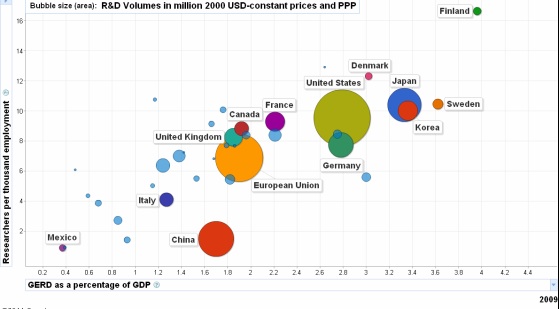
They are something we do here at the Institute level when we buy a new piece of shared equipment, but they are also something a nation does when it sponsors R&D through agency grants programs or through national laboratories.  The below graph (full movie presentation go here) shows 2009 OECD data for researchers per 1000 employees (y-axis) versus National R&D as a percentage of GDP (x-axis). The bubble size adds a third dimension: non-normalized national R&D. What jumps out pretty clearly is that Finland is investing in science at a very high level. And, that the US, if one normalizes by either population or GDP isn’t the leader.

Although the public often sees these investments through the lens of the deficit, the larger context is a nation’s ability to grow its way out of its fiscal problems as opposed to deflation and massive deleveraging. Science investments create the “garden” environment for the next wave of technology revolutions that Tyler Cowen talks about in his recent book, The Great Stagnation.

How is science investment paying off for Finland? Having recently returned from Helsinki, I can report first hand evidence of a vibrant technology start-up community, perhaps Europe’s most healthy economy, and a K-20 education system that is a world-leader. To me those are side-payoffs from the science investment. And they are very important.

However the central payoff from national science investment is the increased probability of a “game changer” discovery that leads to a revolution on the scale of the Industrial Revolution. Because science is serendipitous as far fundamental discoveries are concerned, we can’t forecast them with any accuracy. What we can do is invest as much as possible so that the probabilities of great discoveries go up.

FT’s Lucy Kellaway and aging in place

The Financial Times, Lucy Kellaway has always been a must read for me, particularly her Martin Lukes series, which sadly ended with his fictional death in a parachute jump.

In today’s regular Monday column, here, she takes on a much more serious issue: the rampant unemployment among young highly educated people due to a finite supply of jobs and baby boomers hanging on.

For me, the operative question is to what extent is this state-of-affairs true for academics (generally) and for science (specifically).

There are certainly “aging superstars” to quote from Lucy and she agrees, they should be kept on. The question she is really raising concerns the question of what is best for society: scarce positions for those who are younger and hence command smaller salaries (we could hire more of of them), or viewing experience as “added value”, something to be monetized in the academic labor market.

It’s a very complicated question–at least in academia, less so in professional sports.


Opposing reports on US Shale gas supplies

In today’s NY Times here.

Money quote:

In private discussions, some federal energy officials have raised questions about the way oil and gas companies may be inflating estimates of the amount of recoverable gas.
“The variability of shale gas well performance is crucial to any assessment of the resource potential of a shale play,” Philip Budzik, an Energy Information Administration research analyst, wrote in an e-mail to an industry analyst last April.

It’s larger than that actually. My guess it it’s the same competing political agendas that have complicated the Keystone Pipeline debate and the environmental safety of fracking technologies. That debate is playing out on many levels simultaneously and its outcome will no doubt be important to US Energy policy as it plays out (or doesn’t) over the next decade.

Cost sharing

It’s a requirement of many federal grants and potentially is a deal killer for younger institutions which may not have the resources to pull it off. The upshot of this problem is that institutions which may win awards on pure merit may have to forego competing for new awards with significant cost share. At the same time, institutions with much more massive resource pools, available to be deployed as cost share, have less competition for scarce federal grants. Merit becomes less important as a criterion while institutional resource base becomes more important. The rich get richer.

Now, I’m not saying that rich institutions don’t deserve a lot of grant support purely based on scientific merit. That’s clear; they do. But I’m also worried that newer institutions will have a much more difficult time getting up to speed, as a result of grant cost-share requirements.

It’s time to rethink grant cost share so that newer places have a chance to compete purely on the merits of the science.