Challenges ahead….

To my mind progress in science faces some pretty steep challenges in the years ahead. Chief among them is the follow-on economic damage of the Great Recession. Across the World, but particularly in North America and Europe, sovereign debt, structural deficits and political paralysis are beginning to threaten governmental support for scientific research. Here in the US, the election silly season combined with automatic sequestration cuts, increasingly make the FY13 scientific budget look pretty gloomy.  In Europe, depending how the Euro crisis pans out, the ability of Brussels to go ahead with its ambitious Horizon 2020 plan is perhaps open to question. Moreover, even in Asia, there are economic clouds which have potential to derail the massive investments in science currently taking place. I worry most about the need for China to boost domestic demand in the face of reduced exports to Europe and America. If China can’t do that smoothly, then there could well be significant instability, both economic and potentially social. And the consequences for Chinese science could well be dire.

Another challenge, especially here in the States, are the increasingly frequent attacks on the credibility of scientists. This is part of a politicization of science, both with respect to scientific theories (which serve as surrogates for “culture wars”) and scientists themselves, as they find themselves drawn into those culture wars. I’ve blogged about this danger here quite recently. The upshot is, that when the general public, upon whose taxpayer dollars science depends, stops trusting science and scientists, then science progress runs into a brick wall.

Finally, Globalism itself is being challenged and with it the massive international collaborations (think LHC, Hubble, Antarctica, ISS) which make up “big science”. Many of the truly daunting scientific problems absolutely require a transnational approach. I can’t imagine a successful single country approach to pandemic flu, to say nothing of climate change, energy production or cracking the human “mind”.

Addressing those challenges wont be easy and will certainly require the sustained contributions of scientists and their supporters. Above all, it may require many scientists to look beyond the “bench” for a bit and to reach out to their colleagues, not only to collaborate scientifically, but to protect a larger scientific agenda.

Bell Labs: The Legacy Lives On….

John Gertner’s fine piece on Bell Labs in today’s NY Times is here. Most interesting to me is the notion of proximity of really bright people as being key to success in science. This is central to what we do at the Krasnow Institute for Advanced Study and why I am working so hard to bring Phase III to fruition, so that all of us at the Institute are finally under one roof.

Let’s not have science become a political football…

One of the great dangers for American science is that it will become increasingly politicized. The partisanship and economic frailty of our current times only exacerbates this risk. A politicized science is one that finds itself, just like any other faction or special interest group, as not credible because of bias and self-interest. And credibility is the fragile currency of science.

Indeed, science’s greatest historical failures, seem to have arisen out self-inflicted politicization. The Eugenics Movement comes to mind. Historically arising from Darwin’s work on biological evolution and natural selection, Eugenics emerged directly from that science, politicized inappropriately to the question of what characteristics constituted a more perfect individual–truly the stuff of political demagogs.

At a recent lunch table here in Washington, I was struck by the dichotomy between Republicans and Democrats over which climate science was to be believed–intelligent lay public members dutifully deferring to scientific research, but only so long as it conformed to their ideological positions.

I have seen the same odd Blue versus Red scientific wars in the areas of embryonic stem cell research, origin of life and more recently economics and it strikes me as damaging, both to scientists and to society, for which good science is so critically important to its welfare.

So as scientists, let’s strive to keep our science at arm’s length from the political wars. Understanding that unprincipled individuals will always be attempting to deploy the latest “finding” to support their own political positions.

Celebrating Faculty Achievement…

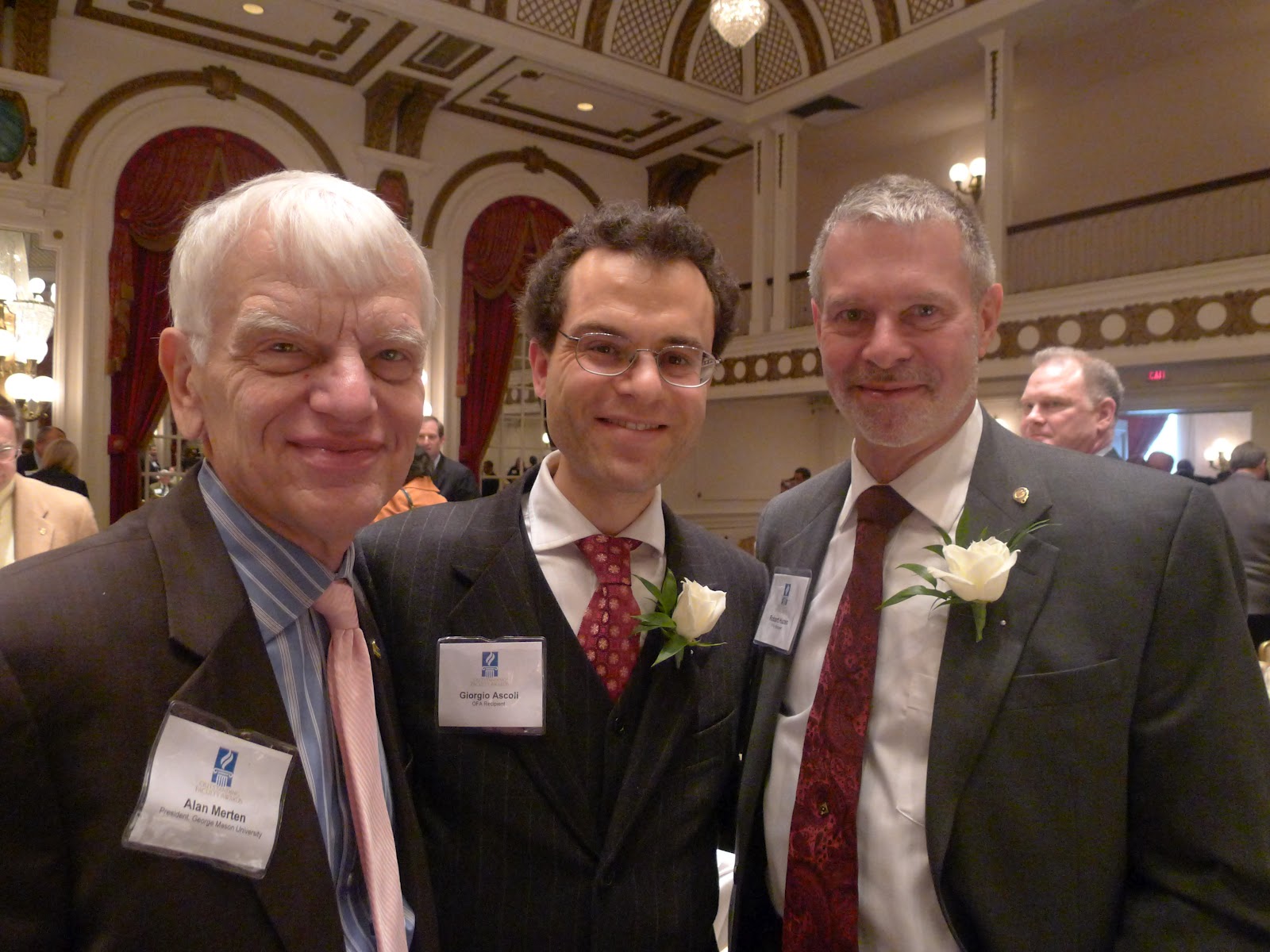
Left to right: George Mason University President Alan Merten, Professor Giorgio Ascoli and Professor Robert Hazen.

Watching two of our faculty stars recognized for their teaching and scholarship in the state capital was really gratifying yesterday.

They were two of twelve from across the Commonwealth, and George Mason was the only institution to have more than one winner.

The Governor presided over the luncheon at the magnificent Jefferson Hotel, after the awardees had been presented on the floor of the Virginia General Assembly. It really was quite an honor.

That Siren for Harvard Undergrads…Wall Street

The link is here, hat tip to a Harvard alumna. Ezra Klein’s meme is that Wall Street firms recapitulate the Ivy League application process mentality providing comfort zone and graduate skills all while…wait there’s more…paying the big bucks.

Money quote:

So it seems universities have been looking at the problem backward. The issue isn’t that so many of their well-educated students want to go to Wall Street rather than make another sort of contribution. It’s that so many of their students end up feeling so poorly prepared that they go to Wall Street because they’re not sure what other contribution they can make.

HHMI’s President Robert Tjian on supporting life science in these times…

His open letter is here. I think Peter Thiel would be glad to see HHMI out there supporting life sciences…even as things get difficult.

Tjian makes the point that HHMI has agility and independence going for it. To that I would also add they also have a very strong dose of meritocracy.

Supporting the very best scientists is the key thing. Note how different that is from trying to forecast programmatic scientific success.

Francis Fukuyama interviews Peter Thiel

In The American Interest, here. One of the best long-form journalism pieces I’ve read in a very long time. It touches on so many of the significant issues of our time (from neurobiology to energy policy) that it’s very difficult to blog about–Advanced Studies tends towards short-form pieces.

Ultimately, it’s a conversation between two extraordinarily bright people about where America is, one decade into the 21st century. You may not agree with either of them on much, but the issues discussed are central to our current problems.

So do read it.

NYT on Big Data

In today’s Review section, here.

Shout out to Mason’s own Rebecca Goldin in the piece:

Big Data has its perils, to be sure. With huge data sets and fine-grained measurement, statisticians and computer scientists note, there is increased risk of “false discoveries.” The trouble with seeking a meaningful needle in massive haystacks of data, says Trevor Hastie, a statistics professor at Stanford, is that “many bits of straw look like needles.”
Big Data also supplies more raw material for statistical shenanigans and biased fact-finding excursions. It offers a high-tech twist on an old trick: I know the facts, now let’s find ’em. That is, says Rebecca Goldin, a mathematician at George Mason University, “one of the most pernicious uses of data.”