
From The Chronicle, here. It’s a billion dollar win for the private research university. Probably trumps any PR issues and in any case, appears to arise from organically grown research (so they are a practicing entity).
Boeing 787 battery redux?
Happened at Narita airport today, story here. Looks like thermal runaway did not happen. But it also is more bad news for Boeing and its new technology aircraft. Would I fly one? Probably yes, but I’d sure worry.
Good news for US science R&D…
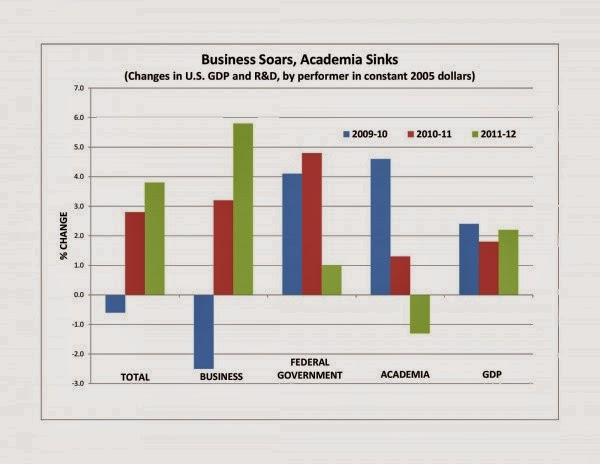
The report is from the NSF. ScienceInsider story, here. Overall I see this as a very positive trend. Academia will catch up as federal R&D investments grow–its a lagging indicator. On the business side, I see research partnerships between academia and industry as being ever more important. Those partnerships are currently at the center of our focus here at Krasnow and I think that emphasis will extend across academia.
All of this depends on some modicum of political stability as far Congress is concerned. But I think we have reason to be cautiously optimistic.
Trouble for the Singapore miracle?
Forbes story here. I’m not qualified to agree or disagree, but it’s the follows a slew of stories related to structural changes in the island state.
Oxford’s Robin Dunbar thinks TB may have co-evolved with us as a NAD producing symbiont when meat wasn’t available…
The paper is open access and is here. Short version: humans evolved to be meat eaters to handle their big brains’ energy budget. Myobacterium tuberculosis co-evolved to be initially a “hedge” symbiont: when meat wasn’t available (with its abundant NAD fuel for our brains) the microbe was there…
Pretty cool idea.
Virginia’s Spaceport…
Wallops Island had its first big commercial launch last week. I see the spaceport as one of Virginia’s key assets for the future. Here’s Jack Kennedy’s op ed in the Richmond Times Dispatch, I agree with him.
Poets can be fraudsters too….
Apparently misconduct is not just limited to scientists, watch out for the poets! Story here. Money quote:
In poetry, at least, everyone agrees it’s not about the money. “One of the hardest things is that the stakes in poetry are not very high,” Kocher said. “I’m not a rocket scientist. I’m not going to cure cancer with one of my poems. I don’t get paid an extraordinary amount of money, and I don’t have any great notoriety outside of the writing community. So to take something that most people engage in as an act of joy and sully it this way—it just seems one of the most egregious offenses.”
IBM’s new cognitive computing business unit…
There are a lot of good stories on this. A good summary at The Economist, here. I’m particularly interested in the notion of cognitive computing. On the one hand, Watson looks to me to be a version of strong AI, using conventional high performance computing to drive an expert’s expert system. On the other hand, there are host of folks (including Dharmendra’s group out at IBM Almaden) who are using neurally-inspired architectures with an aim towards a new version of cognitive computing whereby the machine computes in ways that are like the way the human brain does. This latter approach is more interesting to me if only for its incredible efficiency (20 watts of energy in to power a human mind).
The hazards of neuroX in k-12…
Popular neuroscience myths are now considered a risk to k-12 education in the UK, story here. Money quote:
“Teachers have a very enthusiastic attitude towards the brain, but there’s no neuroscience in teacher training at the moment and that makes teachers a little bit vulnerable to the very skilled approaches of entrepreneurs in selling products that are supposedly brain-based but actually are not very scientific in their basis and have not been properly evaluated in the classroom,” warned Dr Paul Howard-Jones, a leading expert on the role of neuroscience in educational practice and policy at the University of Bristol.
Going long on Alaska wheat….
Story here. Short version: Monsanto just invested $1B in Climate Corporation and the purchase raises interesting questions.
 Discoverers and Discoveries