

My friend, science writer George Johnson’s latest piece in the NYT, here. I think the most interesting notion is the idea that scientists strive for ‘exciting’ novel results (to move their professional ambitions forward) and hence bias what they publish towards what in fact isn’t robust.
NIH on the science reproducibility problem…
Michigan’s new president…
Why I blog…
Not me. Will Wilkinson here. Hat tip to Marginal Revolution. But what Will writes applies here.
Max Tegmark’s beautiful essay on mathematics, space-time and consciousness….
Robot wakes up from sleep in space and prepares to orbit a comet…
Loyal readers will know how much I enjoy space exploration stories. Yesterday was therefore a red letter day for me as the Rosetta spacecraft woke up and phoned home, story here. Note to Tyler Cowen: average is over for space robots also.
The Two Cultures are alive and well….
William Dereseiwisz pans Michael Suk-Young Chwe’s ‘game theory’ theory of Jane Austen here. Cutting right to the chase, here’s the money quote:
There is only one problem with this approach: it is intellectually bankrupt. Actually, there are a lot of problems, as Michael Suk-Young Chwe’s abominable volume shows. If this is the sort of thing that we have to look forward to, as science undertakes to tutor the humanities, the prospect isn’t bright.
Robert Shiller on neuroeconomics….
From yesterday’s NYT, here. This year’s Nobel laureate in economics is of the firm opinion that the field of neuroeconomics is going to become increasingly important because humans do not behave rationally. I agree with the basic point but I would add two things: first, at least in the US (probably less so in China) fMRI studies are often statistically underpowered. I think this is generally a challenge for all of behavioral economics. Second, in real economic ecosystems (with millions of human agents) complexity plays an important role in emergents (such as market prices for goods). To capture these complex adaptive systems we really need the tools of computational social science and especially the tools of agent-based models. These models have the strength of accommodating millions of agents (in silico) and potentially provide insights and predictive power to the above types of emergents.
Labor issues in academia….
The issue with low pay and no benefits for adjunct professors has been around for a while now. Here is a new take on it from Slate Magazine looking at the oft used phrase “do what you love”. Money quote:
If DWYL denigrates or makes dangerously invisible vast swaths of labor that allow many of us to live in comfort and to do what we love, it has also caused great damage to the professions it portends to celebrate. Nowhere has the DWYL mantra been more devastating to its adherents than in academia. The average Ph.D. student of the mid-2000s forwent the easy money of finance and law (now slightly less easy) to live on a meager stipend in order to pursue his passion for Norse mythology or the history of Afro-Cuban music.
The reward for answering this higher calling is an academic employment marketplace in which about 41 percent of American faculty are adjunct professors—contract instructors who usually receive low pay, no benefits, no office, no job security, and no long-term stake in the schools where they work.
The problem is how to fix. Adjuncts are typically hired to teach sections filled with students but no available tenure-line instructional faculty member. This happens when faculty members are on sabbatical, or when they “buy out” of their course load from research grants (remember at US research universities, a faculty member typically splits their work between research, teaching and service). In theory the “buy down” from the grant should be sufficient for a living wage for the adjunct but as a matter of fact, rarely is that functionally the case (i.e. the adjunct is paid much less than the amount of the buy down).
Why?
Because the buy-down dollars are just too tempting for budgeteers….and because the market supports the low wages paid. With the advent of adjunct unionization, this may perhaps change.
Where are our readers?
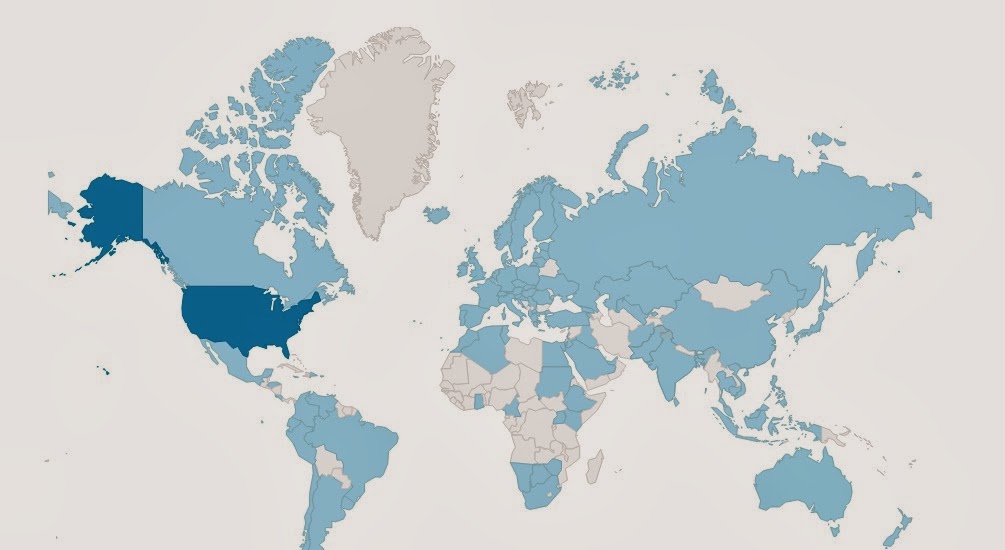 |
| Google Analytics “blue map” of Advanced Studies last 24 months |
To answer the question: you are apparently all over the globe with a not unexpected majority of hits here in the United States.
We’ll continue to work to attract new readers in Madagascar and Papua New Guinea..among other places.
In the meantime, thank you for your readership and we’ll try to keep the focus appropriately global for our discussions.
 Discoverers and Discoveries