The Smart Phone and Privacy

The Wall Street Journal has been all over the recent Smart Phone controversy–and if you have a subscription, be sure to take a look at the lead story in the Reviews section of today’s paper. In the meantime, our colleagues at MIT and the Santa Fe Institute have gotten well-deserved kudos for their recent academic studies of smart phone-generated data sets as predictive tools for human behavior, emotion and attitudes. Although, as has been pointed out–much of the recent work with smart phones was pioneered in traffic analysis work from the intelligence community in the last century.

On the other hand, smart phones are rather unique devices in that they can harvest vast quantities of data about ourselves in more-or-less real time and to a first approximation we assume they are under our own control–which they may not be.

And that’s the nub: as with Facebook, it’s unclear which parts of our smart phone are actually under our control and which parts are not, particularly with regards to personal information that many folks may consider private.

I was struck recently while getting my new Iphone 4 in the Apple Store how aggressively the “find my iphone” capability was pushed at me by the Apple employee handling my purchase. And later, after reading today’s Wall Street Journal piece, as I experimented with turning off location services, I couldn’t help notice the warning that: if I were to shut off location services, then I would no longer be able to find my iphone.

Of course, the above stands to reason. But I can’t help but assume that Apple is using the harvested data from location services as creatively as Professor Pentland at MIT.
Fukuyama on Social Sciences

The article is here.

Money quote:

The aspiration of social science to replicate the predictability and formality of certain natural sciences is, in the end, a hopeless endeavor. Human societies, as Friedrich Hayek, Karl Popper and others understood, are far too complex to model at an aggregate level. Contemporary macroeconomics, despite dealing with social phenomena that are inherently quantified, is today in crisis due to its utter failure to anticipate the recent financial crisis.

The Biosphere

I’m hard at work on a paper that concerns the Biosphere, a term originally introduced by an Austrain geologist, Eduard Suess during the late 19th century. Suess used the term apparently to represent everything in Nature that was organic (from a chemical standpoint). The biosphere was also a very important concept for the eminent Russian scientist, Vladimir I. Vernadsky during the early 20th century.

I still find the term very useful from a scientific standpoint, although it’s use has somewhat declined here in the early years of the 21st century. From my standpoint, the biosphere is a complex adaptive system, and a very important one at that, since we are at the moment (until human space travel becomes a bit more advanced) utterly dependent upon it for our existence.

Tale of Two Capitals

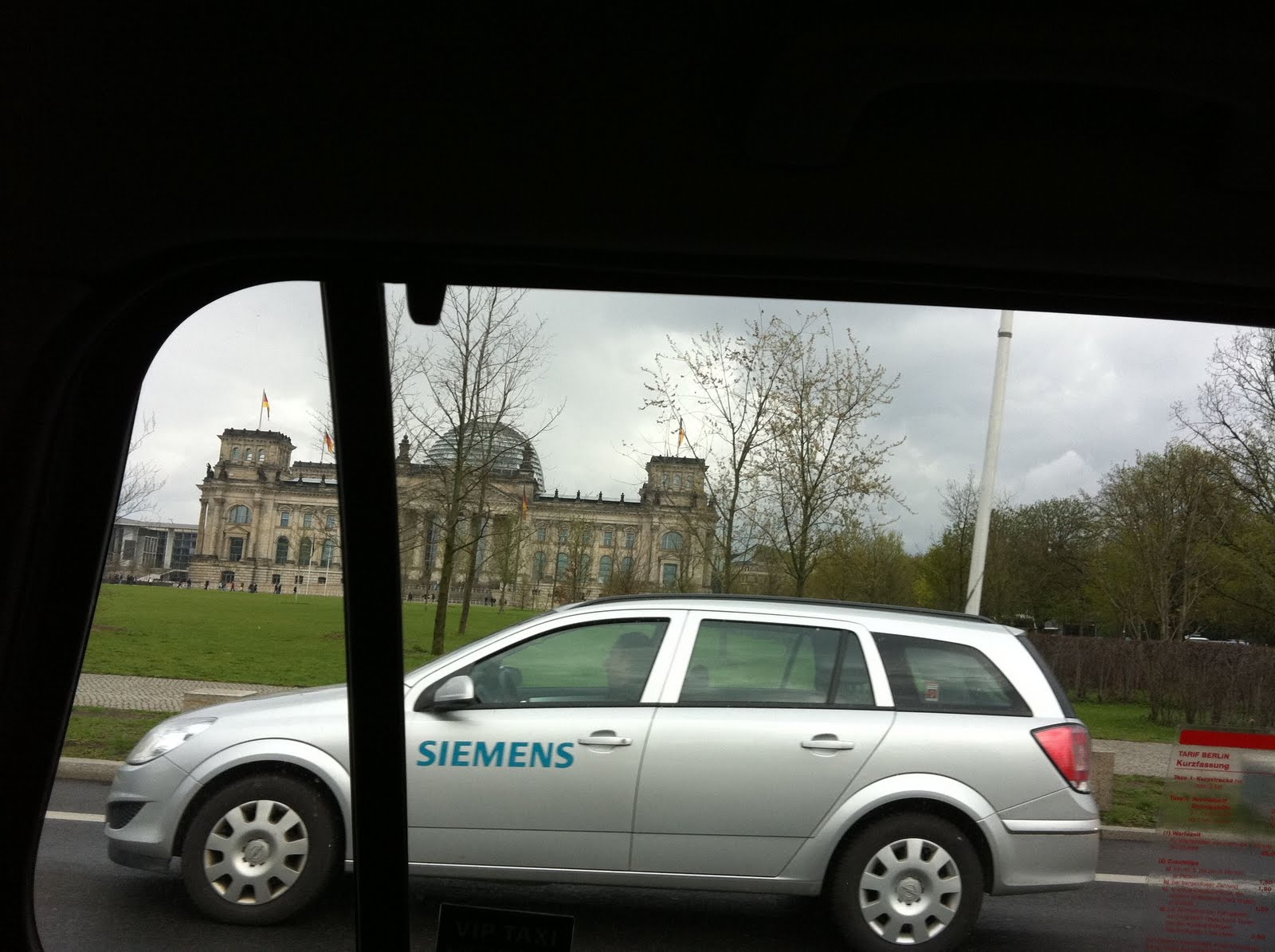
Or should I say two capitols! The people’s house in Berlin was just as cloud covered 48 hrs ago when I took this picture as ours is today.

It’s good to be back. But it was a productive trip.

My first transatlantic crossing (757) in a narrow body jet since I was a kid taking DC-8’s and Boeing 707’s across. I guess they are really worried about the load factor.

PS…no compensation from Siemens for accidental product placement.

Off to Berlin again…

Returning to the venue of the 2009 Decade of the Mind meeting. This trip will be exclusively geared towards facilitating formal collaborative relationships between the Krasnow Institute and several European research institutions.

This will be my first trip without my mac air–just taking the Ipad and we’ll see how I get by.

The art of compromise

Well, I have to admit, I’m relieved that Congress and the President came to some sort of agreement last night. Shutting down the Federal Government would have been just incredibly disruptive to science, particularly the important biomedical research being conducted by our colleagues on the Bethesda campus of the National Institutes of Health.

Which brings me back to the subject of compromise. It would be interesting to design a brain imaging experiment which studied compromise. Just outside the boundaries of neuroeconomics, this would be a social neuroscience experiment with political science overtones…..the underlying question is whether there are subtle individual differences between those prone to “split the difference” and the “take no prisoners” folks.

On further search: see the work of Drew Western, who apparently was on the team that imaged partisan Democratic and Republican party members with regards to the 2004 presidential campaign and is the author of a book, The Political Brain.

Shared instrumentation

The notion of sharing scientific equipment is absolutely central to science. In my first days as a young aspiring scientist at the Marine Biological Laboratory in Woods Hole, working on a phenomenon called sponge cell reaggregation, in an invertebrate zoology class this was drilled into me.

The equipment used to ask scientific questions, especially in biosciences, are extremely costly, but they are key enablers of researchers. One needs access to such equipment to conduct experiments and test hypotheses. Using grant money or even institutional funds to purchase duplicate instruments is not only often wasteful, it promotes the sort of silo mentality, more commonly found in other sectors.

The collegiality of scientists as they share instrumentation, without demand for compensation, is one of the characteristics of the profession which really sets it apart from others. It helps create a fellowship that transcends borders, disciplines and even scientific disagreement (which can be vehement).

I’m very proud of the state-of-the-art shared instrumentation at Krasnow, but even more proud of the way our investigators share the tools they need.

Tenenbaum et al. review in SCIENCE

Of course, behind a firewall, for those without subscriptions, but if you do have one, I think it’s an important article for those of us interested in the intersection of human cognition and computation. Click above to get the abstract.

The basic cognitive problem addressed is how human rapidly learn and abstract given the noisy, relatively sparse inputs of our sensory systems. It’s a big problem for the Decade of the Mind crowd and for those interested in the whole notion of reverse-engineering our brains.

At the same time, this is not the article for explaining how things are done at the neural level. But it does perhaps lay out some clues as to what we might be looking for.

Definition of Spring in DC….

Yes, it’s Cherry Blossom Festival time. Today’s perverse Spring snow storm didn’t really materialize, but the fear of it kept the crowds manageable.  Just to give our readers some sense of scale, think that there are probably a thousand trees like this one, all in bloom at the same time around the Tidal Basin next to the Jefferson memorial.