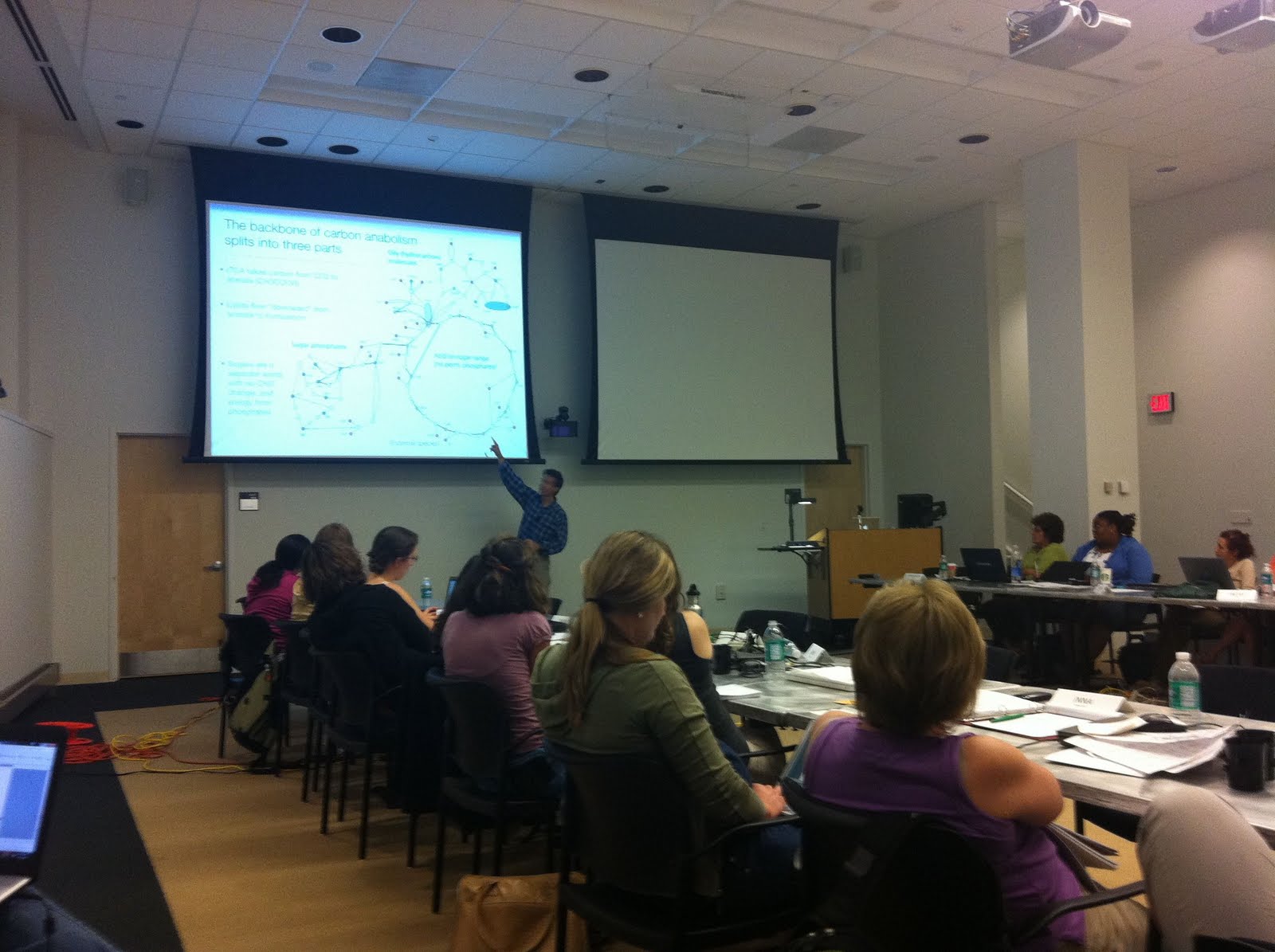
At George Mason, Eric Smith of the Santa Fe Institute, giving, bar none, one of the best lectures on both origin of life and biochemistry ever. All part of an NSF grant to the Santa Fe Institute in collaboration with our own Harold Morowitz to teach high school teachers.
Psychopathology–Paul Bloom’s Review in the NYT
It’s here. Here’s the teaser:
Do psychopaths enjoy reading books about psychopaths? In his engagingly irreverent new best seller, The Psychopath Test: A Journey Through the Madness Industry (Riverhead, $25.95), the journalist Jon Ronson notes that only about one in 100 people are psychopaths (there is a higher proportion in prisons and corporate boardrooms), but he wonders if this population will be overrepresented among readers of his book.
Fukushima Report: bad news
Here are two reports, each quite alarming
2) Spike in infant deaths in the Pacific Northwest (hat tip Tyler Cowen)
Finally, a commenter at FT reports a virtually empty A380 Superjumbo (around 30 total passengers) to Tokyo here.
The official IAEA blog is here.
Los Angeles to Tokyo in a bit over 2 hrs
It’s here, courtesy of my favorite aviation blog, Ben Sandiland’s Plane Talking. This is all making news because of the on-going Paris Air Show. Sandiland has a very high level of credibility among aviation buffs and he thinks this is going to happen.
Regeneration as a biological phenomenon
I’m busy co-editing a virtual symposium issue of our journal, The Biological Bulletin on regeneration with my MBL colleague Joel Smith. For loyal readers unfamiliar with regeneration in the biological context, we are referring to the phenomenon whereby certain animals regenerate tissue (limbs and sometimes even brains) either in the natural course of their life cycle or in response to injury.
Regeneration was one of the main concentration areas of Bernie Agranoff’s laboratory at Michigan at the time when I was doing my thesis work under him. The lab model was the goldfish optic nerve, which in response to injury, can completely repair itself.
But that was a long time ago. What has been wonderful about the present virtual symposium as been re-familiarizing myself with a field, that is, if anything, more exciting and relevant today, that it was in the last century, when it was part of my daily science diet.
In particular, I’ve been enjoying reading the work of HHMI scientist Alejandro Alvarado. His work in the area is seminal and he has brought the full power of molecular and cellular biology to the question.
Sam Deadwyler and Ted Berger
Two old-school brilliant hippocampologists make today’s NY Times, the link is here. The short version is that they were able to mimic CA1 output to rescue a memory in rat. I’ll have to take a look at the original paper to critique it further, but it’s important if it holds up.
Biddy Martin comes to Amherst
My Alma Mater has successfully raided the University of Wisconsin’s flagship Madison campus to recruit its new President. The Chronicle’s link is here.
The connection between Madison and Amherst is not without precedent. Alexander Meiklejohn was President of Amherst College from 1913-1923, from which he decamped for Madison to start an experimental college at the University of Wisconsin. His successor at Amherst, was my great grandfather, George D. Olds.
Congratulations to Amherst College on a great recruitment.
David Eagleman–a professional portrait in Texas Monthly
The link is here. I read this portrait of a successful neuroscientist at Baylor with some trepidation because I admire broad perspectives and the ability to communicate science to the public. See what you think. What are the needed credentials to speak meaningfully on science and philosophy?
Solar Power close to economic feasability?
At today’s Financial Times here. My colleague Tyler Cowen isn’t convinced and brings up a mismatch with another of today’s headlines at Marginal Revolution.
My sense is that over the long haul, solar power is the big Kahuna of renewables. But the key technological advance may be some ways in the future–if we can capture solar flux directly in space and the packetize it for delivery here on Earth.
In the meantime, the existing solar capture technologies are all intriguing, from artificial photosynthesis to better photovoltaics.
The Stanford Patent Decision
ScienceInsider covers it here. It’s a big deal in my opinion and it’s got to be of concern to university tech transfer officers across the nation.