

The report in Nature Geoscience is here. The geopolitical significance could be large. China has been adopting a neo-mercantilistic policy with regards to these commodities for some time. They are ubiquitous in modern gadgets of all sorts and until we have adequate resource substitution, technological supply chains will depend on a constant supply. Right now, the supplier is largely China. According to this report, that could change.
Both an Institute for Advanced Study and an Academic Unit: redux
As an academic unit of Mason we are slowly maturing. I am learning that I am the one to whom distraught students finally turn when something goes really awry. Similarly, we are learning to factor the teaching load into our faculty evaluations. But mostly, we are learning what it means to architect and then nurture new programs. We have minted our first PhD’s and are well on our way to the same for masters degree recipients. We are part of the multi-year self-evaluation cycle at Mason called Academic Program Review and we are learning to work with rubrics as we evaluate student learning outcomes.
At the same time, an interesting challenge: we have to keep focused, not on incremental research findings, but on the really big discoveries, the ones that change paradigms. Which means, we need to have faculty members who can do both: the teaching intertwined inextricably with the research.
The Economist writes an epitaph for manned space flight for ever and ever….
It’s their cover piece from this week, here. I don’t hold a strong enough opinion on the future of manned space to argue their thesis one way or the other. I simply find it extremely problematical to extrapolate far into the future from present trends, particularly when dependent on a number of linked complex adaptive systems (e.g. geopolitics, markets, biosphere).
By the same logic, we should just give up on neuroscience, since the brain is so complex and our progress in understanding it, to date, so slow. I don’t think I’m a buyer on that proposition either.
14th Amendment Option Redux….
The buzz on a constitutional response to the debt ceiling is here. We’ll see….
One of our own….
Kudos to Professor Dan Cox, on winning the Virginia Academy of Sciences Highest Prize for original research. The story is here.
Dan’s Drosophila lab is one of the most exciting places at Krasnow and he’s been instrumental in building out our cellular imaging facility.
New Open Access Journal
Howard Hughes Medical Institute, Max Planck and Wellcome Trust join forces to create a new journal. The link from ScienceInsider is here.
Here at The Biological Bulletin, we wish our new sister journal well.
Sorry about that T-Bill you’re holding….
The Economist on what might happen if the US doesn’t raise the debt ceiling.
Brookings Hamilton Project
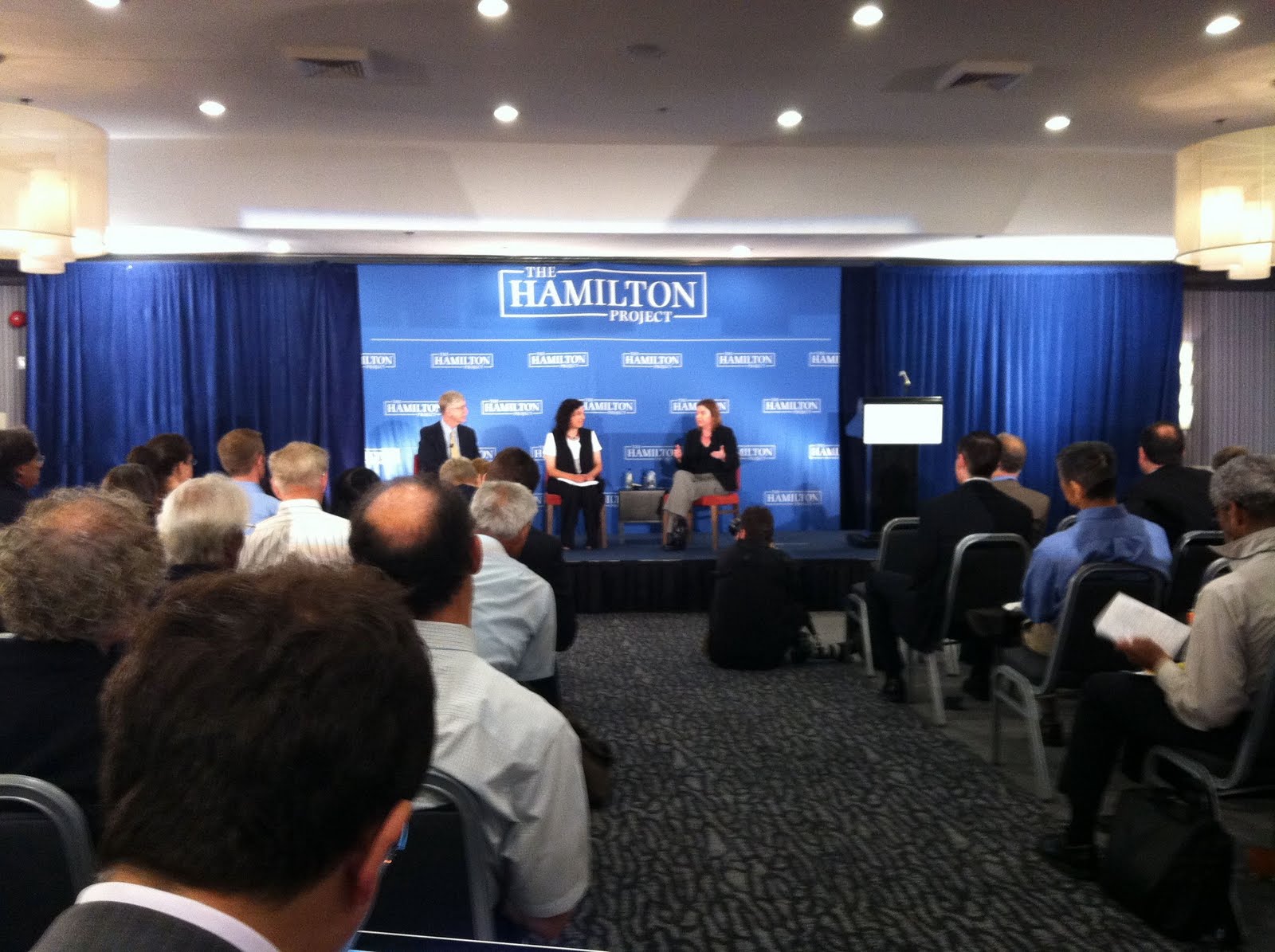 |
| Left to Right: NIH Director Francis Collins, Moderator Ann Kellan, MIT’s Angela Belcher |
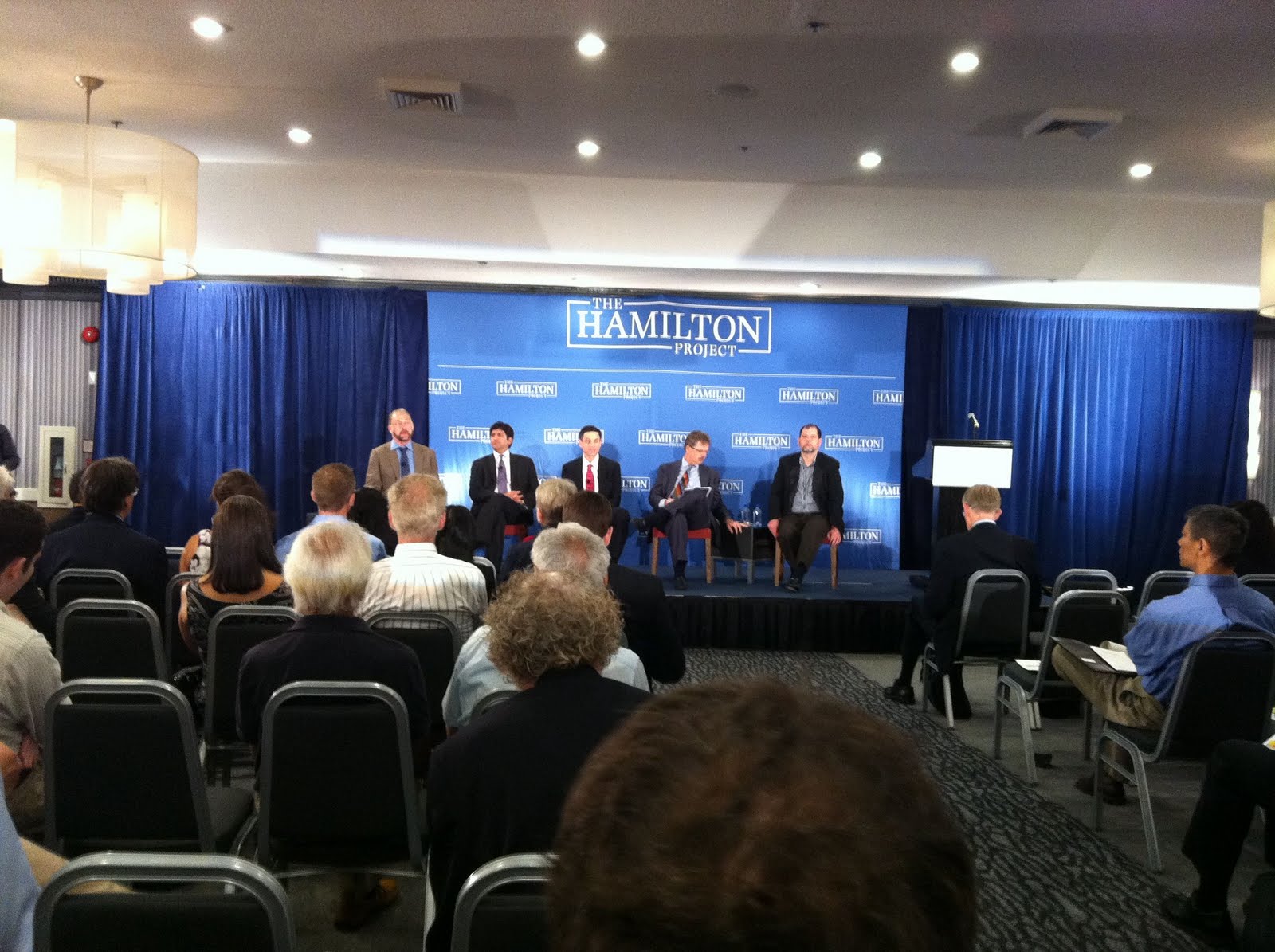 |
| Left to Right: Tim Bresnahan, Anesh Chopra, Michael Greenstone, Glenn Hutchins and Tyler Cowen |
Brookings’ Hamilton Project is about America flourishing, to use the term of positive psychologists. This morning’s symposium on Capitol Hill was entitled “PhD’s, Policies and Patents: Innovation and America’s Future”. I stayed as long as I could through the first two sessions.
NIH Director Francis Collins had two really interesting ideas that are relevant to what we do at Krasnow. The first is the notion that “the genome is a bounded set of information”. Of course that is what gives power to bioinformatics (Mason gave birth to what I believe was the US’s first degree program in this field). But it also shows the way to Collins second big idea: “hypothesis limited research”. This of course in contrast to the Popperian hypothesis-based research. In other words, use the boundedness of the genome to discover the full set of answers to a scientific question (e.g.: tell me all of the genes expressed by a pyramidal neuron).
Chopra had another interesting idea: that we lack an instrumented medical system, educational system and power grid. In other words, policy makers can’t get at the real-time granular and aggregated data. He also characterized the Administration (where he serves as CTO) as an “impatient convener”. Well, with the debt limit crisis coming to a critical phase, I’d say that’s a pretty accurate description of what the President’s got in front of him over the next four weeks.
Finally, my colleague Tyler Cowen went beyond his new book, The Great Stagnation, and talked about an agenda for studying historical episodes where great innovation has taken place (his example is late 19th century Hungary) without obvious prerequisites being met.
I also ran into Krasnow Advisory Board Member, Elizabeth Marincola.
All told, an interesting morning.
Human magnetic sense?
Nicholas Wade’s piece in the NYT is here. The article’s headline makes the mistake of confusing gene with protein gene product. However, it would be interesting to get the crystal structure for the human cryptochrome protein and try to make sense of how it could act as a compass from a physical chemistry point of view.
Faculty work load
The question of operationally defining a tenure-track faculty work-load is fraught with risks. The basic categories are teaching, research and service, however the relative emphasis, the baseline teaching load and defining appropriate metrics are what make this whole matter difficult.
Ideally, the process should be transparent, there should be a clear process to “buy-down” course load from grants and the outcome should be aimed at maximizing the scholarly talents (this means research and teaching) of each faculty member.
At Krasnow, we are working first to allow each faculty member to self-select with regards to either teaching or research as far as primary emphasis. Selecting teaching will end up with a higher base teaching load, but also will mean that the primary evaluation criteria will be based on teaching metrics (not only course evaluations from students, but also peer review and curricular development). Selecting research will “lock-in” the base teaching load, but also will mean that the primary criteria for evaluation will be on research productivity.
With regards to service, the trick is to define it broadly enough to allow for external professional organization service, editorial board membership while including the more typical intra-university committee membership.
Finally, in the interests of transparency, there is the need to quantify. Fully transparent, implies some sort of algorithm for objectivity in the above areas. I’d be interested in input from readers of Advanced Studies on how to do that.

