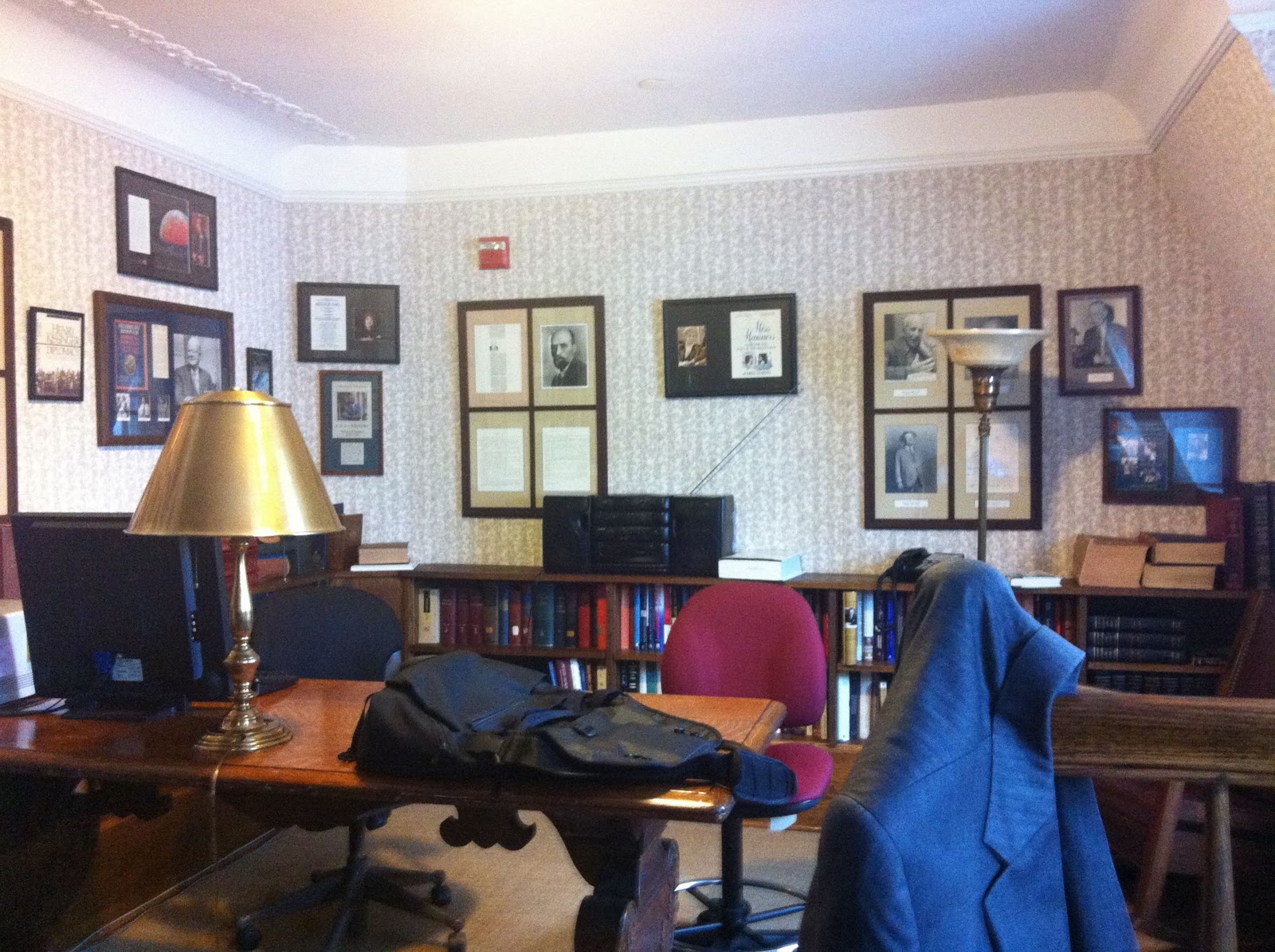
A room with a view

Four long stories above Massachusetts Ave NW, on embassy row,  this is the Writers Room of the Cosmos Club. It’s probably my favorite place to get work done outside of my office.  Today I’m catching up on an array of paperwork after finishing the NSF panel yesterday before a lunch with one of the EU science attaches here in the Garden dining room.

What strikes me most about DC these days is the sense of collective denial about the sheer size of the cuts (most likely of federal discretionary spending) that will either be imposed by the Congressional Super Committee, or, alternatively, sequestered automatically.

Running an Institute, with a large sponsored research budget, my strategic thinking has turned towards how to position Krasnow to both survive such cuts and even to thrive. My worry is that a lot of my colleagues in similar positions just aren’t thinking about this issue.

The larger questions are first: who will be supporting basic and translational science going forward, and second: how will that happen?

There are a second level of questions which center on Federal R&D:

–Which agency portfolio’s are likely to emerge relatively unscathed?

–Will there be a “despair” effect, whereby mid-ranked scientists throw in the towel, to the advantage of the very best?

Finally, how can we create new novel mechanisms for supporting international collaborations?

Reviewing grants

I’m submerged at the moment in a virtual pile of grant proposals that are stored in my iPad. They are collectively very interesting, but also have a unique ability to suck up all of one’s available time. How far away are we from Strong AI to review grants?

Luck and science success

There’s an apocryphal story about how my Dad and Peter Milner discovered the phenomenon of reinforcing self-stimulation (“the pleasure center”)–the stimulating electrode was in fact bent and went into the medial forebrain bundle quite by accident. That was the luck. The scientific success came from recognizing the resultant behavior and following up on the histological data to see where the stimulating electrode actually went.

As far as I know, the above story is true.

But the combination of luck and good science are behind many significant discoveries. The key is to work hard enough to generate your own luck and then to be imaginative to recognize a lucky success for what it is with subsequent follow up experiments.

That’s the best advice I can give for a young experimentalist these days.

State of the Institute Talk

Tomorrow’s regular Monday seminar here at Krasnow is my annual report on the state of the institute. To telegraph, we face four main challenges going forward:

First, we have to position the Institute to adapt to what will surely be a changing federal R&D environment in the near future.

Second, we need to build on our critical mass of tenure-line faculty members. Both of our academic departments need to grow to adequately support their programs and to use our new research infrastructure effectively.

Third, we need to think internationally, both in terms of future scientific collaborations, but also in terms of funding of our scientific research.

And finally, we need to continue to actively fund raise from our stakeholders and donors to support Phase III and the synergies that will come from having all of our faculty, students and staff under one roof.

I’m looking forward to my talk…