
I got to watch two of our brightest doctoral students explain some pretty complicated electrophysiology to a VIP visitor today and it was a terrific sight. He was clearly impressed and I think they enjoyed themselves–although I saw they were really hoping he didn’t nudge the prep as he leaned forward to look through the stereo-microscope.
Angel Cabrera
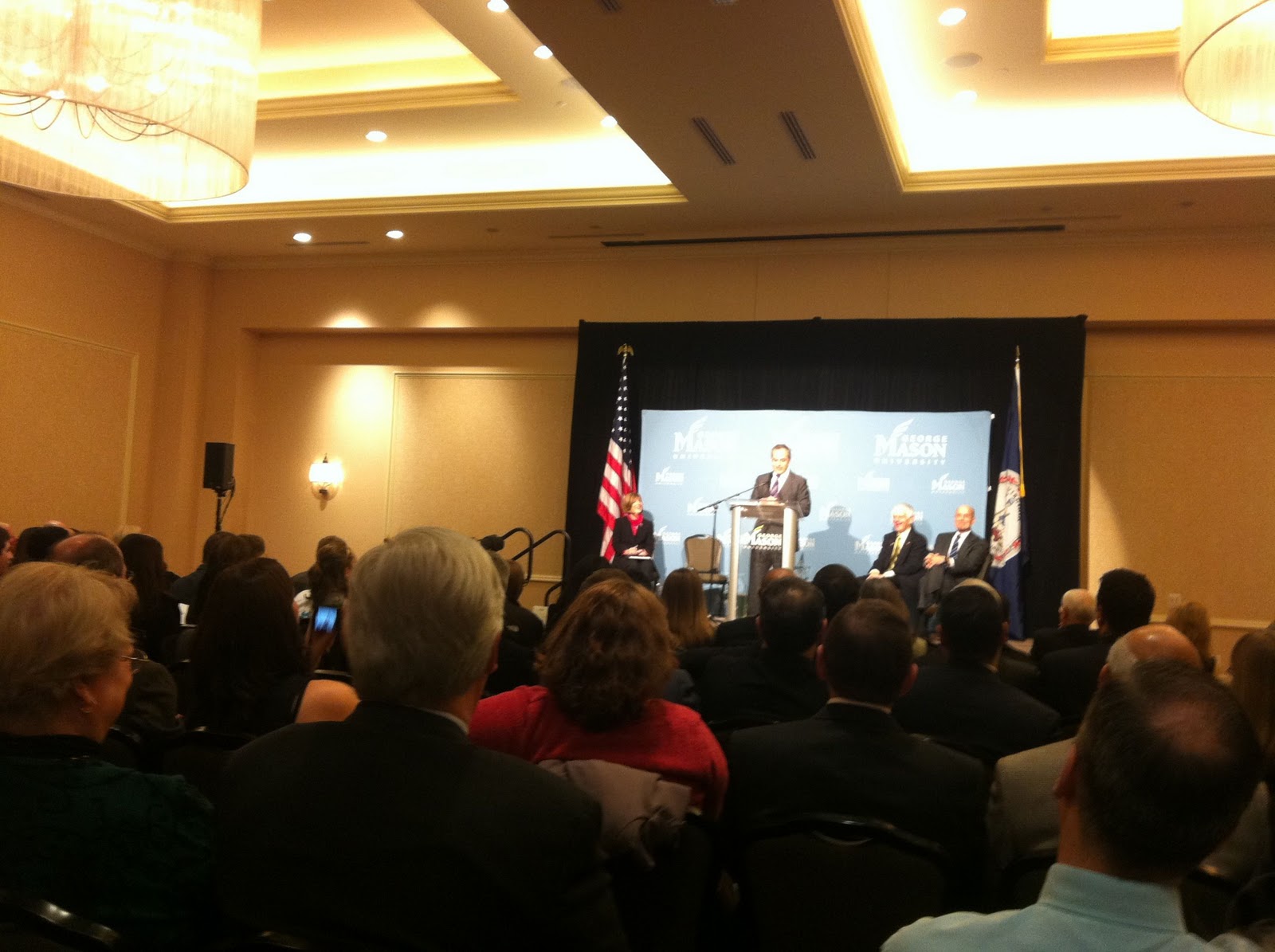
George Mason’s Board of Visitors announced the appointment of Dr. Angel Cabrera to be Mason’s next President in the last hour. The photo is from the press conference that just ended a few minutes ago.
He brings both incredible dynamism and experience to Mason most recently as President of the Thunderbird School of Global Management.
Born in Spain, he trained in Madrid as an engineer and then went on to Georgia Tech to get his doctorate.
Here is a recent You Tube video in which his passion for education is abundantly clear:
Mason will clearly continue its tradition of innovation under dynamic leadership. Dr. Cabrera will take office on July 1 of next year.
Teasers
We’ll be commenting on some major news tomorrow, although after an early morning presser. And then, following an embargo, we’ll reveal a major award to one of our faculty members here at Krasnow. So stay tuned.
Doctoral trainees soft-skills: the transatlantic perspective
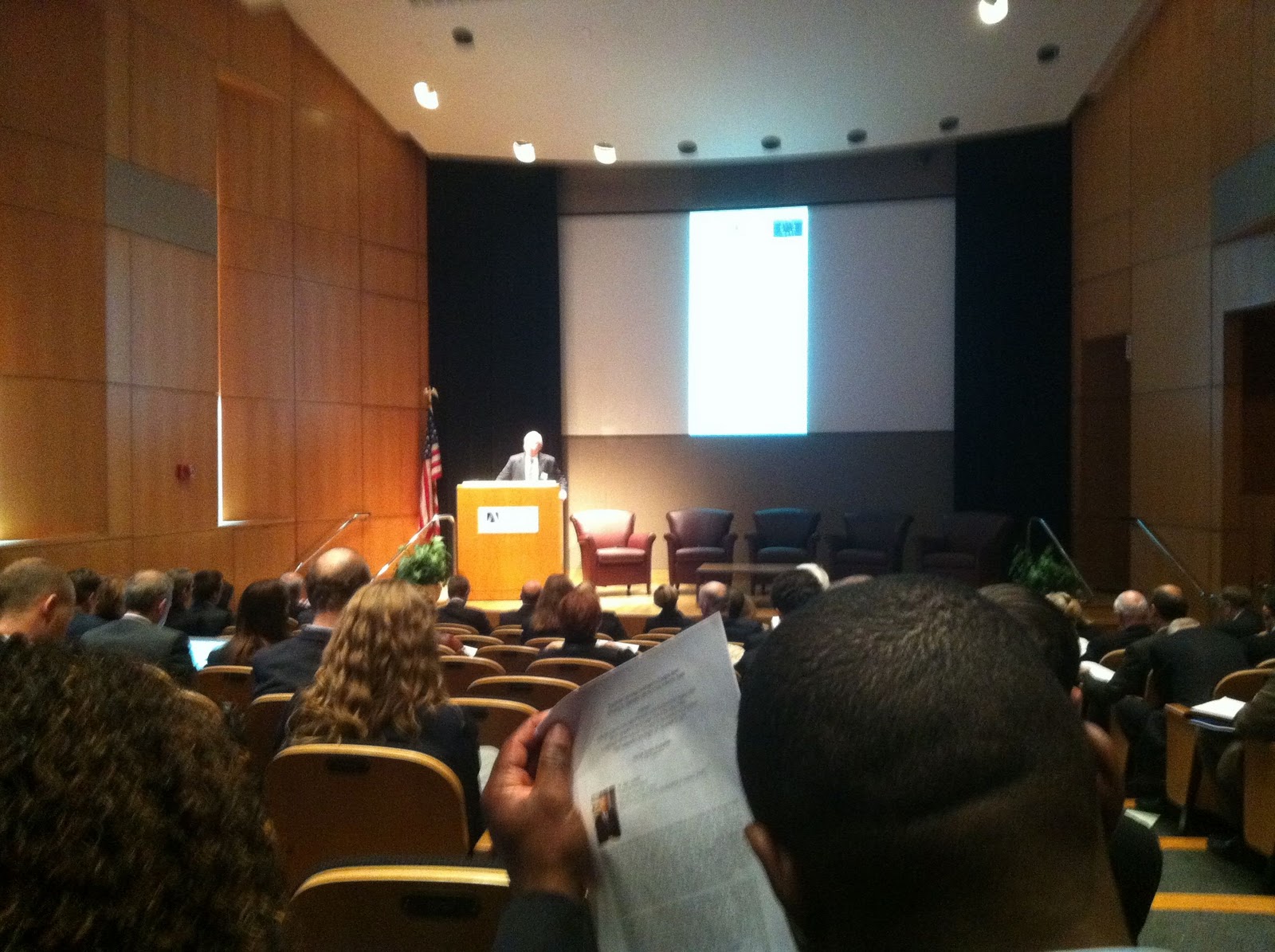
Yesterday there was a terrific conference put on by the Polish Presidency of the European Union at the headquarters of the American Association for Advancement of Science here in Washington.
I had the honor of speaking about a real concern of mine: namely the doctoral students are only trained in the soft-skills (e.g. grantsmanship) of the place where they are receiving their training. So, for example, a doctoral student in neuroscience being trained here in the US, typically doesn’t learn anything about the European Research Council’s “starter grants”–even if that student is European and actually planning to return to Europe post-PhD.
The reverse is also true. What I am advocating for is a plan to create a transatlantic soft-skills curriculum, whereby all doctoral trainees learn something about each system: Europe and the US.
And of course, this could be expanded usefully elsewhere around the world.
Cutting off the patient to save the limb?
The UK will go its own way from the rest of Europe. The Financial Times story is here. Of course, the UK has always been outside the Eurozone, but today’s news feels qualitatively different. The word of course is that David Cameron did this to please his Tory friends in London’s City financial district. Whatever the reason, it strikes me as not particularly good news for those of us hoping for something that will stabilize the markets.
Reuter’s story is here. Money quote:
Cameron’s decision to stay out of the treaty-change camp could spell problems for Britain. Deeper integration on the continent could involve changes to the single market and financial regulation, both of which could have a profound impact on the British economy.
“Cameron was clumsy in his manoeuvring,” a senior EU diplomat said. It may be possible that Britain will shift its position in the days ahead if it discovers that isolation really is not a viable course of action, diplomats said.
Higher Education and the Khan Academy
Inside Higher Ed has the excellent story here. And, in case you’ve never watched any of the excellent video’s, you might want to look here.
Bottom line: while you are learning, Kahn Academy is learning about your learning. Given his background at the hedge fund/tech interface, makes perfect sense to me.
Changes coming to Penn State Football?
Back to the 1970’s at Amherst College
At my Alma Mater, typewriters are in! The Chronicle has the story here. What those students really need are those 70’s hi-tech Smith-Coronas with the famous Coronamatic ribbon cartridges. As common then, as Apple gear is today.
Architecture in Washington DC
Heard yesterday at the Embassy of Finland during the Finnish national holiday festivities:
The embassies have the only interesting architecture in Washington
An interesting comment that I’ll need to think about. Personally, I find the monuments on the Mall quite strikingly beautiful in the right light (for example early morning), although I’m not sure if I would call them interesting.
However, without question, the Finnish Embassy is one of the most interesting and beautiful buildings in Washington–just opposite the Vice President’s mansion on Massachusetts Avenue. According to the Ambassador, it’s also green–although I’m not sure if she was referring to its sustainability or the patina of its copper exterior. Perhaps both.
The Original Krasnow Board
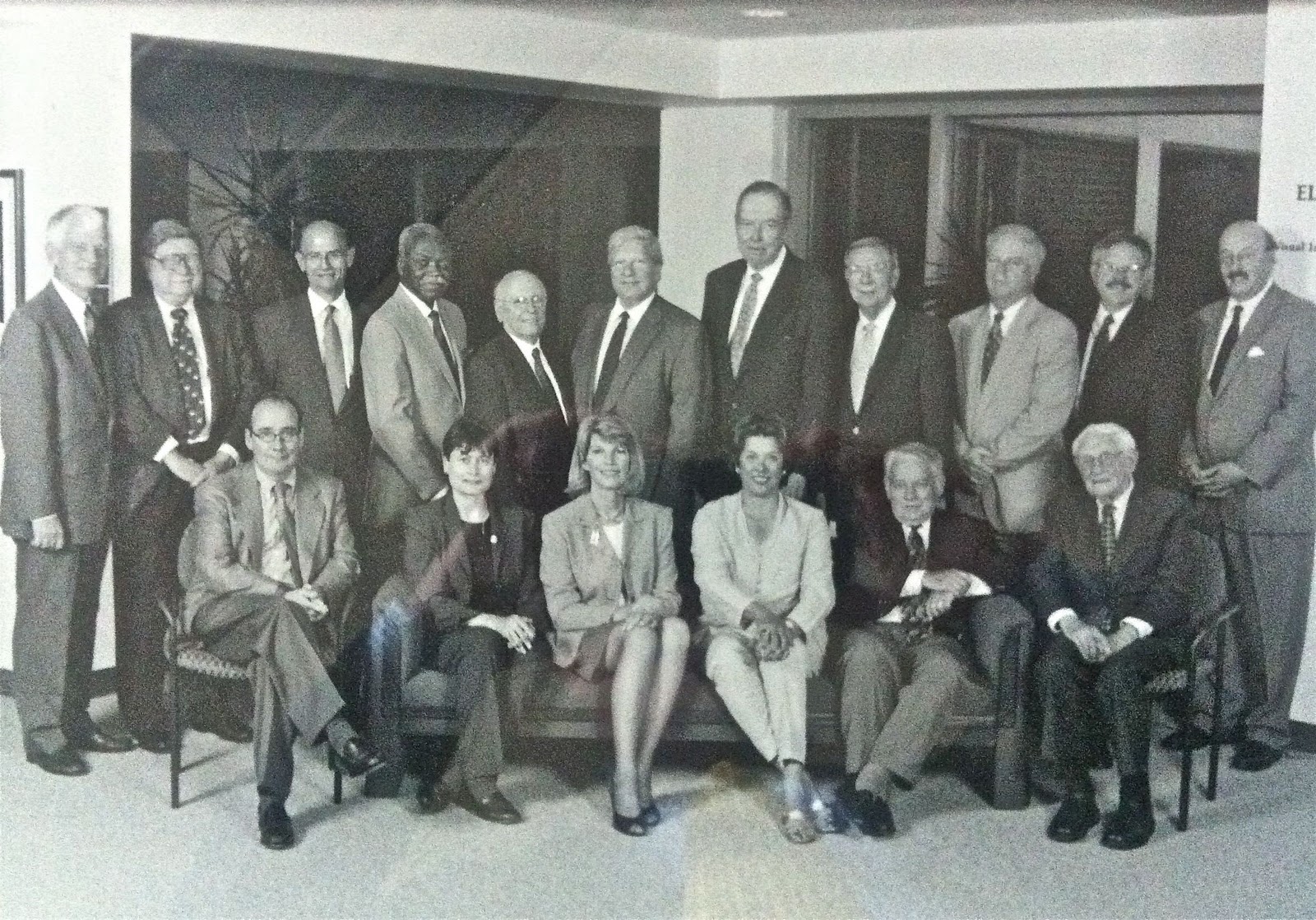
Amazing what an iPhone camera can do with a bit of editing. The photo is of the Institute’s governing board about the time of the turn of the century.
No, there were no iPhones at the time, but I did just take the picture of the photo because these were individuals who played a key role in the founding of the Institute.
Back Row (left to right): Alan Merten, Harold Morowitz, Bill Nitze, Ted Braithwaite, Mark Friedlander, Gene Samburg, George Johnson, Robert Gambino, Maurice Scherrens, John Burris and Tom Wise.
Front Row (left to right): myself, Katherine Wallman, Virginia Pomata, Patricia Kluge, Peter Stearns and Julius Axelrod.
Among those in the photo are: a Nobel laureate, three college presidents, a UN ambassador/RAF fighter pilot, three biologists, a psychiatrist, three political appointees, an author of over 100 books and a corporate CEO. Can you identify them?
 Discoverers and Discoveries