
Fantastic news this morning as the Nobel Prize in Chemistry was awarded to Jennifer Doudna and Emmanuelle Charpentier for CRISPR gene editing. Story here. I’m proud that NSF’s Biological Sciences Directorate played an important role in supporting Dr. Doudna’s research through the Division of Molecular and Cellular Biology. Kudos to the winners and their funders.
Cell assemblies are memory traces…
This morning I had a fascinating video conversation with a former postdoc, now associate professor. We were talking about a neuroscience concept called the cell assembly–an idea that had its genesis in the lab of my Dad’s postdoc advisor, Donald Hebb at McGill University in the early 1950’s. Basically the idea goes something like this:
Memories, perceptions, concepts are all stored in the human brain via spatially-separated collectives of neurons that are bound together by their activity (firing action potentials). The pithy version of this goes: neurons that fire together, wire together.
In any case this allows individual neurons to participate in many such cell assemblies and the available cell assemblies based on the combinatorial mathematics of c. 86 billion neurons is very large. Further, these cells assemblies (think each containing perhaps 300 members) are very robust. With a symphony orchestra, you probably won’t notice any single instrument dropping out during Beethoven’s 9th symphony finale. Same with cell assemblies.
I am still very much struck by this construct of cell assemblies. As neuroscience has progressed, this is an idea that is very much evergreen.
Sensor networks re-imagined
The NSF-funded National Ecological Observatory Network (NEON) was commissioned last year for a likely 3-decade campaign to collect biosphere data across the United States. While some of that data is collected by humans, a lot of the data is automatically sensed and then logged to cyber-infrastructure for later analysis. Another NSF-funded project called SAGE, led by Pete Beckman of Northwestern University (full disclosure, I’m on that team), is working to add AI at the Edge capability to those sensors so that they can be triggered in real time by events such as fire or flood to reconfigure their software for different capabilities.
Meanwhile, there are other things to sense beyond NEON’s current domains: earthquakes, wildfires, and public health emergencies. And there are natural experiments to that lend themselves to adding consequential knowledge to our nation: population gradients from pristine land to urban centers, geo-chemical gradients and different state policy solutions come to mind.
And NEON’s airborne sensor program, currently implemented in human-piloted aircraft, seems to me to be begging to migrate to drones and data-fused with on-orbit sensors like NASA’s OCO2 satellite.
In short, there is much work to be done. And this needs to be built on-top of the infrastructure that already exists–a spiral design scenario. This preserves the considerable set of investments that have already been made, but generates new and better capabilities.
Science and partisanship
I was reading the morning feed from an alumni list server for individuals that attended one of the scifoo camps sponsored by Google, Nature and O’Reilly publishing. There was a pretty intense discussion of how politically partisan the posts had become in the context of Scientific American’s recent unprecedented endorsement of Biden. The entire discussion worries me. When scientists publicly take sides, they invite a backlash. Which has already happened I think. Science then becomes politicized in much the same way mask-wearing has and it doesn’t serve the public well.
I am well aware that scientific results have political implications. And that’s fine. But, when one side becomes anti-science (as in against the scientific method/process) then if they hold power, further accumulation of scientific knowledge becomes at risk (e.g. Galileo). And this puts the nation at further risk: anti-science nations don’t compete well in the geopolitics of the 21st century.
Science is not a special interest. But it risks being perceived as one.
Gradual School and Postdoc land
In one of my classes this semester, we’ve reached the point where we are talking about that crucial part of the innovation ecosystem where the work actually has to get done. There are several great videos from this lab that capture the essence. This one is my favorite (and no, Gradual School is not a typo):
Does Venus host Life?
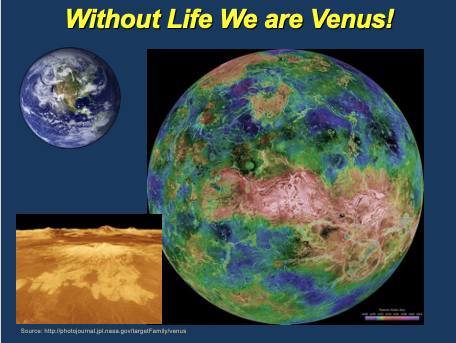
This is a topic close to my heart since the above slide was part of my Rules of Life slide deck while I was running NSF’s Biological Sciences Directorate. Well, turns out Venus may harbor life. Lay version of the story here. So I may need to revise my thinking.
Turing test Op Ed in the Guardian
Marvelous Op Ed by the language AI, GPT-3, here. She/he’s trying to persuade us not to be afraid of AI. Success?
The role of the ribosome in origin of life theories…
The problem is as follows: the ribosome is a specialized macromolecular complex with the specific function of translating messenger RNA into proteins. So how would it have evolved prior to proteins in an RNA world (or even a metabolite world)?
Selection pressure is lacking. There are no proteins that need to be made.
So the thought is, it must have been doing something else. What might that else be? And can we glean that from its current form?
My introduction to this fascinating question came from my reading of Eric Smith and Harold Morowitz’s 2013 book, The Origin of Life on Earth: The Emergence of the Fourth Geosphere. My copy of which, is currently at my university office–probably the one book I am really missing here at home.
What I miss most about pre-COVID work…
- Face-to-face impromptu chats with colleagues
- Students knocking on my office door
- My microscope
- Taking the bus or metro
- ADHH on Tuesdays
- Walking across the Fairfax campus in the Fall or Spring
- Journal club in person
- Upgrading to business on my points
- All things Alaska, especially Toolik Field Station
- Friday Evening Lectures in Lillie Auditorium
Cold Fusion Redux…
NASA Glenn Center’s work on Lattice Confinement Fusion, story here. Original peer reviewed paper in Physical Reviews C, here and here. Context of course is the old “cold fusion” story, here.
The application in question is powering a spacecraft without solar or the radioisotope thermoelectric generator used on the Curiosity Mars Rover and some of the existing deep space probes.
 Discoverers and Discoveries