More problems for BOLD

As many of you know, I worry deeply that functional MRI has been oversold. While recent papers have suggested that functional neuronal activity may occur without a concomitant BOLD signal, another critique suggests that the statistical techniques for analyzing fMRI themselves may be suspect:

Money quote from the neuroskeptic blog:

Just in case you need reminding of the story so far: A couple of months ago, MIT grad student Ed Vul and co-authors released a pre-publication manuscript, then titled Voodoo Correlations in Social Neuroscience. This paper reviewed the findings of a number of fMRI studies which reported linear correlations between regional brain activity and some kind of measure of personality. Vul et. al. argued that many (but by no means all) of these correlations were in fact erroneous, with the reported correlations being much higher than the true ones. Vul et. al. alleged that the problem arose due to a flaw in the statistical analysis used, the “non-independence error”. For my non-technical explanation of the issue, see my previous post, or go read the original paper (it really doesn’t require much knowledge of statistics).

Hat Tip to Marginal Revolution

Jim

Getting the Discussion Section right

As an editor of a scientific journal, I’ve had a long history of tending to focus on the Methods and Results Sections (especially the figures and their legends) at the expense of the Discussion Section and the Introduction. This in the context of the current way we organize scientific articles.

That said, I find myself facing the challenge of mentoring doctoral students in how to write a paper for publication. The difficulty is that even though I might discount the Discussion as an editor, still as an author, they do need to be written.
It is easy to communicate what not to do:
Don’t simply regurgitate the Results with the addition of speculative commentary and citations.
Don’t write a mini-Review paper–confusing that distinguished scientific form for the function of Discussion.
Don’t hype your results beyond what they clearly say. Especially avoid phrases like “to our knowledge, the present work represents the first….”
But what should go into a Discussion?
Seems to me that the biggest clue come from the word “discussion”.
Here are the dictionary definitions:
1. Consideration of a subject by a group; an earnest conversation.
2. A formal discourse on a topic; an exposition.
So let us take the first definition. Imagine a group that includes you, the author, and additionally your readers (including potentially your reviewers). The Discussion section should represent the consideration of the Results where your written words represent that complete consideration as if all the members of the group were in fact participants.
Hence, you might imagine the Discussion to represent the stylized representation of that group consideration were it to actually take place in a seminar room, complete with slides and pointed questions.
You present that familiar slide which summarizes your findings (each one corresponding to a result). Your audience members ask scientific questions (just as they would during a seminar) and you do your best to answer them. The above written into a Discussion section, amounts to a formalized discourse (the second definition from above)–but really amounts to just the imaginary “minutes” of what was presented and what was asked during our imaginary talk where you are presenting to the group (your readers).
Thus one ought to order the paragraphs of the Discussion section such that the most important finding goes first. Then it is put into context–why it is the most important finding. Most important is the implicit inclusion of what might be construed as reasonable scientific critiques on the finding (this is the inclusion of your imagined audience) along with your answers to those critiques. It is within this imagined give and take that appropriate referral to the relevant literature becomes important.
To do the above clearly requires both some sense of imagination based heavily in reality. You’ll write a better Discussion if you’ve actually presented your real data to a real audience!
And then on to the next most important finding.
The trick is to embody all of this “discussion” in your Discussion without it all sounding like the minutes of the local PTA meeting. Rather the “minutes” are transformed into a formal exposition (second definition).
One ends with a summing up of what the significance of the Results taken in their totality might mean to the field–with speculation kept to a real minimum.
Jim

Tripping Hazards In Neuroethics: An Opinion

No doubt many readers are familiar with debates about the role of neuroscience in seeking to enhance (or augment) cognition, and possible policy implications, recently featured in Nature. Diverse contributions to science policy discussion help highlight important considerations for policy makers, including potential “tripping hazards” along the path to feasible policy, as illustrated in the recent commentary from Greely et al (2008). By “tripping hazards,” we mean papered-over or simply overlooked value fault-lines in policy formation that are likely to erupt in problems of feasibility or public acceptance. The authors’ recommendations about the use of cognitive enhancing drugs in healthy persons include concerns about safety, coercion, and fairness (meanwhile dismissing others as lacking substance). Their discussion of safety relies upon selectively stretching the idea of effectiveness and purpose for medication, while calling for safety standards to be held the same as for medicines treating illnesses. The “evidence-based evaluation” for which they call would thus be stretched over the values they’ve selected for inclusion and exclusion, and would be more likely to set up a “stretched line tripping hazard” for policy making than it would be to resolve controversy. The “thin ice tripping hazard,” on the other hand, emerges from their discussions of coercion and fairness, where the recommendations cannot support the weight of the problem. One sign of thin ice ahead is contradiction among recommendations, partially acknowledged but not here addressed, that we protect freedom by discouraging even indirect coercion to take enhancement drugs such as in schools, and protect fairness by providing them to all test-takers in a competitive examination. We commend the authors for contributing to the ongoing public debate but note that much remains to be done.

Jim Olds and Lee L. Zwanziger

Lee works at the FDA and therefore notes that the findings and conclusions in this letter have not been formally disseminated by the Food and Drug Administration and should not be construed to represent any Agency determination or policy.)


Greely H, Sahakian B, Harris J, Kessler RC, Gazzaniga M, Campbell P, Farah MJ.”Towards responsible use of cognitive-enhancing drugs by the healthy.” Nature. 2008 Dec 11;456(7223):702-5.

Zeke goes to the White House

Zeke Emanuel and I went to Amherst College together. His brother Rahm is already pretty famous, but for those of us who spent the undergraduate years with Zeke–he was one scarily bright guy.

Enjoy this Chicago Tribune profile of the other Emanuel–probably the Nation’s premier bioethicist and possible future Nobel Laureate.
Hat tip to Tyler Cowen at Marginal Revolution.
Jim

Krasnow Friendraiser 2009: Wizards vs Pistons


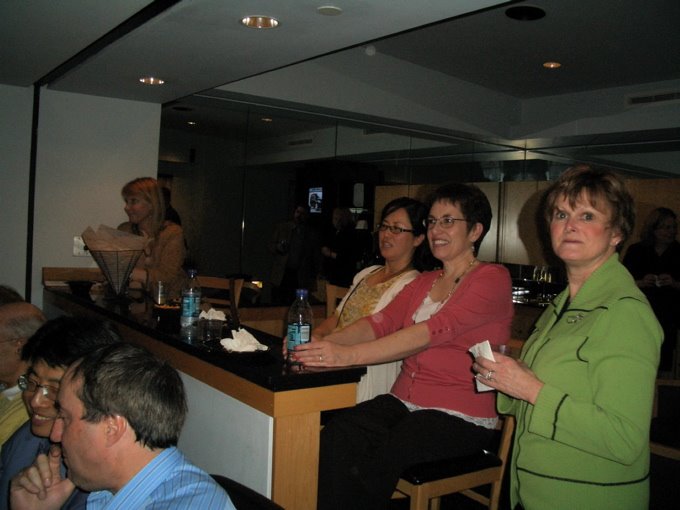
For the third year running the Institute for Advanced Study hosted a friend-raiser at the Verizon Center as the Wizards gave the Detroit Pistons a run for their money. We had a mix of scientists, board members, friends and staff for a heady mix of basketball, cognitive sciences and keeping track of our NCAA brackets.

This year we were honored to also enjoy the company of former Congressman Tom Davis, pictured above with a young fan.