Seeking isolation: social neuroscience (or the absence of it)

Sarah Maslin Nir has a fascinating piece in today’s NY Times on-line about men who seek nearly complete social isolation (think Robinson Crusoe) here. Money quote from the University of Chicago’s John Cacioppo:

In our culture, there is this mythic individualism that we cherish,” said Dr. Cacioppo, who studies the biological and cognitive effects of isolation. “That’s particularly true for men — they are supposed to be an island unto themselves. They take that myth more seriously and try to pursue it.

A visit to my Alma Mater


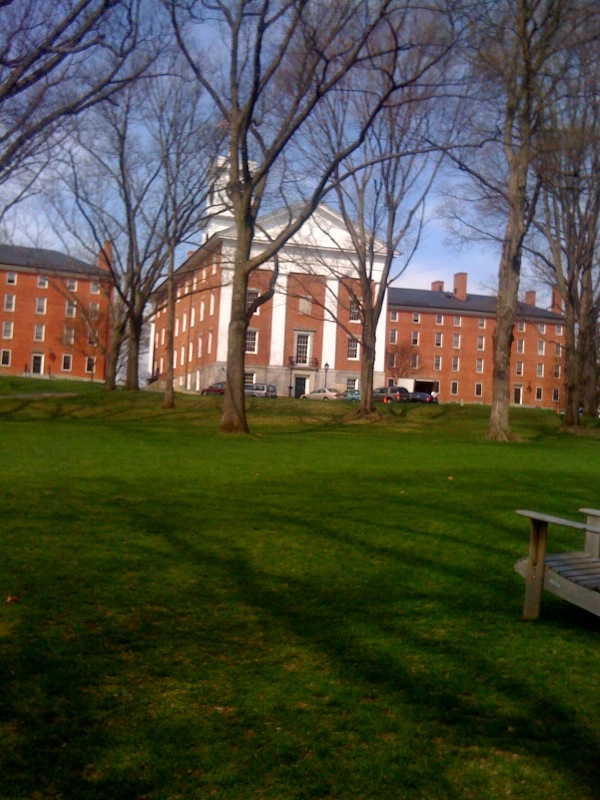
I had the pleasure to visit Amherst College on a delightful Spring Day last week. As you can see, in this picture of Johnson Chapel taken from Stearns Hall, the leaves aren’t yet out on the trees of the Freshman Quad. Yet the College on the Hill continues to thrive. The students that took me to lunch before my talk asked difficult questions, but they are clearly serious and give me great hope.

At the same time, western Massachusetts is having a difficult time of it. The Great Recession has not been kind. Here inside the Beltway, we sometimes miss the larger picture of what is happening across the country. Driving back to Bradley Airport, through formerly prosperous mill towns made concrete the suffering inflicted by this crisis.

Both an Institute for Advanced Study and an Academic Unit

One of the unusual aspects of the Krasnow Institute is that over the years, it has evolved into both a Institute for Advanced Study and a regular academic unit of George Mason University. One might construe the two, as mutually exclusive–how could a true Institute for Advanced Study offer programs and degrees–but from my own perspective, nothing could be further from reality. In fact, the degree programs with their graduate students and doctoral-level research, reinforce the scientific pursuits of Krasnow.

There’s another aspect to the equation though: having an academic unit embedded within an Institute for Advanced Study (as opposed to say a College or a School). The culture of an Institute for Advanced Study centers around scientists reaching across disciplines to solve fundamentally hard problems. Under such intellectually challenging circumstances, there is considerably less time for the famous academic “foul play” that Kingsley Amis‘ character, Lucky Jim, found himself embroiled in. Students thrive in this sort of milieu (Woods Hole comes to mind) precisely because they become themselves personally involved in the original research. Faculty thrive because they are rewarded for reaching across the typical disciplinary boundaries–for that is where the big payoffs in science lie.

Steven Sacklarian’s art work at Krasnow

Many of you will have noticed the very striking work of Steven Sacklarian (1889-1983) that is on display around the Institute. Information about this important artist is here. I hope that our science community and visitors will enjoy the new paintings. To me, many of them bring to mind the cellular processes that make up biology.

Jim

Gravity as an emergent property of information in the Universe

Money quote:

A few month’s ago, Erik Verlinde at the the University of Amsterdam put forward one such idea which has taken the world of physics by storm. Verlinde suggested that gravity is merely a manifestation of entropy in the Universe. His idea is based on the second law of thermodynamics, that entropy always increases over time. It suggests that differences in entropy between parts of the Universe generates a force that redistributes matter in a way that maximises entropy. This is the force we call gravity.

Back from Palm Beach


I’m back from Palm Beach and the lifeguard stand yesterday morning was flying a flag that apparently indicates “dangerous marine wildlife”. Obviously my first thoughts (it was near perfect surfing conditions, off-shore breeze and a nice curl) were of large great white sharks cruising just behind the break. But then I started thinking about how the Marine Park’s here in Florida have had their own dangerous marine wildlife conditions–seems to me that an Orca confined within a tank is a recipe for disaster.

But then walking along the beach, and noticing the very dangerous remnants of a Portuguese Man’O War jellyfish, I was satisfied that I’d found the real danger in an invertebrate with a serious attitude (as far as stinging is concerned).

But then I learned later, in fact I’d been right originally–it was the sharks.

I may be the editor of The Biological Bulletin, but I’ve got a lot to learn about marine biology!

Jim

Talking about a theory for neuroscience

I’m giving a talk this evening for the Philosophical Society of Washington–the abstract is here. One of the issues that jumps out whenever I give one of these talks is how neuroscience, unlike disciplines such as physics or chemistry, lacks a general theory that provides a framework or skeleton for both old knowledge and more importantly new discoveries.

As a discipline, we in neuroscience, are very good at amassing and organizing (and even sharing) data. But a general theory (analogous to say quantum mechanics or relativity)–that we are lacking. Instead we have a multitude of nascent bounded theories for various levels of organization within the brain. Hence, we have some idea of how individual neurons signal one another, how groups of neurons may act together to store memories and create perceptions, how brain diseases affect this or that brain region, and how drugs may act to ameliorate brain conditions (or sometimes create addiction). But what we lack, is a general theory of how the brain’s organization and dynamics lead to the phenomena we generally associate with brain: consciousness, creativity, deception and the like.

So that could be a very exciting thing for a discipline (i.e. the most exciting times are yet to come) or very frustrating.

I’m going to argue this evening, that perhaps we can see the vague outlines of what such a general theory might look like.

I’ll post more on this soon.

Jim