The Larval Stage of Institutional Development

Krasnow’s larval stage was as a stand-alone institute constituted as a non-profit. It operated out of rental class-B commercial space in downtown Fairfax and had several employees (two of whom are still with us!). The Institute for Advanced Study had grand plans though–even at that time (nearly two decades ago), and moves were afoot for a meeting to be co-sponsored with the Santa Fe Institute which would focus our scientific program towards the intersection of neurobiology, cognitive psychology and computer sciences. There were also plans and money for a dedicated facility (albeit more like a think tank than a place with laboratories), and a seminar series was commenced that also, continues to this day. The initial aspirational models for the Institute were places like the Santa Fe Institute and to a lesser extent Cold Spring Harbor Lab, and Woods Hole. The notion is that we would always be stand-alone and that in a decade or so, there would be bricks and mortar, a powerful governance board that would provide the resources for an endowment and a cadre of scientists who would be principally identified as investigators rather than as academic faculty members.

The larval stage ended in 2002 with the merger with George Mason and the metamorphosis into the mature Krasnow Institute for Advanced Study as a full academic unit of the University. And yet, there are elements of the larval DNA that still remain: one of which is a commitment to the elite post-graduate educational programs offered by our early aspirational peers. While we have buttered our bread over the years since the merger with the development of doctoral programs in neuroscience and computational social sciences, this early notion of running summer short courses remains. The location of course is dramatic and special (the Institute is only 12 miles from the US Capitol Building). We now have superb conference and hotel facilities. And there is a critical mass of both faculty and related content/research that might be offered.

So we’re reactivating that latent part of Krasnow’s genome, left over from our larval era. In the meantime, we enjoy the massive advantages that come from being a part of a large, healthy public research university.
Neurology update

Neurology is in the news this week. Oliver Sack’s wonderful piece on alexia is still behind the New Yorker firewall. But by all means go out and find yourself a copy of the magazine. It’s an excellent read.

Then, Andrew Sullivan has a short blog entry on anosognosia that is itself linked to a great piece by Eroll Morris where he interviews V.S. Ramachandran.

Enjoy!

Thinking about the Two Cultures

I’ve been thinking a lot about C.P. Snow’s Two Cultures lately. Snow, in his seminal mid-twentieth century lecture (followed by an article and two books) put forward the notion of a dialectic between the social sciences and the hard sciences. One of his most famous quotes concerns querying some literary friends about the 2nd Law of Thermodynamics in response to their complaints about the general ignorance of scientists about literature. The upshot is that they didn’t know about entropy or the 2nd Law.

Here at Krasnow, we have, only in recent years, become a true locus for advanced studies as we added, first a center for social complexity and second a department of computational social sciences to our existing center of mass in neuroscience (writ large). These days research at Krasnow spans Snow’s two cultures pretty effectively, but largely without the communications divide postulated in Two Cultures.

Why is this?

For one thing, I think it’s a result of an unspoken norm at Krasnow to strive mightily away from the technical jargon of one’s field. For another, it’s the result of another de facto agreement to actually communicate intellectually outside one’s comfort zone. Taken together, the result is what has been called a “third culture”. From my own perspective as Institute director, this third culture is one where intellectuals actively appreciate the connection between human creative and artistic expression and the neural activity of brains that produce those expressions. Hence high culture becomes an emergent of interacting human minds, rather than a no-go zone for those well-steeped in the hard disciplines. At the same time, intellectuals in the social sciences are willing to explore and leverage the tools of hard science (especially computation and complexity theory).

Summer Short Courses

Next summer (2011) we have some major academic plans on the table. We’re going to be offering summer short courses at the Fairfax Campus of George Mason. The topics are still in flux, but they will bring top-flight faculty from around the world to Mason’s brand new Hotel and Conference Center, the Mason Inn. Generally we’ll be teaching week long short courses in our areas of expertise: social complexity, neuroethics and policy, and possibly agent based modeling. The courses will leverage the newly expanded Institute Facility (by next summer we’ll be around 60,000 square feet) and the University’s close proximity to the Nation’s capital. Stay tuned!

The Annual Science Retreat


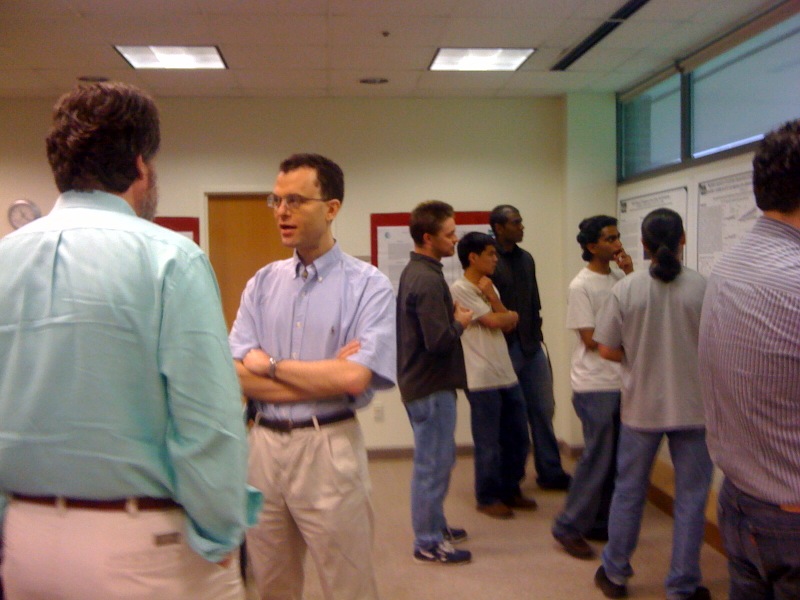
This is one of my favorite times of year: our annual science retreat at the Institute for Advanced Study. This year, as with others, we get a fabulous overview of the depth and breadth of the research portfolio at Krasnow. Yesterday’s session featured back-to-back talks, today student poster sessions and a faculty luncheon.

In the foreground here Giorgio Ascoli is engaged in a deep discussion about networks with Claudio Cioffi. Behind them doctoral students and Ted Dumas focus in on a poster.

Craig still makes news….

Genome Pioneer Craig Venter still knows how to make the news. Read about it here.

This time, he’s entirely synthesized the entire genome of a bacterium.
Teaser quote from the New York Times on-line:
At a press conference Thursday, Dr. Venter described the converted cell as “the first self-replicating species we’ve had on the planet whose parent is a computer.”

Olvia Judson’s NY Times Science Blog

I am a very avid supporter of Olivia Judson’s wonderful science blog over at the New York Times (click on the link above). Today she salutes archaea, the third domain of the tree of life. These microbes are both ubiquitous and in many senses unexplored territory as far as biology is concerned–they’re difficult to culture in the laboratory.

Teaser quote:

More diagnostic: archaeal cell membranes have a different structure and composition from those of bacteria or eukaryotes. And although archaea organize their DNA much as bacteria do (they also have no cell nucleus, for example), many aspects of the way the DNA gets processed are distinctly different. Instead, the processing is more similar to what goes in within eukaryotic cells. Archaea also have large numbers of genes that are not found in the other groups.