
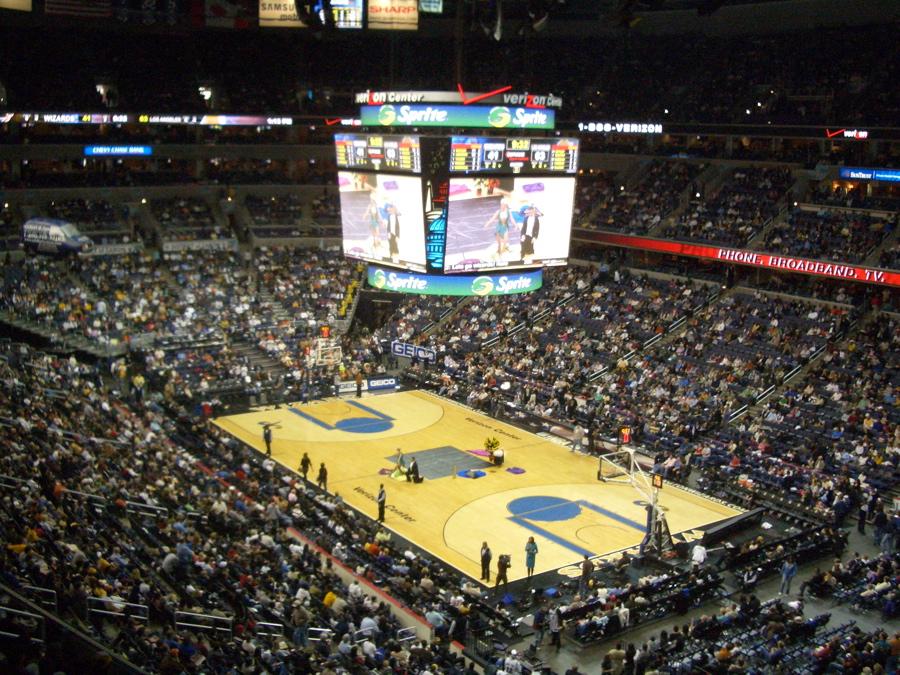
Yesterday afternoon, friends of the Krasnow Institute for Advanced Study celebrated the Super bowl early as they watched the Los Angeles Lakers blow out the Washington Wizards from a Verizon Box at the sold-out Washington Verizon Center. Among those attending the “friend raising event” were Len and Ginger Pomata, Bill Nitze, who have been instrumental in advancing the science of the Institute through their gifts.
Category: Uncategorized
Oprah interview on XM radio
This is the show that aired on January 17. At least part of the interview is available at the link.
Jim
Spring semester begins
Tomorrow (Tuesday) is the first day of the Spring semester here at Mason. Here are three things I want to accomplish before commencement:
–Recruit at least two new thought leaders to the Advisory Board.
–Garner foundation support for our doctoral programs. Both programs are now beginning to have real track records (normative time to Ph.D. is typically five years or so) and it’s time to gain external recognition of what we are doing in interdisciplinary graduate education and research training.
–Double the number of proposals for sponsored research funding over the same period last year. At the same time, we’ll move towards diversification of our grants portfolio–I would like to also double the number of agencies and foundations that we submit grants to.
Jim
Physics takes a big hit in the latest federal budget
The omnibus federal spending bill really gives experimental physics the raw end of the deal. This is a large cut for the fiscal year already under way. It’s going to only hurt this country’s competitiveness over the long haul.
Jim
Big Business and Research Universities
The link is to a NYTimes.com piece by G. Pascal Zachary….
Successful research universities are increasingly allowing corporate privileged access to their latest findings in science and technology. I know there are positives and negatives to this…those arguments have been back and forth for years. What’s interesting are the perspectives from the players and what this all means, not that it’s happening.
Money quote:
The appeal of these arrangements is that “we get broad engagement with universities,” says Andrew Chien, Intel’s director of research. “Their researchers work on frontiers, in unexplored territory. We want explorers.”
Intel hopes to learn more about scientific and technical developments that might influence its business, even decades from now. The company says it benefits from having its own employees rub shoulders with professors, while gaining the chance to observe younger talent in Ph.D. programs.
“You can view this as a pure pipeline,” says Chien, himself a former professor.
This is a perspective that I think has particular resonance for the Krasnow Institute for Advanced Study and its various stakeholders and friends–particularly those in the private sector. One of the strategic directions that we’ll be heading in the next year will be towards building relationships like the ones Intel has with Berkeley, University of Washington and CMU.
Bayh-Dole (British Version)
Financial Times’ Jonathan Guthrie waxes on the gulf between UK uber-scientists and their business counterparts. Not sure he’s right though. The best scientists think like an entrepreneur–just not with a dollar profit bottom-line.
Jim
Hamiltonian Blog
Check out Professor Paul So’s blog–only it’s about his new art space in DC on the historic U St. corridor, Hamiltonian Gallery. Paul is an esteemed senior faculty member at the Institute, while also a member of the Physics department. Who says science isn’t about art!
Jim
Over the river and to the Woods…
This is the day when America seems to collectively travel in preparation for tomorrow’s Thanksgiving meal. We’re no exception: we head for the house at Wintergreen inside of the next hour, hopefully missing at least some of the traffic that will surely clog the interstate highways later this afternoon.
Among the things I give thanks for is the opportunity to lead an amazing institute for advanced study, where collegiality, an open mind and excellent research are in abundance. To all of my colleagues and readers, I wish all a very happy holiday.
Jim
Joys of Serving on a Search Committee: No Really!
There is a common notion that among academics that serving on a search committee is a whole lot less satisfying that say, giving a talk in Aspen or making a new discovery at the laboratory bench. But this isn’t always true. Yesterday our search committee got together to make some key decisions in one of our faculty searches and–even though the meeting was 2 hours long–it was an absolute pleasure. Why?
For one thing, most of us have been colleagues for years. There is an easy going professional friendship that allows for humor, yet at the same time manifests a group open-mindedness.
Secondly, we have an incredible set of candidates. There are folks who, among themselves, have published in the likes of Cell, Nature, Neuron and the like, who come with existing NIH grants in hand, and whose research statements are both well-written and frankly intriguing. Growing your faculty becomes enjoyable when the prospects are for great new colleagues.
Finally, with a computer plugged into a powerpoint projector, we were able to call up CV’s, letters and the like and read them together, with ease.
Jim
Nature’s Cover
Yes, it’s that time of year: the Society for Neuroscience’s meeting this year is in San Diego. On cue, Nature and Science usually devote their cover to the field. This year Nature has a spectacular cover on the Brainbow project at Harvard.
As usual Science Magazine follows suit. Neuroscience is a field in full.
This year I’ll be staying in Washington. However, the Institute will have a very significant presence at the convention. I’ll look for some guest contributions on the meeting when our folks return.
Jim
 Discoverers and Discoveries