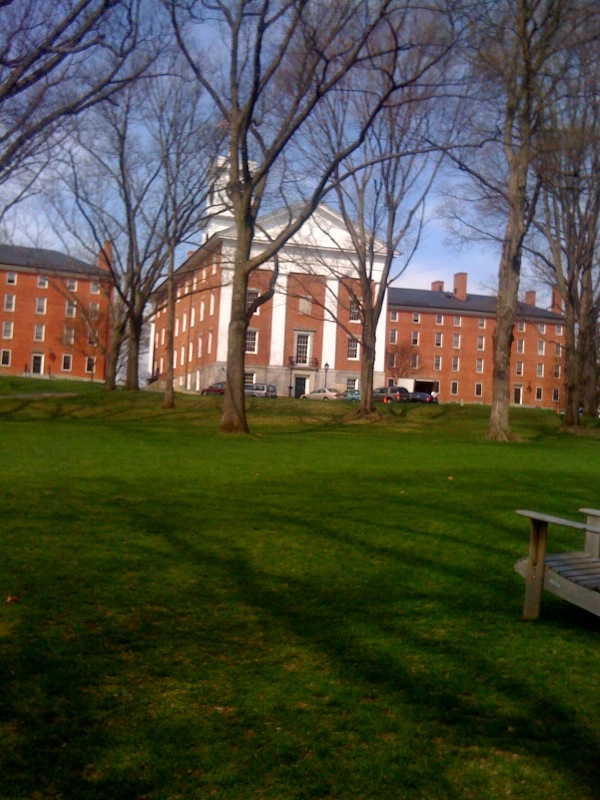

I had the pleasure to visit Amherst College on a delightful Spring Day last week. As you can see, in this picture of Johnson Chapel taken from Stearns Hall, the leaves aren’t yet out on the trees of the Freshman Quad. Yet the College on the Hill continues to thrive. The students that took me to lunch before my talk asked difficult questions, but they are clearly serious and give me great hope.
Category: Uncategorized
Blogging sabbatical
Well, I’ve had a very enjoyable sabbatical from blogging at Advanced Studies after five years of more or less constant posting. During the break, we had two amazing blizzards here in Washington and there’s still a whole lot more snow on the ground than we ever get during a “normal” winter–that even though it’s nearly 50 degrees outside and this would be the typical time we’d be seeing daffodils. Also, I’ve been teaching a very enjoyable course on the function of the hippocampus–cross listed to both advanced undergraduates and doctoral students here at Mason. I forget sometimes how satisfying teaching can be.
We saw a pretty entertaining movie the other night, Tenure, which made me laugh, but also reminded me of the very frightening events from Alabama over the past week.
In any case, we’re rested, relaxed and ready to blog.
TTYS
Headed back from Seattle
We had an excellent editorial board meeting of The Biological Bulletin yesterday evening. I have to say it was also delightful to enjoy the “tropical” weather relative to what we’ve been getting in the Nation’s capital.
Fall semester draws to a close
My university made the news today with the announcement of the gift of a large and strategically located piece of land out near Dulles International Airport–we do keep growing here at Mason, in spite of these interesting times.
Understanding cities with agents
Dear Jim,
Thanks for inviting me to write a guest entry on your blog about my research interests and background. It is actually quite strange writing on someone else’s blog rather than my own. Since starting at the Department of Computational Social Science in August, I have been overwhelmed with how friendly and supportive everyone has been.
Prior to arriving at GMU, I spent several years at the Centre for Advanced Spatial Analysis (CASA) at University College London, both as a PhD student and as a research fellow. My PhD was carried out under the supervision of Professors Mike Batty and Paul Longley and sponsored by the Greater London Authority (GLA) Economics unit. It focused on integrating geographical information systems (GIS) and agent-based models thus providing the ability to link agents to actual ‘real’ world places and explored general questions about residential location and spatial interaction. Specifically how agents locate and interact with their surrounding environment, along with how competition for land results in distinct spatial patterns emerging. This has subsequently led me to develop my research interests in agent-based modeling (ABM) of cities.
Cities are extremely important as they provide habitats for over half of the world’s population and this percentage is expected to increase further in future decades. This increase will cause many problems such as sprawl, congestion and segregation; along with environmental effects associated with land use and land cover change. However, understanding such systems is extremely complex because of the many different factors and activities that are seen within cities all of which operate at different temporal and spatial scales. As Professor Sir Alan Wilson writes, understanding cities represents “one of the major scientific challenges of our time.”
I believe that a greater understanding of cities can be gained through the use of agent-based models: from the split second decisions involving local movements such as people walking, to the development of land over months and years, the migration of peoples over decades, to the rise and fall of cultures and civilizations over eons. These processes all that have at their core people (in some shape or form), thus understanding the reasoning on which individual decisions are made may therefore help us better understand the effects of such growth. However, there are several challenges which need to be addressed ranging from validation of such models to the communication of models. More recently I have been exploring how one can take advantage of advances in digital data, 3D modeling environments and virtual worlds such as Second Life for the creation and outreach of agent-based models.
These broad research interests have been the foundation of the graduate course that I am currently teaching this semester entitled “Agent-based Modeling of Urban Systems” which explores many aspects of urban systems from the micro-movement of pedestrians to residential dynamics. Next semester I will be teaching two classes. The first is “Spatial Agent-Based Models of Human-Environment Interactions” which explores how one can link socio economic and environmental models, along with GIS to study topics in areas such as agriculture, forestry, human/non human populations. The second course “Land-Use Modeling Techniques and Applications” focuses on a variety of land-use change models including cellular automata and agent-based models, along with exploring the drivers of change.
I am finding it great to be among a group of faculty, staff and students who are interested and extremely knowledgeable about ABM from a variety of backgrounds and I am looking forward to developing further links with people at GMU in the future.
Sincerely,
Cox Lab Moves to Krasnow Institute
Dear Jim,
Many thanks for the opportunity to contribute to your blog. My research group and I are very excited to be moving our laboratory from the Prince William Campus to the beautiful new facilities at the Krasnow Institute for Advanced Study this Fall. Prior to joining the Department of Molecular and Microbiology at George Mason in Fall 2004, I completed my PhD in the laboratory of Dr. Haifan Lin at Duke University where my research focused on the molecular mechanisms governing stem cell regulation. I next went on to complete postdoctoral training as a Jane Coffin Childs Fellow in the laboratory of Dr. Yuh-Nung Jan at UCSF where my research focused on investigating the molecular and regulatory mechanisms governing class-specific dendrite morphogenesis.
Presently, my research laboratory is focused on a number of key areas of inquiry including the mechanisms by which the size, shape and complexity of dendritic arbors is achieved and subsequently regulated, how the boundaries of neuronal receptive fields are specified and refined, how dendrites function in mediating recognition between synaptic partners, and how dendritic fields are established, maintained and remodeled during development.
To investigate these questions, we use Drosophila genetics to dissect the molecular mechanisms mediating class specific dendrite morphogenesis. The Drosophila peripheral nervous system (PNS) serves as a molecular, genetic, morphological and physiological model system in which to investigate these processes. Specifically, our group is focused on the roles of transcriptional, cytoskeletal, cell surface receptor, and RNAi (siRNA/miRNA) regulatory mechanisms governing class-specific dendrite morphogenesis as they relate to dendritic field specification and dendritic tiling. We have also recently published a paper describing novel methods for the isolation and transcriptional expression profiling of class-specific neurons as a tool to investigate these processes.
Apart from my research program, I am currently the Graduate Program Director for the Biosciences PhD and M.S. Biology degree programs at Mason and am delighted to take on the role as Director for the new Confocal Imaging Core of the Krasnow Institute (C.I.C.K.I.).
I am particularly anxious to establish new collaborations with other Krasnow Investigators in the areas of high-resolution cellular imaging and neuroinformatics and look forward to interacting with all the faculty, students, and staff in the Neuroscience program.
Sincerely,
Dan Cox
This year’s MacArthur winners
I am a huge supporter of the MacArthur “genius” fellow awards. These are folks who are working outside the usual paradigm–the narrow annulus where the work is incredibly innovative yet at the same time highly rigorous.
Jim
Academic Blogs
I’m pleased to report that Advanced Studies has made a list of 100 Best Blogs and Websites for Innovative Academics. We try!
New Gates Foundation grants
The Gates Foundation pursues a pretty innovative approach in awarding research grants. Here’s the key quote from the Financial Times:
To apply for a grant, the foundation requires only the outline of a hypothesis and a way of testing it: it does not need applicants to provide data to support their theory, a requirement that puts many researchers, especially those from the developing world, in a chicken-and-egg conundrum.
I’ve been urging our PI’s to think outside the box lately about funding sources. This looks like a pretty good idea, although it needs to be tied to world health.
Jim
Financial Times on Machine Learning
Alane Cane has written a spectacular piece in today’s FT regarding the limitations of AI and cognitive computing. Featured in the article is IBM’s Dharmendra Modha:
IBM was a pioneer in the field and today continues to invest heavily in AI research. Dharmendra Modha, a scientist in the company’s California research laboratory is working on cognitive computing, which he defines as a computer model that simultaneously exhibits characteristics seated in the human brain, including perception and emotion.
His aim is to discover how the brain works, not how the mind works, he is quick to emphasise.
Last year, his group achieved a milestone by managing to simulate the operation of a mouse brain on an IBM Blue Gene supercomputer.
He notes: “We deployed the simulator on a 4096 processor Blue Gene/L supercomputer with 256 megabytes of memory per processor.
We were able to represent 8m neurons and 6,300 synapses (connections) per neuron in the one terabyte main memory of the system.”
There will be, of course, a considerable time lag before the benefits of this research are seen in actual products.
Mr Modha thinks it could be 10 years before cognitive computing of the kind he is working on makes its debut in productivity and security systems. It is, however, a giant leap from 1956 when an IBM supercomputer of the day simulated the firing of a mere 512 neurons
Read the whole article!
Jim