Understanding cities with agents

Dear Jim,

Thanks for inviting me to write a guest entry on your blog about my research interests and background. It is actually quite strange writing on someone else’s blog rather than my own. Since starting at the Department of Computational Social Science in August, I have been overwhelmed with how friendly and supportive everyone has been.
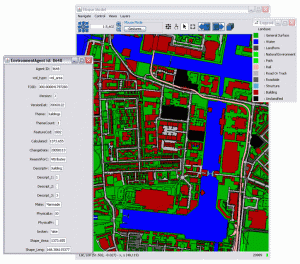
Prior to arriving at GMU, I spent several years at the Centre for Advanced Spatial Analysis (CASA) at University College London, both as a PhD student and as a research fellow. My PhD was carried out under the supervision of Professors Mike Batty and Paul Longley and sponsored by the Greater London Authority (GLA) Economics unit. It focused on integrating geographical information systems (GIS) and agent-based models thus providing the ability to link agents to actual ‘real’ world places and explored general questions about residential location and spatial interaction. Specifically how agents locate and interact with their surrounding environment, along with how competition for land results in distinct spatial patterns emerging. This has subsequently led me to develop my research interests in agent-based modeling (ABM) of cities.

Cities are extremely important as they provide habitats for over half of the world’s population and this percentage is expected to increase further in future decades. This increase will cause many problems such as sprawl, congestion and segregation; along with environmental effects associated with land use and land cover change. However, understanding such systems is extremely complex because of the many different factors and activities that are seen within cities all of which operate at different temporal and spatial scales. As Professor Sir Alan Wilson writes, understanding cities represents “one of the major scientific challenges of our time.”

I believe that a greater understanding of cities can be gained through the use of agent-based models: from the split second decisions involving local movements such as people walking, to the development of land over months and years, the migration of peoples over decades, to the rise and fall of cultures and civilizations over eons. These processes all that have at their core people (in some shape or form), thus understanding the reasoning on which individual decisions are made may therefore help us better understand the effects of such growth. However, there are several challenges which need to be addressed ranging from validation of such models to the communication of models. More recently I have been exploring how one can take advantage of advances in digital data, 3D modeling environments and virtual worlds such as Second Life for the creation and outreach of agent-based models.

http://vimeo.com/moogaloop.swf?clip_id=4429002&server=vimeo.com&show_title=0&show_byline=1&show_portrait=0&color=00ADEF&fullscreen=1

These broad research interests have been the foundation of the graduate course that I am currently teaching this semester entitled “Agent-based Modeling of Urban Systems” which explores many aspects of urban systems from the micro-movement of pedestrians to residential dynamics. Next semester I will be teaching two classes. The first is “Spatial Agent-Based Models of Human-Environment Interactions” which explores how one can link socio economic and environmental models, along with GIS to study topics in areas such as agriculture, forestry, human/non human populations. The second course “Land-Use Modeling Techniques and Applications” focuses on a variety of land-use change models including cellular automata and agent-based models, along with exploring the drivers of change.

I am finding it great to be among a group of faculty, staff and students who are interested and extremely knowledgeable about ABM from a variety of backgrounds and I am looking forward to developing further links with people at GMU in the future.

Sincerely,

Andrew Crooks

Cox Lab Moves to Krasnow Institute

Dear Jim,


Many thanks for the opportunity to contribute to your blog. My research group and I are very excited to be moving our laboratory from the Prince William Campus to the beautiful new facilities at the Krasnow Institute for Advanced Study this Fall. Prior to joining the Department of Molecular and Microbiology at George Mason in Fall 2004, I completed my PhD in the laboratory of Dr. Haifan Lin at Duke University where my research focused on the molecular mechanisms governing stem cell regulation. I next went on to complete postdoctoral training as a Jane Coffin Childs Fellow in the laboratory of Dr. Yuh-Nung Jan at UCSF where my research focused on investigating the molecular and regulatory mechanisms governing class-specific dendrite morphogenesis.


Presently, my research laboratory is focused on a number of key areas of inquiry including the mechanisms by which the size, shape and complexity of dendritic arbors is achieved and subsequently regulated, how the boundaries of neuronal receptive fields are specified and refined, how dendrites function in mediating recognition between synaptic partners, and how dendritic fields are established, maintained and remodeled during development.


To investigate these questions, we use Drosophila genetics to dissect the molecular mechanisms mediating class specific dendrite morphogenesis. The Drosophila peripheral nervous system (PNS) serves as a molecular, genetic, morphological and physiological model system in which to investigate these processes. Specifically, our group is focused on the roles of transcriptional, cytoskeletal, cell surface receptor, and RNAi (siRNA/miRNA) regulatory mechanisms governing class-specific dendrite morphogenesis as they relate to dendritic field specification and dendritic tiling. We have also recently published a paper describing novel methods for the isolation and transcriptional expression profiling of class-specific neurons as a tool to investigate these processes.


Apart from my research program, I am currently the Graduate Program Director for the Biosciences PhD and M.S. Biology degree programs at Mason and am delighted to take on the role as Director for the new Confocal Imaging Core of the Krasnow Institute (C.I.C.K.I.).


I am particularly anxious to establish new collaborations with other Krasnow Investigators in the areas of high-resolution cellular imaging and neuroinformatics and look forward to interacting with all the faculty, students, and staff in the Neuroscience program.


Sincerely,


Dan Cox

Academic Blogs

I’m pleased to report that Advanced Studies has made a list of 100 Best Blogs and Websites for Innovative Academics. We try!

In the meantime, the academic year has started. I’m teaching later today and the weather here in Washington is almost October-like! Ah the wonders of Fall!
Jim

New Gates Foundation grants

The Gates Foundation pursues a pretty innovative approach in awarding research grants. Here’s the key quote from the Financial Times:

To apply for a grant, the foundation requires only the outline of a hypothesis and a way of testing it: it does not need applicants to provide data to support their theory, a requirement that puts many researchers, especially those from the developing world, in a chicken-and-egg conundrum.

I’ve been urging our PI’s to think outside the box lately about funding sources. This looks like a pretty good idea, although it needs to be tied to world health.

Jim

Financial Times on Machine Learning

Alane Cane has written a spectacular piece in today’s FT regarding the limitations of AI and cognitive computing. Featured in the article is IBM’s Dharmendra Modha:

IBM was a pioneer in the field and today continues to invest heavily in AI research. Dharmendra Modha, a scientist in the company’s California research laboratory is working on cognitive computing, which he defines as a computer model that simultaneously exhibits characteristics seated in the human brain, including perception and emotion.

His aim is to discover how the brain works, not how the mind works, he is quick to emphasise.

Last year, his group achieved a milestone by managing to simulate the operation of a mouse brain on an IBM Blue Gene supercomputer.

He notes: “We deployed the simulator on a 4096 processor Blue Gene/L supercomputer with 256 megabytes of memory per processor.

We were able to represent 8m neurons and 6,300 synapses (connections) per neuron in the one terabyte main memory of the system.”

There will be, of course, a considerable time lag before the benefits of this research are seen in actual products.

Mr Modha thinks it could be 10 years before cognitive computing of the kind he is working on makes its debut in productivity and security systems. It is, however, a giant leap from 1956 when an IBM supercomputer of the day simulated the firing of a mere 512 neurons

Read the whole article!

Jim

Goldilocks on Wall Street

Greetings to all. I am the new Chair of the Dep’t. of Computational Social Science at the Krasnow Institute for Advanced Study at George Mason. Jim has graciously invited me to contribute to his blog. I am an economist with broad interests in economic theory and policy, behavioral economics (how people depart from perfectly rational behavior), cognition (thus my Department’s natural connection to Krasnow), and computation (my Ph.D. is from Carnegie Mellon).

Under normal circumstances I would comment here on matters of basic research and science policy. But the current financial environment is sufficiently grave that I will take the liberty of discussing the proposed bailout of Wall Street.

For the last year or so banks have been sufficiently worried about the risks posed by the mortgage-related assets of their peers that most interbank lending has become expensive (as measured by the so-called TED spread, for instance). Indeed, in the past couple of weeks such interbank activity has nearly dried up—this is the ‘credit crunch.’ Such short term lending is an important activity in the day-to-day operations of major banks, and its demise has led to the Fed providing short term credit facilities to keep overnight and other short term lending and borrowing going. But what we don’t really know (yet) is just how bad bank balance sheets look. It is reasonable to assume that many are weak—thus the urgency with which bailout legislation has been crafted and voted on—but just how weak is not known. The big problem, as I see it, is that bank solvency is not really knowable ex ante, i.e., before a rescue plan is implemented. Here’s why:

Economists are wont to focus on prices to explain the inner workings of the economy. An important part of proposed bailout/rescue plans is use of certain auction mechanisms in order to ‘discover’ the proper prices for ‘toxic’ mortgage-backed securities and related financial assets that troubled firms wish to take off their balance sheets. The functioning of these auction mechanisms is critical to the performance of the bailout, but the exact nature of these mechanisms is not yet specified. Indeed, there is a ‘Goldilocks’ flavor to how such auctions have to function in order to relieve the credit crunch. Currently there is no market for the most toxic of these assets—they are illiquid and their value may be very close to $0. If a government auction for them produces very low prices for such assets then the troubled banks selling them will benefit little from such sales and may be made insolvent. If these auctions produce prices that are too high then taxpayers will be on the hook in a big way and banks will get recapitalized from a true government bail out—welfare for Wall Street even though these same institutions have earned staggering profits in recent years. Instead of auction prices that are either too low or too high it is hoped that the Treasury auctions find prices right in the middle, sufficient to keep the banks operating and thus restoring confidence so interbank lending can resume at reasonable rates. Thus Goldilocks.

The trouble with this whole approach to finding the ‘right’ price for a particular mortgage-backed security (MBS)/collateralized debt obligation (CDO) is that the real determinant of the value of the underlying mortgage assets depends on the health of the overall economy. If the near term recession is mild or even non-existent then stable home prices would result, meaning higher auction prices for distressed mortgage-related securities would be in order. If a longer, deeper recession is in the cards then lower auction prices for MBS/CDOs are justified, even though this would likely ‘take out’ several large banks. In the case of a big recession/depression then the value of many mortgage-related assets is probably close to $0 and many banks will be insolvent.

If one looks at the economy in a static equilibrium way, as is conventional in economics, then one might say there are multiple equilibria in the picture I have laid out: low housing prices and insolvent banks represent one equilibrium and higher housing prices and stabilized institutions are another. Unfortunately, unless one has a reasonably accurate model telling you the effect of a bailout on the real economy, it is going to be guesswork as to which kind of bailout plan leads to which equilibrium. In an economy with multiple equilibria, a specific bailout plan, in essence, selects the final outcome for the economy by picking prices paid for ‘toxic’ securities. Prices that are too low might in advertently ‘kick’ the economy down to a deep recession or depression equilibrium.

The real problem, it seems to me, is that we have only the crudest understanding—zeroth-order models and gray beard guesses—for the overall effect of alternative bailout plans on the real economy. The great 20th Century Economics Nobelist Herbert Simon often argued that we, as a nation, need much more support for basic research in the social sciences. Imagine the ‘return on investment’ today from a few million dollar research program that had created a reasonably-accurate, quantitative model of the current financial system? Maybe it would be saving us a few trillion dollars right now.

From Columbus Ohio

Ohio State beat hapless Youngstown State University by an enormous margin, while Michigan lost to Utah yesterday in college football. They are very happy about that here today. It’s too bad I’m a Michigan fan. But the weather here is spectacular, even as we worry once again about New Orleans in the context of a hurricane.

I’ve enjoyed this holiday Labor Day weekend. Tomorrow we return to Washington and the work of the Institute.

Jim

Wrong phone directory

It’s a rainy, foggy morning here in Woods Hole. I woke up to the fog horn. The journal staff here played a practical joke on me: they found a copy of the 1978-1979 Woods Hole phone director (where I am listed as a student) and left it on my desk prominently displayed. I thought nothing of it until I tried to look up a number and saw the old three digit extensions.

Tomorrow is the date for the MBL corporation meeting. And then the MBL Friday Evening lecture: Sir Paul Nurse, the Nobel Laureate will talk about “Great Ideas in Biology”. Should be an interesting day.

Jim

Nadine Kabbani

Dear Jim,

Thank you for inviting me to this blog. I am enthusiastic to be joining the faculty of the Department of Molecular Neuroscience at the Krasnow Institute for Advanced Study during the Fall semester. I come to Mason after several years of postdoctoral training at the Institute Pasteur in the lab of Dr. Jean Pierre Changeux, eager to establish a research program in the area of proteomic and functional analysis of nicotinic receptors in the brain. The proteome, now recognized as the next major post-genomic domain of molecular organization in cells, is an increasingly exciting place for neuroscience research! My niche of the neuroproteome encompasses molecular interactions of nicotinic receptors expressed in the cortex and striatum of the mammalian brain. Recently we have published findings on the discovery of novel nicotinic receptor interacting proteins from the mouse brain. In my lab at the Krasnow Institute, we will examine the role of these interactions in the function of nicotinic receptors using various cellular and molecular methods as well as mass spectrometry and bioinformatic techniques. We will also define additional proteomic interactions of central nicotinic receptors, and examine proteomic adaptations in key brain regions of nicotine addiction.
I look forward to valuable collaborations with experimental and theoretical scientists and interactions with students and other faculty in the Neuroscience program.

On a less scientific note, I am just beginning to prepare for my move back to the Washington DC area set for next month. A little sad to be leaving Paris, I have booked a return flight for Thanksgiving!

Best wishes for your summer plans and I look forward to seeing you in August.

Sincerely,

Nadine Kabbani