Powerpoint in teaching

I’m teaching NEUR 327 in the Spring. That’s one of the core neuroscience courses for the undergraduate major, Cellular, Neurophysiological and Pharmacological Neuroscience. I’m inclined to ignore Blackboard and teach using a combination of Facebook and Google tools. I’m also leaning towards minimizing the use of Powerpoint just because of its tendency to make the eyes roll upwards into their sockets.

Quite seriously, the use of Powerpoint for creating slides, is dangerously oversold, at least from the standpoint of pedagogy, as distinct from a research talk. I can’t decide whether it’s the formulaic slide lay-outs or the inane animations that arouse my distaste. Or perhaps it’s the ubiquitous use of images and graphics that are only tangentially related to the subject matter at hand….

As for Blackboard (the pretty much ubiquitous electronic learning platform across many colleges and high schools)…..I find it clunky–especially in comparison to Google’s collaborative tools and what one can do creatively on Facebook.

Peter Thiel, founder of PayPal on the fix we are in

A dark view of where we are these days….it’s here.

Money quote:

Most of our political leaders are not engineers or scientists and do not listen to engineers or scientists. Today a letter from Einstein would get lost in the White House mail room, and the Manhattan Project would not even get started; it certainly could never be completed in three years. I am not aware of a single political leader in the U.S., either Democrat or Republican, who would cut health-care spending in order to free up money for biotechnology research — or, more generally, who would make serious cuts to the welfare state in order to free up serious money for major engineering projects. Robert Moses, the great builder of New York City in the 1950s and 1960s, or Oscar Niemeyer, the great architect of Brasilia, belong to a past when people still had concrete ideas about the future. Voters today prefer Victorian houses.

Postdocs organize at MIT

This good news from Science Careers Blog, postdocs at MIT are forming a organization not unlike their student counterparts. All of this is important because, as with doctoral students, postdocs are engines of science. We count them, as we do graduate students, to access the vitality of a research university’s science enterprise. They deserve a “share” of shared governance.

Return to DC

I’m back from the Eastern Shore. Was on on the Bay this morning in a classic cat boat, it was very nearly perfect weather.

In the meantime have received abysmal news from NIH concerning the metrics on investigator initiated RO1 grants. The success rates are at an all time low of 17.4% for the year that ended September 30. That combined with “sunset” provisions for NIH RO1’s after one resubmission are changing the game entirely for biomedical research. There is much to worry about.

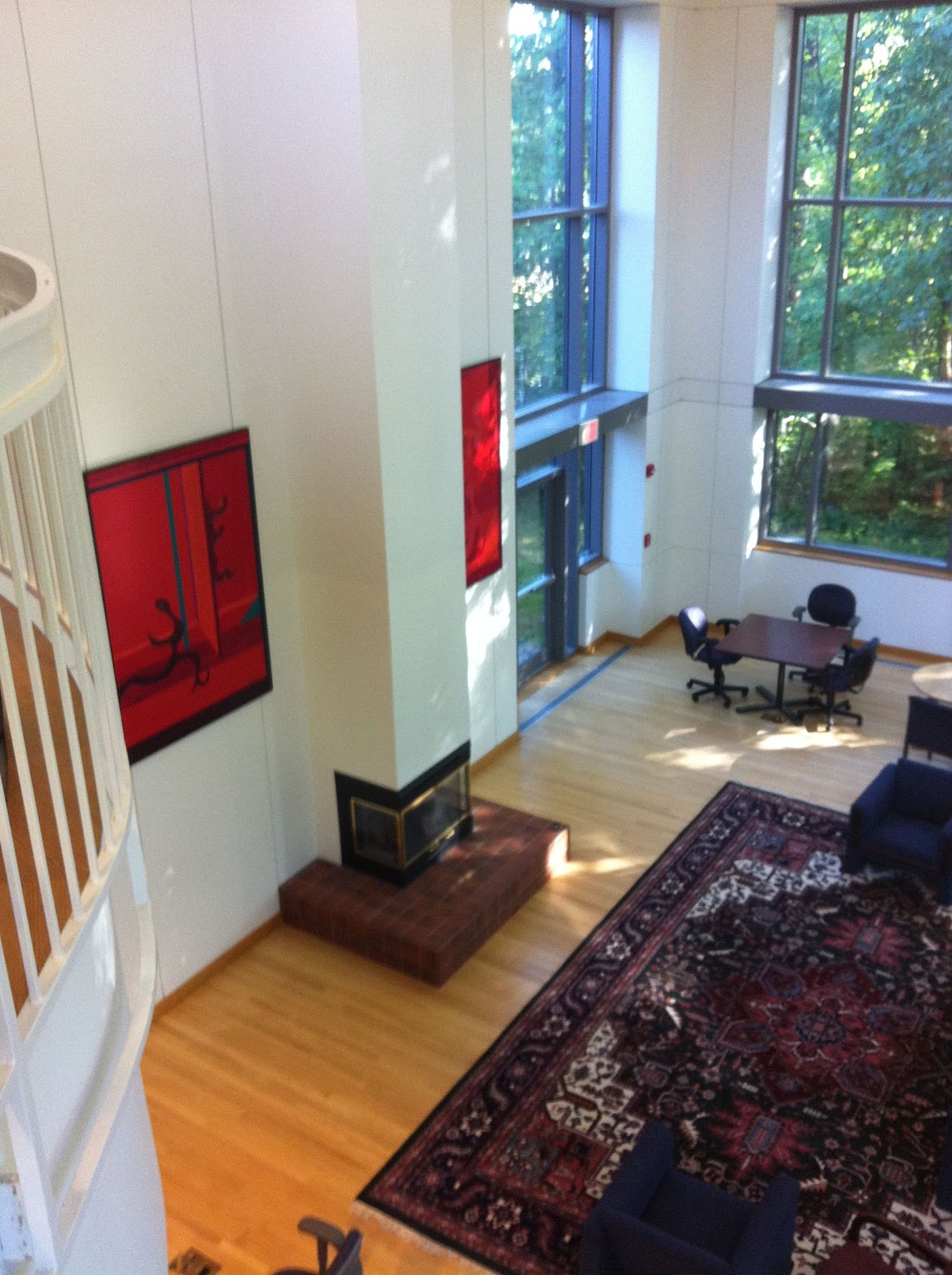
Art at the Krasnow Institute

One of the really nice things about the Krasnow Institute for Advanced Study is the art. Somehow there seems to be an important connection between science and art, probably because both involve human creativity and expression. These two pieces are by the Bulgarian-born artist, Stephen Sacklarian.

Not enough is really known about the neuroscience of artistic expression although with the advent of fMRI, the area is definitely opening up.

Does neuroscience need a general theory of neuroscience?

Just finished up a long conversation with one of my former students. Among our many topics was a questioning of my old assumption about the field of neuroscience: namely that neuroscience desperately needs a general theory (in the sense that the standard model and quantum mechanics are general theories) on which to scaffold the data from our experiments.

The question is: does neuroscience really need such a theory to be a mature science? Can neuroscience progress and even come to deep knowledge even, as a matter of course, understanding comes with a degree of irreducible complexity?

Certainly physics tolerates the current limitations of quantum mechanics and general relativity, although there are many physicists out there who presumably are doing there best to reconcile the two.

But can we really have a science, which produces practical knowledge (curing of brain diseases) but lacks a theory?

Of course I do recognize that there are many neuroscientists who are thinking at the theoretical level and who work very hard at coming up with something like what I’ve writing about. It’s just that so far, there’s been a lack of any real consensus, and to quote myself, “we really haven’t had our Einstein”…..yet.

Why Silicon Valley Works…

Hat tip to Tyler Cowen, here’s Paul Graham’s interesting idea: Graham starts from the notion that the default is for start-up hubs is failure, then he points to what makes the Valley a success. Money quote:

I think there are two components to the antidote: being in a place where startups are the cool thing to do, and chance meetings with people who can help you. And what drives them both is the number of startup people around you.

I was just mentioning to Tyler that perhaps the problem with DC is that here, the cool thing is a job from the Plum Book.