Special Teaching Deals Being Called Off…

From today’s Chronicle here. My colleague, Jorge Haddock, dean of our School of Management, is part of the story:

Some administrators are beginning to make changes, sometimes by giving professors a choice in the process. At George Mason University, professors who agreed to chair one of five “areas,” or departments, within the university’s School of Management had always taught just one course a year, compared with the usual faculty load of four courses per year. When Jorge Haddock took over as dean of the management school two and a half years ago, he thought the course release for area chairs was too generous. So he offered them a new deal: They could teach two courses a year, with pay for one month during the summer, or teach three courses a year with pay for two summer months. While the university pays more, Mr. Haddock says it’s worth it to make faculty workloads more equitable across the board and to get full-time professors back into the classroom.
More on ditching Blackboard and powerpoint in teaching…

At least one of my colleagues here at Krasnow teaches using Facebook. I’m guessing he uses some combination of Facebook “pages” and “groups” and I’m hoping he set up another professional identity/login separate from his personal one.

Another colleague, she teaches in the Boston area, mentioned dropping the canned powerpoint slides that come with adopting a textbook these days.

Still other colleagues use Apple’s Wiki Server on in-house machines.

The key to all of these ideas is that the learners and teachers are able to leverage the collaborative power of the Net without falling prey to having the learning process (think learning management systems) absorb all the energy that should go into the class subject matter….this is especially true with regards to neuroscience, since the subject matter can be quite technical.

So here’s a bleg for Advanced Study readers: how would you use what’s free on the Cloud to teach undergraduates science?

The Institute wears its Fall colors…

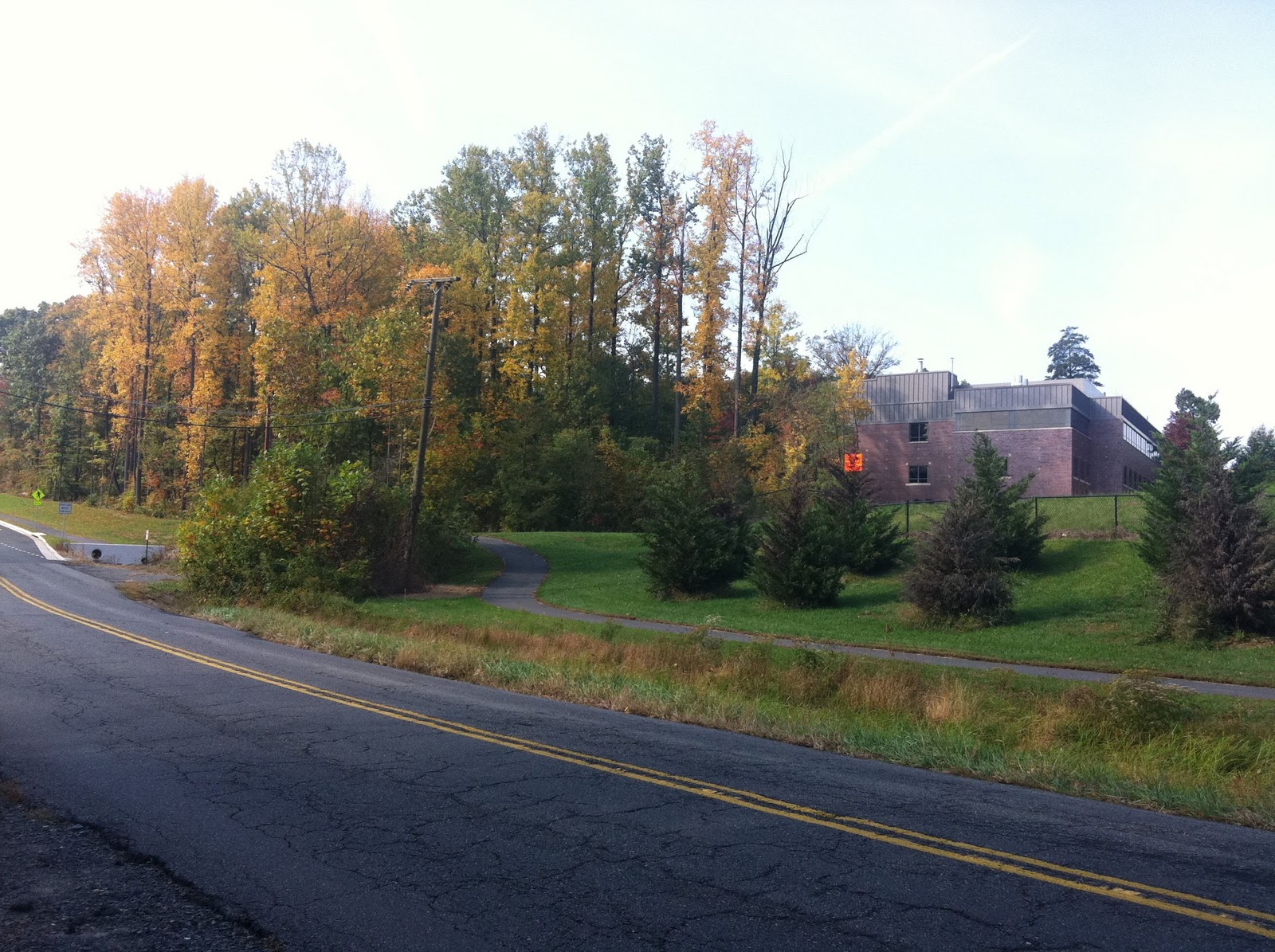
We’re in the middle of Fall here and the DC area is really almost at its very best. Here’s a view of the new laboratory wing of the Institute with the glass cube great room concealed behind a carpet of tulip poplar yellows. Roberts Road in the foreground represents the eastern boundary of the campus which extends far to the west of the Krasnow Institute for Advanced Study.

Just how smart was Archimedes?

A terrific piece by Mary Carole McCauley in the Baltimore Sun, here. For those with a love of both archeology and mathematics.

Money quote:

Thus began a search for buried treasure — in this case, the lost writings of Archimedes of Syracuse, a famed Greek mathematician and inventor who lived in the third century B.C.
Noel and his boss, museum director Gary Vikan, found a 174-page book made of cured goatskin that was ugly beyond belief. The sheaves were singed around the edges, the text and pages were defaced by water stains, and mold had eaten away entire sections.

Syracuse University, the Chronicle Debate Continues…

The Syracuse story began to play out in the Chronicle two weeks ago with Robin Wilson’s piece here. Today, Eric Hoover’s response is here.

As Syracuse is one of our official university peers, I’ve been following this story quite closely.

At question is the leadership style of President Nancy Cantor and her strategy to connect the University more closely with its community. Hoover’s response is specifically aimed at questions regarding the new strategy and I have to say it makes sense: over the long haul, given that the majority of Syracuse’s student body are going to be coming from its region in upstate New York, it makes sense to develop the caliber of those students.

The underlying assumptions are that the “out of state” competition is going to get tougher and that Syracuse wont be in a position to win that competition against other national schools (such as the place where Cantor was provost, Michigan).

Syracuse recently “voluntarily” stepped down from the prestigious AAU. I wonder to what extent there is an inter-relationship between the two stories.

University of Maryland’s Center for Complexity in Business

The Center had its third annual complexity in business conference today here in DC and it was excellent. The keynotes were delivered by Felix Reed-Tsochas and Uri Wilensky. The breakout talks that I saw were uniformly excellent.

It’s great to have two excellent complexity centers (including our own) here in the National Capital Area.

Pearson and Google taking on Blackboard?

From the Chronicle, here. As I mentioned in a recent post, I’m getting geared up to use Facebook for the course I’m teaching next semester. But these two companies collaborating are going to present a real challenge to Blackboard.

From my viewpoint, the key advantage to using Facebook to teach is that there is virtually no learning curve for your undergraduate students and very little for faculty.

But we’ll see….

Biowarfare threat to the US–latest report

From ScienceInsider, the news blurb is here. The report card is from the bipartisan, WMD center. The conclusion is not positive.

I would simply add that in the decade since the anthrax attacks here in the US, the cultural memory has dimmed a bit, with societal anxieties now centered on the economy.

PBS’s Frontline series recently featured The Anthrax Files in collaboration with Propublica and McClatchy. One of my close colleagues and I were discussing the remaining uncertainties about the case yesterday at the Cosmos Club.

Keep calm and carry on, I suppose.