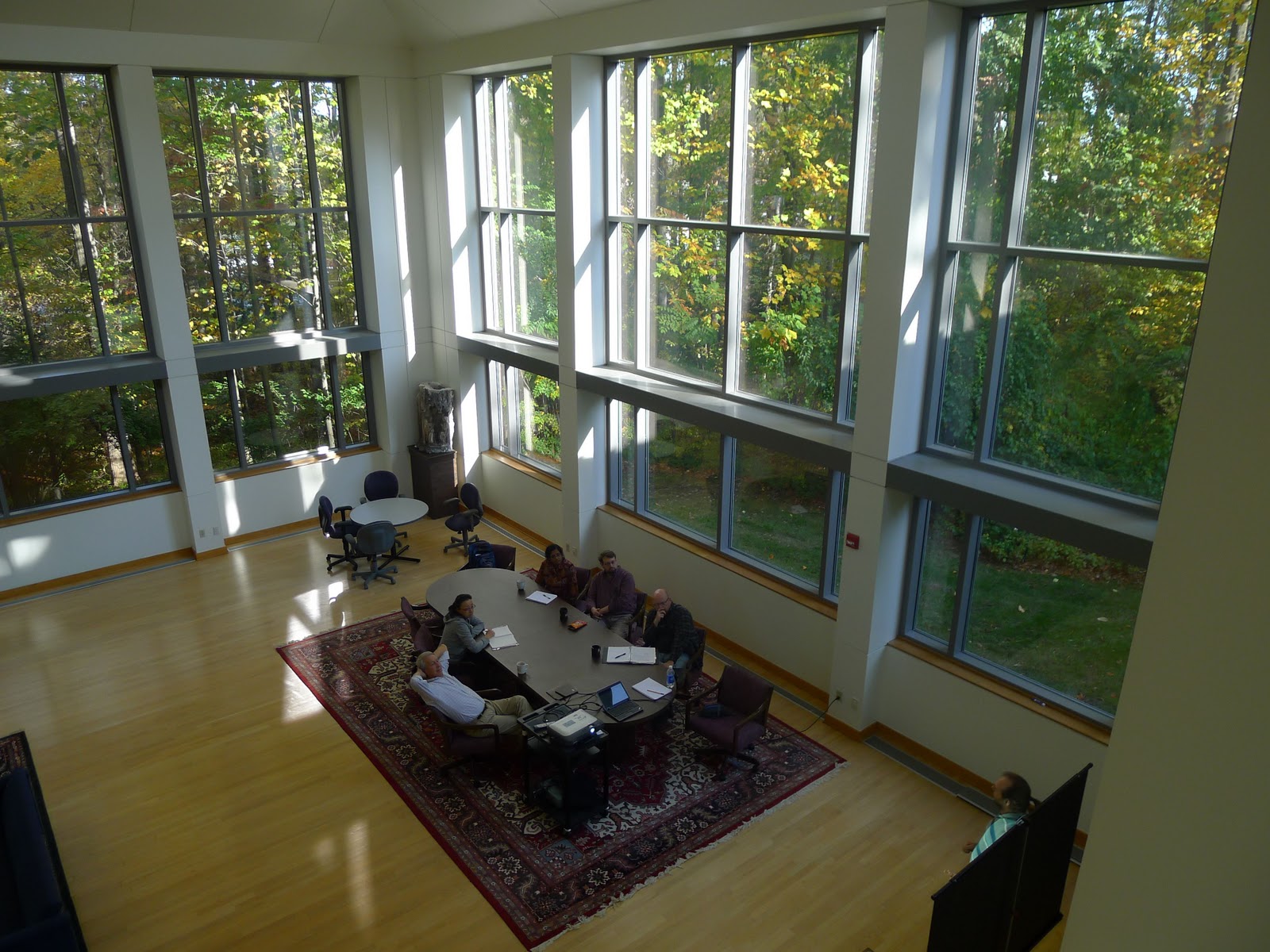
Informal seminars

One of the very nice aspects of our scientific life at the Krasnow Institute are the informal talks that occur pretty much every day. I took this late afternoon photo yesterday. It looks like our Adaptive Systems Laboratory group under Professor Ken De Jong are getting together.

As Director, one of the great joys of my job is to learn a bit about all of the research that goes on here. And it’s quite a span, ranging from origin of life to origin of the 2008 financial crisis.
Sometimes a great seminar

Krasnow celebrated the 400th Monday seminar talk yesterday with one of the best I’ve ever seen: Elly Nedivi from MIT presented some of her terrific chronic in vivo imaging of individual neuron dynamics and showed pretty clearly what modern neuroscience can achieve.

One of her key enabling collaborators, Peter So is the brother of our own Krasnow faculty member, Paul So–small world networks!

Paul Allen Smackdown of the Singularity

From Technology Review, hat tip Andrew Sullivan: here. Bottom-line, the “complexity brake” will arrest our acceleration towards Kurzweil’s Singularity.

And the argument has as its basis, the complexity problem as far as a general theory of neuroscience is concerned.

Since I don’t share Kurzweil’s rosy vision of his Singularity, I’m pleased. In addition, this should keep us neuroscientists employed well into the future.

Proposed merger of University of Maryland campuses

The proposal to merge the College Park campus with the Law School and Medical School in Baltimore is reported in the Chronicle here. It’s being strongly opposed by Baltimore City interests, but it certainly would increase the prestige of the university. It also makes sense thinking in the longer term about whether Mason or Maryland will be the dominant public research university in the National Capital Area.

So, as an ardent Mason supporter, here’s hoping that the folks in Baltimore are successful.

Stuxnet II is out there….

From Wired Magazine, this excellent portrait of DuQu. Bottom line: it’s doing active reconnaissance  on cyber systems and it’s as sophisticated as Stuxnet. The implication of the article seems to be the DuQu is setting up for a future cyber attack, learning about specific systems architectures and transmitting that information…somewhere.