
Kudos to the film location, Caltech, where I was a faculty brat and got to watch this play out in real life!
MICKI–Microscopy Imaging Core of the Krasnow Institute
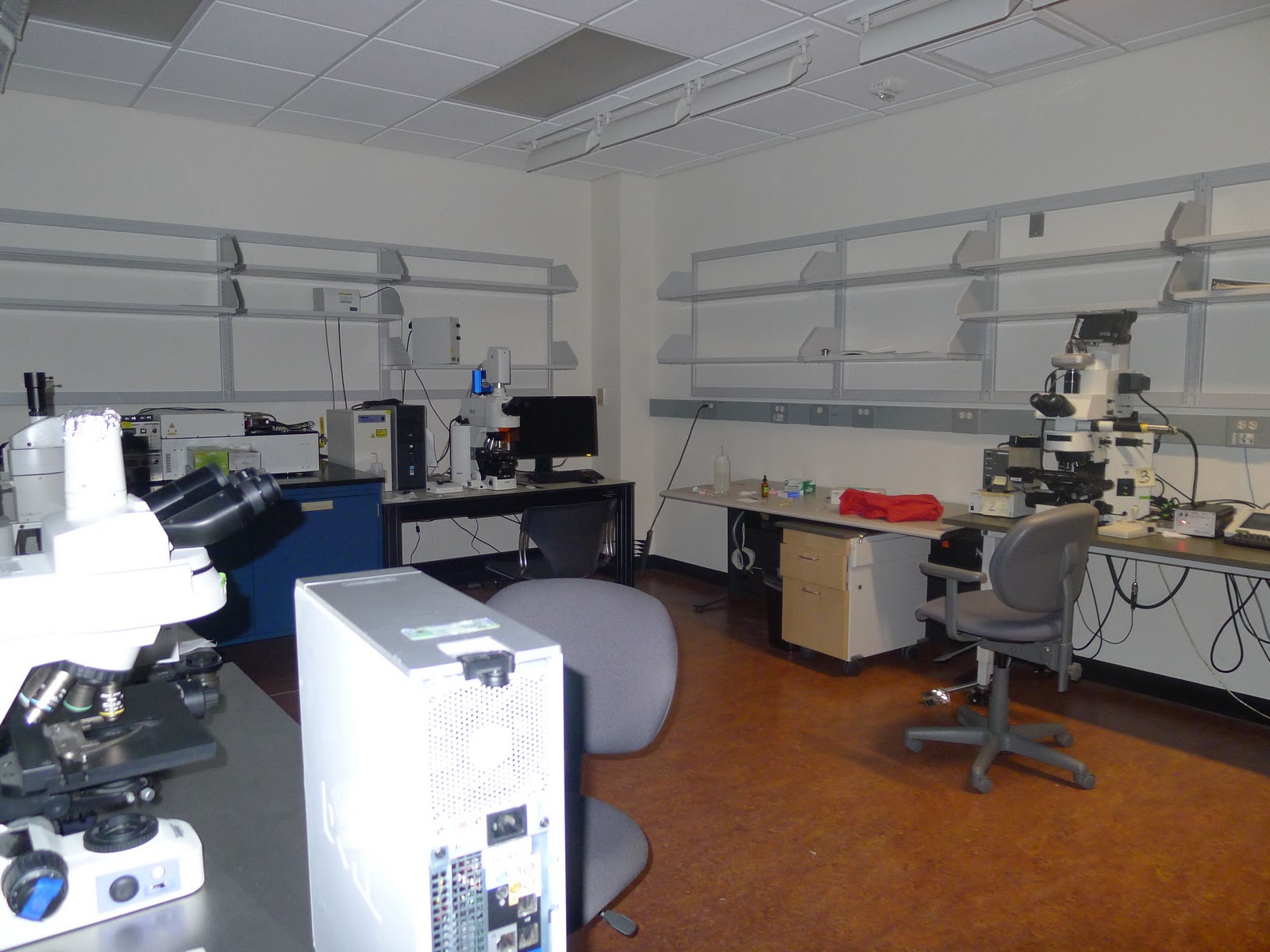
Just opened in our new space. Our cellular imaging core. The facility is already being used extensively by several of our neuroscience labs, but it’s available for other interested investigators in the Washington D.C. area and includes confocal microscopy.
Cellular imaging is a complement to our existing non-invasive human brain imaging capabilities here at Krasnow. In my own research, I’ve used confocal microscopy to image in vivo, the translocation of protein kinase C following sea urchin egg fertilization. Here at Krasnow, cellular imaging is used for a variety of neuroscience models ranging from drosophila (fruit fly) to mouse.
For those interested in using MICKI, please just drop me a line.
The difficulties of the Eurozone…
The current challenges in the Eurozone have the potential to reach far out into global science, certainly beyond Greece and even beyond the EU. The reason is simple: Europe plays a central role in many “big science” initiatives (the obvious ones of course in particle physics and astronomy). But the EU also supports an enormous amount of very high caliber research in the life sciences through its Framework funding initiatives.
Above and beyond the funding of science, there’s also a critical mass of top notch scientists in Europe and the tendrils of their collaborations reach around the globe.
So we wish our colleagues across the Atlantic the best. All of science has a vested interest in the current Eurozone crisis being resolved positively and promptly.
Cultural neuroscience
This is a potentially very controversial term that I first learned about in Singapore, about a year ago. The notion is that culture has the ability to affect our neurobiology. This is not so far off from the question Nicholas Carr as asking a bit back–can Google make us stupid? Clearly, there’s a valid line of research on adult brain plasticity driven by our environment. My own research and that of many other colleagues completely supports this idea.
The above intriguing idea is whether a culture, in the anthropological sense, has the ability to influence brain connectivity above the between- and within-subject variability of a population?
Putting it another way, given the fact that any two of us (from the same culture) have differently wired brains, can our shared culture influence both of our brains in some measurable way that rises above the threshold of natural variance in the cultural group to which we both belong?
My gut sense is no. But as far as I can tell, there is no data out there to make a scientific case upon, one way or the other.
Note above all, that this is not the same question of whether population genetics can influence brains. Although without a doubt culture is an emergent of many brains, and the instruction manual for constructing those brains is in our genes.
But to learn more, next June in Ann Arbor….
Another terrific piece of Science from the Mosers
In the October 13 issue of Nature, here is the abstract. If you don’t have access to behind the firewall, the basic finding is a flickering of place field representation in the hippocampus when the spatial environment of the animal is shifted (teleported to use their word) instantly. This supports the notion that the collection of place field representations connected with a particular spatial environment represent neuronal attractors.
Enjoy!
Where are you?
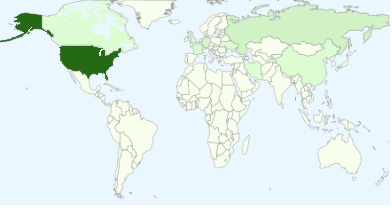
Here’s a map from Google analytics on where you are. A lot of our readers are, of course, here in the United States but you are also in Russia, China, Europe, Canada and Iran! Thanks for your continuing interest in Advanced Studies and the Krasnow Institute for Advanced Study at George Mason.
David Barash on Chalmer’s Hard Problem…
He’s a professor of evolutionary biology and psychology at the University of Washington. You can find his take on where we stand with current neuroscience here.
Overall, I agree with him.
No, we’re not yet at Mind Reading
This perhaps overly excited piece in the Economist got my attention. At it’s root are a series of studies that have come out over the past several years where machine learning has been used to “recognize” the signatures of concepts (like nouns) from many fMRI scans. Tom Mitchell’s work at Carnegie Mellon comes to mind.
While these are indeed exciting studies, the notion that we’re somehow at the threshold of ubiquitous “mind reading” and deception detection strikes me as far fetched. As an example, the concept of “banana” can surely be found in either an individual’s ground truth or a lie. While we might be able to pick out the brain activity signature of banana in both, we’d really have a great deal of difficulty figuring out which context was the lie.
Mentoring students in science soft skills
Yesterday I mentioned how European and North American science are joined at the hip. To walk around the Krasnow Institute, this is clear. Our students and faculty are truly international. And yes, that includes the rest of the world besides the EU, Canada and the United States. But I’d like to focus on one lacuna in how we handle advanced scientific training, both here and abroad:
Part and parcel of doctoral education here at Mason is training in the “soft skills” necessary to professionally succeed in science as it’s practiced here in the US. This includes grantsmanship aimed at US funding agencies such as NSF or the NIH. Crucially, we don’t, in general offer such soft skills for the European system (e.g. Framework 7).
By the same token, in my visits to Europe, I’ve noticed a complementary absence of such soft skill training for US sponsored research sources.
None of this would make much of a difference except for the fact that both here and in Europe, the trainee pool includes doctoral students and postdocs from everywhere. Hence, the New Yorker, I met briefly on one of my recent trips to Europe, will have a difficult time applying for her first NIH RO1 if she returns to the US. And our European trainees, while adept at preparing specific aims, intellectual merit and broader impacts (hallmarks of US NIH and NSF grant applications), will be in the dark as far as applying for EU support from Brussels.
This problem is even more acute for students from places other than the EU and North America. Simply put, we must train our students to succeed as scientists where ever they chose to put down roots.
Funding science: imagining the future
One of the problems with modern scientific inquiry is that it’s inherently costly, both in terms of labor and instrumentation (to say nothing of consumables like reagents). What that means in terms of the modern global economy is that cutting edge science, as it is currently funded, is difficult to sustain during times of economic crisis. Societies have a tough enough time taking care of basic needs. The fuzzy promises of science, where deliverables are really never honestly predictable, take second seat to jobs, food, energy and defense–even though all of these basic needs really depend on science and technology.
Really this problem is another version of humankind’s difficulty with the “discount curve”. I’d rather have my loaf of bread today than two loafs one year from now.
Nevertheless, long term human success as defined by access to basic needs, economic success, and having a high quality of life are quite constrained by our scientific success. For example, until we find a cure for Alzheimer’s disease, we will be spending an increasingly larger piece of the pie on chronic long term health care as we live longer. Those are resources that could be deployed quite usefully in other areas.
Similarly, with 7 billion human inhabitants of Earth, and the probable need to adapt our agriculture to climate change, we will need something beyond the “green revolutions” of the 1960’s to supply food, even at the current levels. To get the multitudes in developing nations out of poverty is an even greater challenge. Those advances will need to come from science.
Some major scientific challenges are currently internationally funded. These include large scale physics and astronomy, antarctic research and some energy projects.
In contrast, certain areas of science are not only underfunded (for example given the sheer size of the potential loss from global economic collapse, economics as a field is clearly underfunded), they are also funded in national isolation, with one country potentially duplicating the research activities of another.
Given how closely tied European science is to North American, it’s often quite astounding to me how many barriers exist to pooling funding resources across the Atlantic. These barriers are fractal in nature because they have similar characteristics at the very large scale all the way to the micro-level where individual university PI’s collaborate (or try to).
We have the WTO, IMF and World Bank to handle the challenges of globalism as far as trade and finance go. We have nothing comparable in firepower (size of the bazooka to use the current terminology) for international science–particularly as far as biomedical, and small-scale basic science is concerned.
We need it.
How might it be funded? Recently the notion of a Tobin, or transaction tax, has been floated as a way to avoid another Lehman Brothers Fall (referring to Fall 2008, but also a mighty economic fall). I’d prefer to see something like a global Tobin tax to fund science, across the globe. Not only might such a financial transactions tax reduce global volatility. It might also provide the bazooka to sustain science stably in an increasingly multipolar, unstable world.
 Discoverers and Discoveries