
To each and everyone, but especially our own here at the Krasnow Institute. Thank you for your service.
The Chronicle weighs in on Penn State…
With an excellent in-depth article on governance and the danger of insularity. It’s here. The money quote comes at the end from an emeritus professor:
“I’m not surprised Penn State has a tendency to cover things up,” he said. “We almost never fire anybody here. We just change their job descriptions.”
MASON
This time not referring to the University, but rather to our own homegrown and widely used java-based simulator for agent based modeling. You can find it here. The link has great simulation demonstrations that you can watch in your browser.
What does MASON stand for as an acronym?
From the web site:
” Multi-Agent Simulator Of Neighborhoods… or Networks… or something… “
Saturation of neuro news
In this week’s run up to the Society for Neuroscience meetings here in Washington, the twitter feeds and blogosphere are saturated with the latest, greatest neuroscience findings. It’s really exciting, but loyal readers are going to be able to find those nuggets with ease.
If I see a real hidden gem at the meeting, I’ll report on it of course.
In the meantime, perhaps this is the week for Advanced Studies to turn its attention to other fields of scientific endeavor. From the West Coast comes the news that West Hollywood will become the first US city to ban the sale of fur. You can read about it here.
On Crocodile Brains….
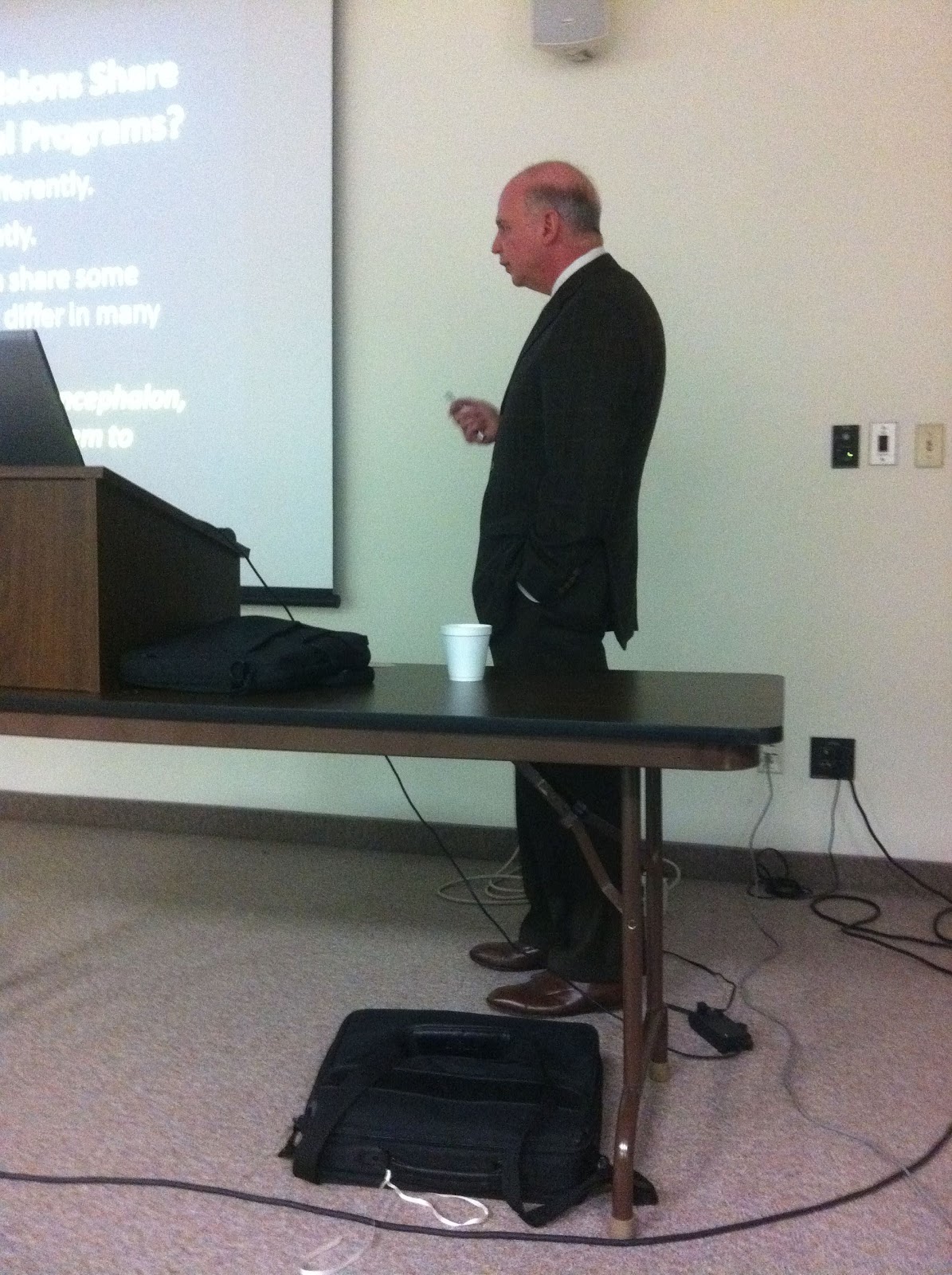
Michael Pritz of Indiana University School of Medicine gave yesterday’s regular Monday Krasnow seminar and it was fascinating. The basic questions were at the intersection of evolution and development (in biology we call this “Evo-Devo”) and basically got to the question of what are the points in the development of a brain that evolution can act upon through selection to produce new species with new brain capabilities.
Pritz’s experimental animal is the croc. Turns out crocodiles are very closely related phylogenetically to birds and….birds have remarkable cognitive capabilities with brains that have a radically different architecture from our own mammalian variety.
Evolution remains central to the scientific explorations at the Krasnow Institute for Advanced Study. Our impressive brains –the human ones in our heads–are themselves the product of evolution and hence, for all their amazing capabilities, have plenty of bugs. They weren’t engineered after all.
Creative Commons License: Advanced Studies

Advanced Studies by James L. Olds is licensed under a Creative Commons Attribution-NonCommercial-NoDerivs 3.0 Unported License.
Based on a work at krasnow.blogspot.com.
The opinions in Advanced Studies do not represent the official positions of George Mason University.
George Pierson’s M-Factor in American History
The famous Yale historian proposed it a half-century ago: movement, migration and mobility. He saw it as key to the American character. Now we see all the atrophying of all three during this Great Recession.
Hat tip to Andrew Sullivan, here’s a paper from The Hamilton Project that proposes a “mobility bank” to assist Americans in moving–as they once did routinely to find better opportunities.
Money quote:
Whereas those with college degrees and savings are much more likely to move in response to job loss and to improve their job market outcomes, those with less skills and no savings may have difficulty financing such transitions. The government should target mobility bank loans toward displaced, unemployed, and underemployed people in depressed areas of the country and should help to insure people against job-outcome uncertainty by making repayment terms contingent on the borrower’s post-move employment and income.
Society for Neuroscience meeting here in DC
The great gathering of neuroscientists occurs this week, starting Saturday. This year, here in Washington D.C. An occasion when the excited young crowd on your Metro train are mostly carrying those cylindrical scientific poster containers that loop over the shoulder. Such a contrast from the usual dour look of our commuters as they anticipate the escalators being out of service wherever they are going.
I’m looking forward to seeing some new science, old friends and new instrumentation.
And I do hope that the escalators will work for once….
The State of the American University
Anthony Grafton in the New York Review of Books reviews eight serious books on the current state of US higher education here.
Money quote:
Yet American universities also attract ferocious criticism, much of it from professors and from journalists who know them well, and that’s entirely reasonable too. Every coin has its other side, every virtue its corresponding vice—and practically every university its festering sores. At the most prestigious medical schools, professors publish the work of paid flacks for pharmaceutical companies under their own names. At many state universities and more than a few private ones, head football and basketball coaches earn millions and their assistants hundreds of thousands for running semiprofessional teams. Few of these teams earn much money for the universities that sponsor them, and some brutally exploit their players.
Nevertheless, aspirants from the entire world still gravitate here. Why? I’d like to think it’s because US colleges still offer a combination of the potential for real upward mobility along with the ability to chart one’s own curricular course.
Pakistan’s nukes
The Atlantic and National Journal collaborated on an excellent piece of investigative journalism. Here’s a link to National Journal, although possibly behind a pay-wall.
Bottom-line: a very detailed description of what de-nuking Pakistan might entail.
 Discoverers and Discoveries