Erin Shuman steals the SFN11 show today

With an absolutely spectacular talk about her work on local control of protein synthesis and degradation in neurons. More here.

I thought the most provocative idea she put forward was the notion of local control of protein synthesis in axons as well as dendrites…and that these local loci may be a lot more important than just governing plasticity.

It’s great to see neuroscience taking the next steps towards becoming a mature field.

Neurolaw #SFN11

Yesterday’s big show was the Neuroscience and the Law symposium. Here is a good summary. Most interesting work was Abigail Baird’s–she’s at Vassar College: teenagers apparently get themselves in trouble by too much engagement of their prefrontal cortex rather than trusting their gut (amygdala and insula). That’s completely counter-intuitive to me because I have always viewed the prefrontal cortex as pretty much the last part of the brain to “get wired up” during human development. Her thesis: too much analytic/executive engagement of prefrontal cortex leads to potentially flawed logical decisions (perhaps especially when we haven’t had a lot of experiences) and too much sensitivity to peer pressure.

Technologies and asking scientific questions

It’s very interesting to me that with each wave of new technological innovation there is a corresponding wave of deployment into scientific instrumentation. And that new wave of scientific instrumentation makes possible a whole slew of new zeroth order questions for investigators to ask.

The key is to recognize the new waves when they happen and then to figure out what basic new questions they allow us to ask at the laboratory bench.

What will be the next follow on to fMRI in functional brain imaging?

A tree is like a neuron–especially after the leaves come down…

The wind is really blowing hard today and the leaves are flying off the limbs. Looking out my office window I already see lots of bare limbs, which day by day, take on the look and feel of apical pyramidal cell dendrites–this is appropriate for SFN11 week here in DC.

I feel bad for the 40,000 neuroscientists who are streaming in to DC as I write these words, only to find that Metro is on a weekend schedule because of Veterans Day (20 minutes between trains). Hope they all brought coats. It’s cold.

Some suggestions for our students, for whom this may well be their first meeting:

Concentrate on the poster sessions and focus with laser attention on the subset in your own area of work. This task alone, will, if done properly, take up the bulk of your working time at the meeting.

Tag along with your mentor, as much as she or he, will allow and observe how networking happens. If you’re lucky, you may end up being introduced to your next boss!

When socializing, especially early in the evening, don’t party too hearty. You don’t want to wake up to your picture on Facebook. And you don’t want to fall into your soup.


Time Running out for the Super Committee

The effects on science and technology funding here in the States could be devastating. Here is the latest from Science Magazine.

My own take is that the Committee will, in fact, probably fail. But the mandatory cuts wont go into effect until Fiscal Year 2013, after the general election. With a new Congress and potentially a new Administration, the law certainly can be rewritten and probably would be.

The central point here is that science funding falls into the category known as discretionary (I know, Beltway-ese). Cuts in discretionary funding wont really do anything substantive to the budget deficit issues. For cuts to be meaningful, as far as the national debt and the deficit, they would need to be in the category called mandatory. Medicare and Medicaid are in this category–and health care is the elephant in the room.

MASON

This time not referring to the University, but rather to our own homegrown and widely used java-based simulator for agent based modeling. You can find it here. The link has great simulation demonstrations that you can watch in your browser.

What does MASON stand for as an acronym?

From the web site:
” Multi-Agent Simulator ONeighborhoods… or Networks… or something… “


Saturation of neuro news

In this week’s run up to the Society for Neuroscience meetings here in Washington, the twitter feeds and blogosphere are saturated with the latest, greatest neuroscience findings. It’s really exciting, but loyal readers are going to be able to find those nuggets with ease.

If I see a real hidden gem at the meeting, I’ll report on it of course.

In the meantime, perhaps this is the week for Advanced Studies to turn its attention to other fields of scientific endeavor. From the West Coast comes the news that West Hollywood will become the first US city to ban the sale of fur. You can read about it here.

On Crocodile Brains….

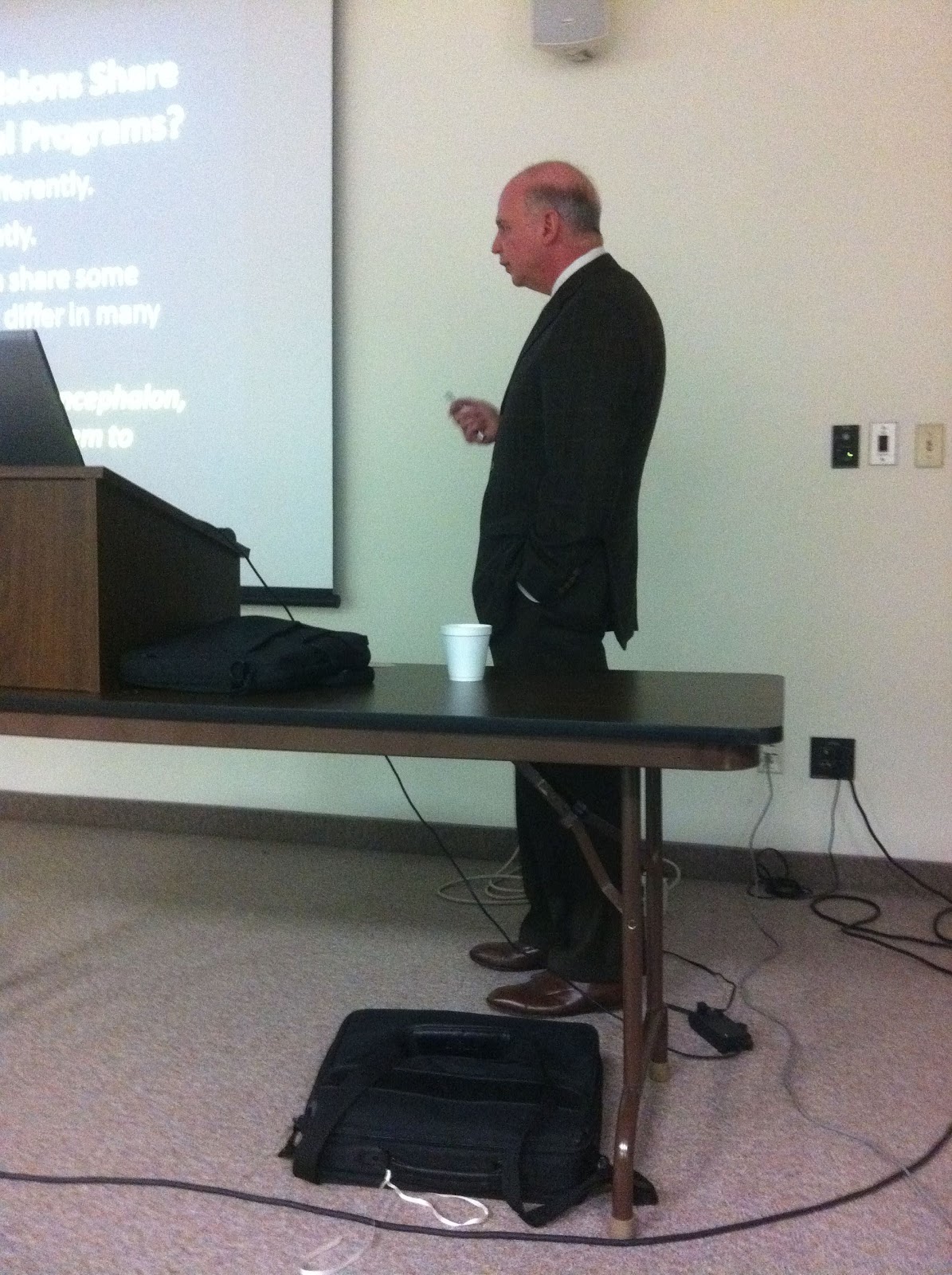
Michael Pritz of Indiana University School of Medicine gave yesterday’s regular Monday Krasnow seminar and it was fascinating. The basic questions were at the intersection of evolution and development (in biology we call this “Evo-Devo”) and basically got to the question of what are the points in the development of a brain that evolution can act upon through selection to produce new species with new brain capabilities.

Pritz’s experimental animal is the croc. Turns out crocodiles are very closely related phylogenetically to birds and….birds have remarkable cognitive capabilities with brains that have a radically different architecture from our own mammalian variety.

Evolution remains central to the scientific explorations at the Krasnow Institute for Advanced Study. Our impressive brains –the human ones in our heads–are themselves the product of evolution and hence, for all their amazing capabilities, have plenty of bugs. They weren’t engineered after all.