
Colleague and friend, Tyler Cowen’s book, The Great Stagnation, is reviewed by one of my favorite FT columnists here. I don’t find TGS nearly as depressing as Martin Wolf: when the next version of the Industrial Revolution comes along, things will get better.
Those Apollo 11 Space Suits….
Rosten Woo’s terrific review of Nicholas de Monchaux’s new book, Spacesuit: Fashioning Apollo is here.
Spoiler: apparently no support for conspiracy theorists who think NASA staged the landing somewhere in Houston.
Publish in high "retraction rate journals"….
From Bjorn Brembs via the London School of Economics site, here. Turns out that if you’re encouraged to publish in high impact factor journals, you’re also being encouraged to publish in high retraction rate journals.
Money quote:
This already looks like a much stronger correlation than the one between IF and citations. How do the critical values measure up? The regression is highly significant at p<0.000003, with a coefficient of determination at a whopping 0.77. Thus, at least with the current data, IF indeed seems to be a more reliable predictor of retractions than of actual citations. How can this be, given that the IF is supposed to be a measure of citation rate for each journal? There are many reasons why this argument falls flat, but here are the three most egregious ones:
- The IF is negotiable and doesn’t reflect actual citation counts (source)
- The IF cannot be reproduced, even if it reflected actual citations (source)
- The IF is not statistically sound, even if it were reproducible and reflected actual citations (source)
In other words, all the organizations that require scientists to publish in ‘high-impact journals’ at the same time require them to publish in ‘high-retraction journals’. I wonder if requiring publication in high-retraction journals can be good for science?
The internet in your Fridge
There’s a Samsung ad out there along those lines.
Here’s a piece from today’s NY Times on how sensors married up with the Net are making for some pretty cool technology. I’m waiting for the sensor in the cat box to activate the cat box cleaning robot.
Christopher Hitchens RIP
A really top notch writer and debater has passed. His Financial Times obit is here. Christopher Buckley’s New Yorker obit is here. Over the years, I always admired his ability to use reasoned argument as a means to advance his views–as opposed to tired emotional screeds that are all too common, especially in the blogosphere. So we’ll miss his voice.
Bright people those Mason neuroscience grad students…
I got to watch two of our brightest doctoral students explain some pretty complicated electrophysiology to a VIP visitor today and it was a terrific sight. He was clearly impressed and I think they enjoyed themselves–although I saw they were really hoping he didn’t nudge the prep as he leaned forward to look through the stereo-microscope.
Angel Cabrera
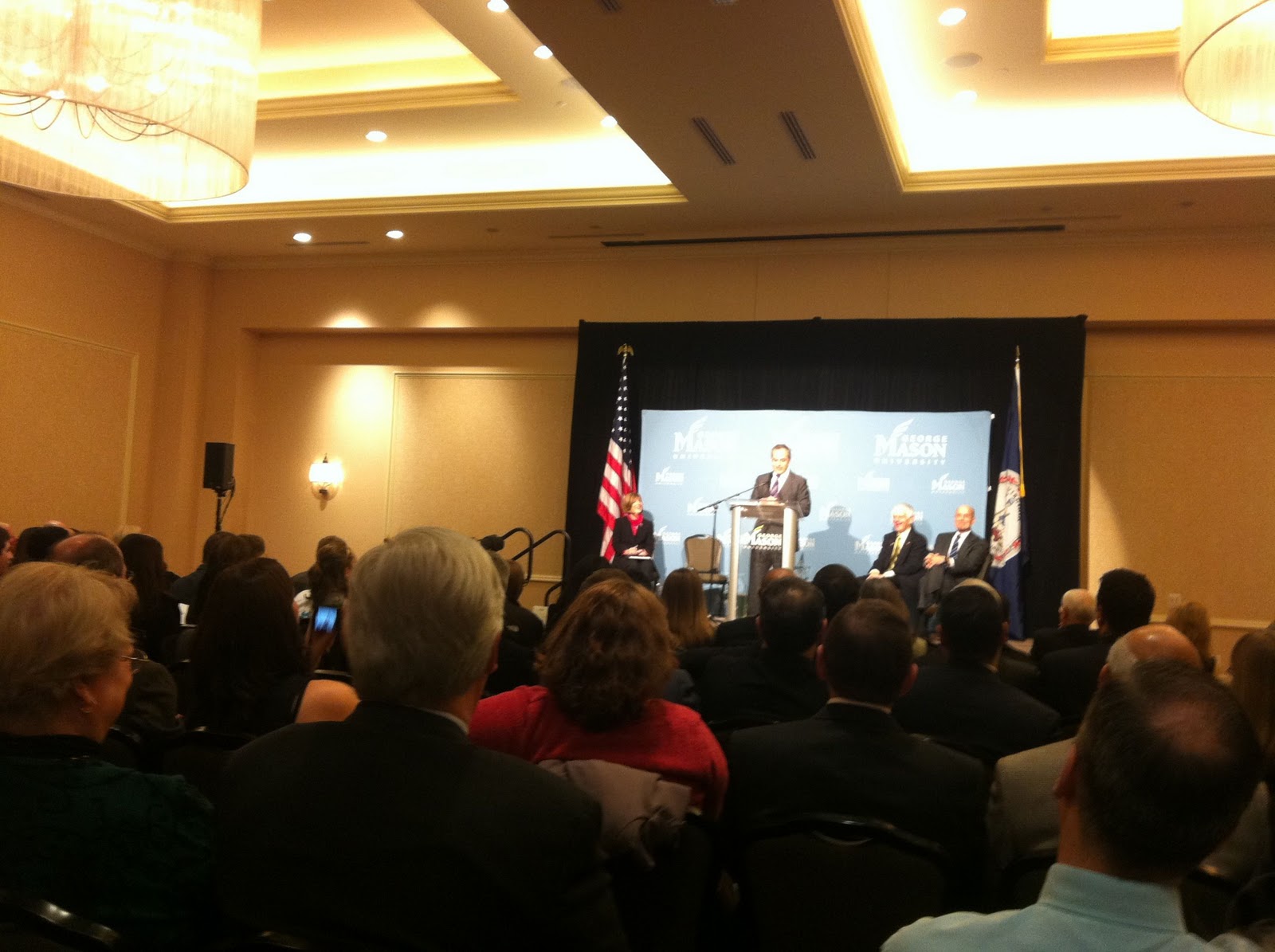
George Mason’s Board of Visitors announced the appointment of Dr. Angel Cabrera to be Mason’s next President in the last hour. The photo is from the press conference that just ended a few minutes ago.
He brings both incredible dynamism and experience to Mason most recently as President of the Thunderbird School of Global Management.
Born in Spain, he trained in Madrid as an engineer and then went on to Georgia Tech to get his doctorate.
Here is a recent You Tube video in which his passion for education is abundantly clear:
Mason will clearly continue its tradition of innovation under dynamic leadership. Dr. Cabrera will take office on July 1 of next year.
Teasers
We’ll be commenting on some major news tomorrow, although after an early morning presser. And then, following an embargo, we’ll reveal a major award to one of our faculty members here at Krasnow. So stay tuned.
Doctoral trainees soft-skills: the transatlantic perspective
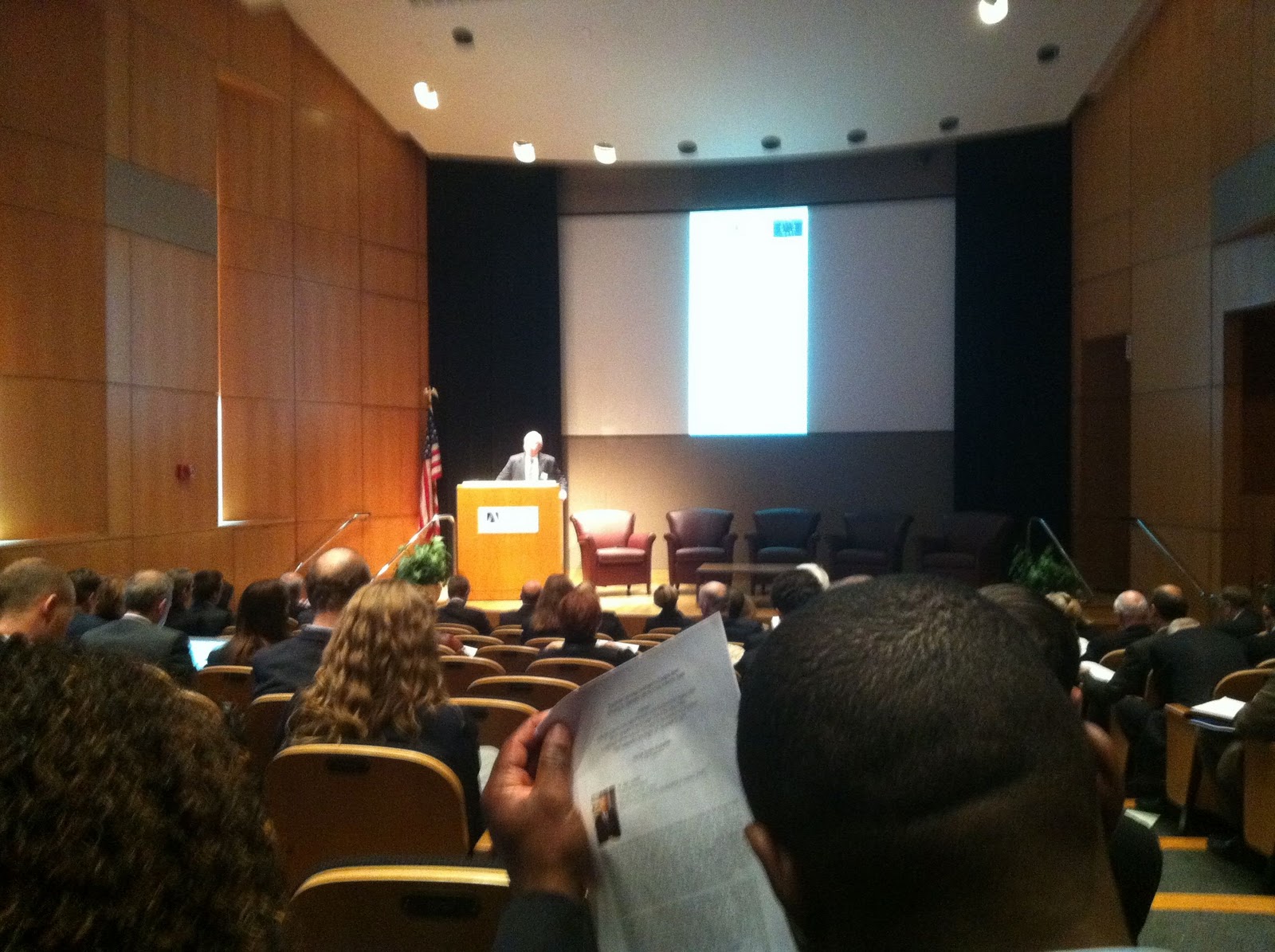
Yesterday there was a terrific conference put on by the Polish Presidency of the European Union at the headquarters of the American Association for Advancement of Science here in Washington.
I had the honor of speaking about a real concern of mine: namely the doctoral students are only trained in the soft-skills (e.g. grantsmanship) of the place where they are receiving their training. So, for example, a doctoral student in neuroscience being trained here in the US, typically doesn’t learn anything about the European Research Council’s “starter grants”–even if that student is European and actually planning to return to Europe post-PhD.
The reverse is also true. What I am advocating for is a plan to create a transatlantic soft-skills curriculum, whereby all doctoral trainees learn something about each system: Europe and the US.
And of course, this could be expanded usefully elsewhere around the world.
Cutting off the patient to save the limb?
The UK will go its own way from the rest of Europe. The Financial Times story is here. Of course, the UK has always been outside the Eurozone, but today’s news feels qualitatively different. The word of course is that David Cameron did this to please his Tory friends in London’s City financial district. Whatever the reason, it strikes me as not particularly good news for those of us hoping for something that will stabilize the markets.
Reuter’s story is here. Money quote:
Cameron’s decision to stay out of the treaty-change camp could spell problems for Britain. Deeper integration on the continent could involve changes to the single market and financial regulation, both of which could have a profound impact on the British economy.
“Cameron was clumsy in his manoeuvring,” a senior EU diplomat said. It may be possible that Britain will shift its position in the days ahead if it discovers that isolation really is not a viable course of action, diplomats said.
 Discoverers and Discoveries