Science Investments…

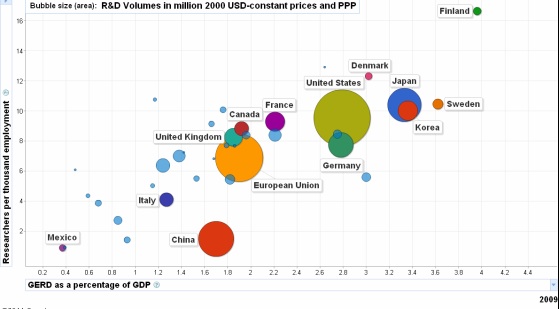
They are something we do here at the Institute level when we buy a new piece of shared equipment, but they are also something a nation does when it sponsors R&D through agency grants programs or through national laboratories.  The below graph (full movie presentation go here) shows 2009 OECD data for researchers per 1000 employees (y-axis) versus National R&D as a percentage of GDP (x-axis). The bubble size adds a third dimension: non-normalized national R&D. What jumps out pretty clearly is that Finland is investing in science at a very high level. And, that the US, if one normalizes by either population or GDP isn’t the leader.
Although the public often sees these investments through the lens of the deficit, the larger context is a nation’s ability to grow its way out of its fiscal problems as opposed to deflation and massive deleveraging. Science investments create the “garden” environment for the next wave of technology revolutions that Tyler Cowen talks about in his recent book, The Great Stagnation.

How is science investment paying off for Finland? Having recently returned from Helsinki, I can report first hand evidence of a vibrant technology start-up community, perhaps Europe’s most healthy economy, and a K-20 education system that is a world-leader. To me those are side-payoffs from the science investment. And they are very important.

However the central payoff from national science investment is the increased probability of a “game changer” discovery that leads to a revolution on the scale of the Industrial Revolution. Because science is serendipitous as far fundamental discoveries are concerned, we can’t forecast them with any accuracy. What we can do is invest as much as possible so that the probabilities of great discoveries go up.

FT’s Lucy Kellaway and aging in place

The Financial Times, Lucy Kellaway has always been a must read for me, particularly her Martin Lukes series, which sadly ended with his fictional death in a parachute jump.

In today’s regular Monday column, here, she takes on a much more serious issue: the rampant unemployment among young highly educated people due to a finite supply of jobs and baby boomers hanging on.

For me, the operative question is to what extent is this state-of-affairs true for academics (generally) and for science (specifically).

There are certainly “aging superstars” to quote from Lucy and she agrees, they should be kept on. The question she is really raising concerns the question of what is best for society: scarce positions for those who are younger and hence command smaller salaries (we could hire more of of them), or viewing experience as “added value”, something to be monetized in the academic labor market.

It’s a very complicated question–at least in academia, less so in professional sports.


Opposing reports on US Shale gas supplies

In today’s NY Times here.

Money quote:

In private discussions, some federal energy officials have raised questions about the way oil and gas companies may be inflating estimates of the amount of recoverable gas.
“The variability of shale gas well performance is crucial to any assessment of the resource potential of a shale play,” Philip Budzik, an Energy Information Administration research analyst, wrote in an e-mail to an industry analyst last April.

It’s larger than that actually. My guess it it’s the same competing political agendas that have complicated the Keystone Pipeline debate and the environmental safety of fracking technologies. That debate is playing out on many levels simultaneously and its outcome will no doubt be important to US Energy policy as it plays out (or doesn’t) over the next decade.

Cost sharing

It’s a requirement of many federal grants and potentially is a deal killer for younger institutions which may not have the resources to pull it off. The upshot of this problem is that institutions which may win awards on pure merit may have to forego competing for new awards with significant cost share. At the same time, institutions with much more massive resource pools, available to be deployed as cost share, have less competition for scarce federal grants. Merit becomes less important as a criterion while institutional resource base becomes more important. The rich get richer.

Now, I’m not saying that rich institutions don’t deserve a lot of grant support purely based on scientific merit. That’s clear; they do. But I’m also worried that newer institutions will have a much more difficult time getting up to speed, as a result of grant cost-share requirements.

It’s time to rethink grant cost share so that newer places have a chance to compete purely on the merits of the science.

Kudos to one of our own: Professor Giorgio Ascoli

Today it was announced that Giorgio Ascoli, already known as a research superstar is also one of Virginia’s best top faculty! The announcement is here.

Giorgio has the title of University Professor at Mason, reserved for the very top faculty and is a member of the Molecular Neuroscience Department here at the Krasnow Institute for Advanced Study.

It’s an honor to count him as a colleague and a friend. Congratulations Professor Giorgio Ascoli!

First day of classes Spring Semester…

It may be foggy and cold here in Washington, but it’s also a day full of anticipation as we begin the Spring (yes that’s the operative word, Spring!) semester here at Mason.

Tomorrow is my first day of teaching in a bit. I’ll be teaching 50 undergraduates in a cellular neuroscience core course. I’m very much looking forward to trying out some new pedagogical ideas….

In the meantime, the first snowdrop blooms are out in our neighborhood. If the winter continues to be as mild as it’s been so far, we should have crocuses within a couple of weeks.

This semester will also be one of transition here at Mason as we salute Alan Merten for a job well-done and welcome Angel Cabrera as our new President on July 1. Change is part of life, no less within the academy. It will be interesting to watch this marvelous place continue to evolve and grow.

Murray’s WSJ essay: Fishtown versus Belmont

In today’s WSJ, a google link is here. The central notion is a new cultural divide and the main statistical results are striking–De Toqueville wouldn’t recognize current America I think. On the other hand, I sure recognize “Belmont”.

Here’s Murray’s money quote:

Over the past 50 years, that common civic culture has unraveled. We have developed a new upper class with advanced educations, often obtained at elite schools, sharing tastes and preferences that set them apart from mainstream America. At the same time, we have developed a new lower class, characterized not by poverty but by withdrawal from America’s core cultural institutions.

The question is what to do about it?  Murray and I agree, doing nothing isn’t a reasonable option. Where we disagree is whether voluntary behavioral changes from members of his “new upper class” will improve things. I don’t think so because the feedback loops that are driving “Fishtown” down are endogenous to Fishtown (as he points out, there isn’t a lot of mobility).

Am inclined to take a really hard look at educational reform (writ large) instead. The work is with the younger generation of Fishtowners.

More art at the Institute….

The latest additions to the Institute’s art exhibits…as part of an exchange between Mason and Sichuan Normal University in China. These wood cuts are the work of Professor Silou Xiang….

I am particularly struck by the way these human faces convey emotion, cognition and the process of aging…all relevant to the scientific programs of the Krasnow Institute for Advanced Study.

For those readers who visit the Washington DC area, please do come by and see these new works up close.

Fermi Paradox Discussion continued….

Started yesterday between Tyler and myself by email, now over at Marginal Revolution.

To continue: if we are not in a simulation, then the question of “why the silence“?

Until recently, one idea was that the step from prokariyot (bacteria for example) to eukaryote (us and other complicated plants and animals) was the big filter, but the most recent evidence doesn’t support this notion.

I still think the filter idea might be operative, but at a much later point–when intelligent civilizations acquire the keys to thermonuclear reactions (aka, the bomb). Now we’ve been lucky for about 60 years, but that’s the blink of an eye in cosmological time. I’m not at all convinced that our luck will hold out.

It’s been said that a “Day After Tomorrow” full out nuclear exchange is no longer in the cards, but I recall seeing a Rand study (pdf), that indicated even a single nuclear blast in LA Harbor would be enough to bring down the US through follow on consequences across the economy and geopolitical sectors.

Note added in correction: A reader reminded me that the movie I’m referring to is The Day After…for which I am grateful.