
One of the reasons I love the weekend FT, here. Simon Schama’s absolutely beautiful piece on how The Bard helped create a nation.
Julio Peironcely’s blog….
Bethesda Maryland…
I’m headed for a meeting in Bethesda this afternoon. As many readers know, I was a postdoc at the NIH after I graduated with my PhD from Michigan in 1987. I also lived there for six years at a time before 9/11 when the campus of NIH will still wide-open, more like a college than the federal installation that it is.
NIH (and here I’m referring to the intramural program that has a campus in Bethesda) has faced many challenges over the years and has managed to thrive in spite. It’s a place that structurally facilitates the sort of high-risk, high-payoff research made possible by freeing investigators from the need to constantly be writing new grant applications.
When I was there, the real limit on my research was my own imagination– in stark contrast to the challenges that young investigators often face in the academy.
All of this may soon be at real risk as the US faces the so called “fiscal cliff” next January. The biomedical research at NIH is one of the few government programs that has maintained real bipartisan support over the years since the World War II. The reason is of course, that NIH makes a real difference in the everyday lives of Americans and…that it just plain works.
Yglesias and the debt ceiling debate
He thinks it was a serious blow to the recovery, here. And doing it all over would be a bad thing. Hat tip to Tyler Cowen.
My own sense is that any signal US political structural dysfunction scares the global economy. And the debt ceiling debate was as clear a signal as one might imagine. The key is that when the world’s only remaining superpower shows sign of instability, risk takers run to the sidelines.
Summer is here at George Mason…
The student population is down and so is the traffic. We’re back from the Memorial Day weekend, but the pace on campus is a bit more relaxed. At the Krasnow Institute, the work on the card-swipe system for the front doors, continues….
This week I’ll be at the NSF in Arlington for a panel review. It’s hard work, but always very interesting.
Krasnow Science Retreat Poster Session: Underway
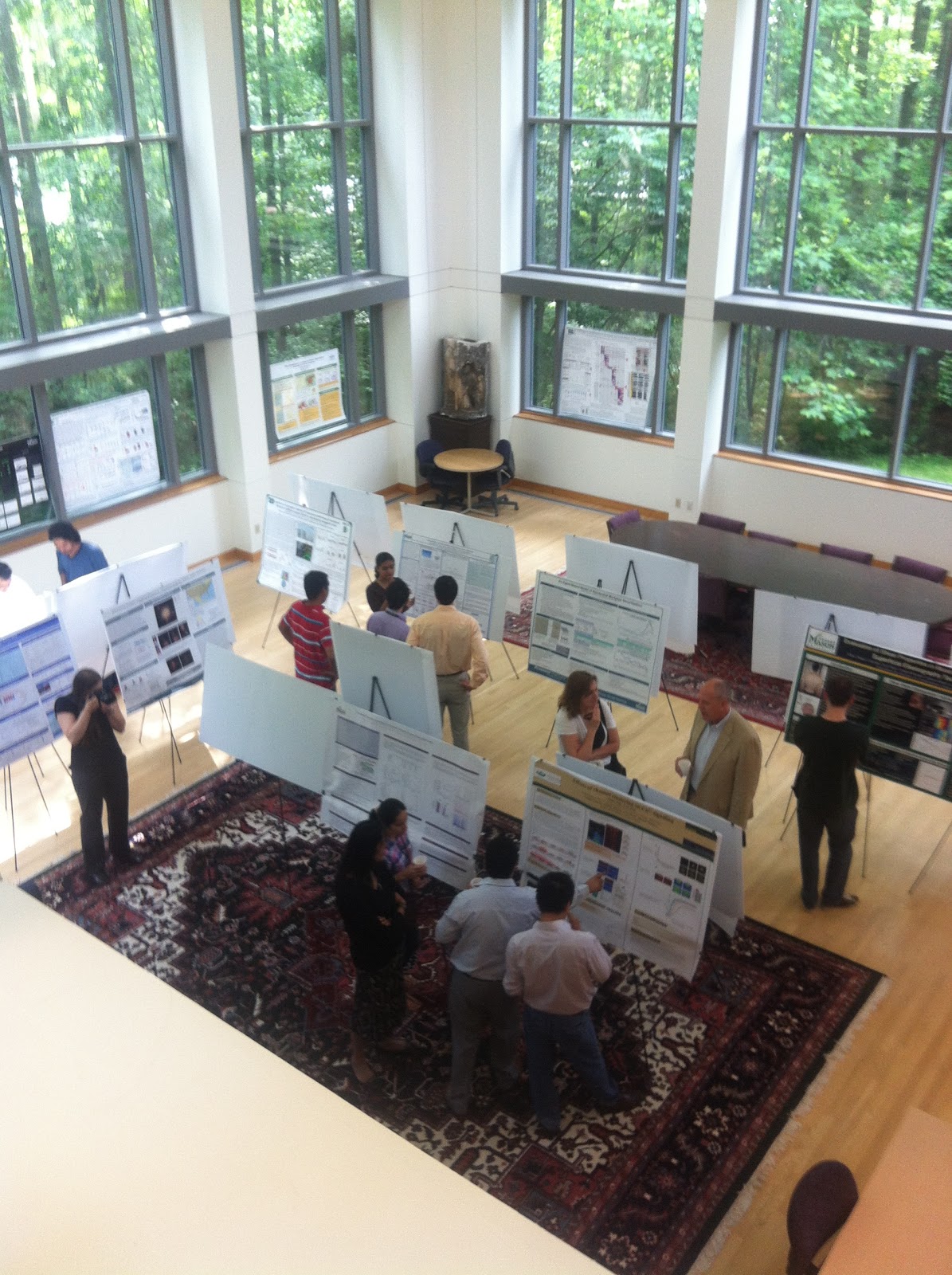 |
| Poster Session at 2012 Krasnow Science Retreat |
Yesterday’s symposium session is now in the books. Today begins with our student poster session followed by the “reveal” on a sculpture of the hippocampal tri-synaptic circuit (several neurons, but accurate down to the spine level) that clearly qualifies as art as well as science. Stay tuned for pictures!
And….(three hours later) here is the reveal:
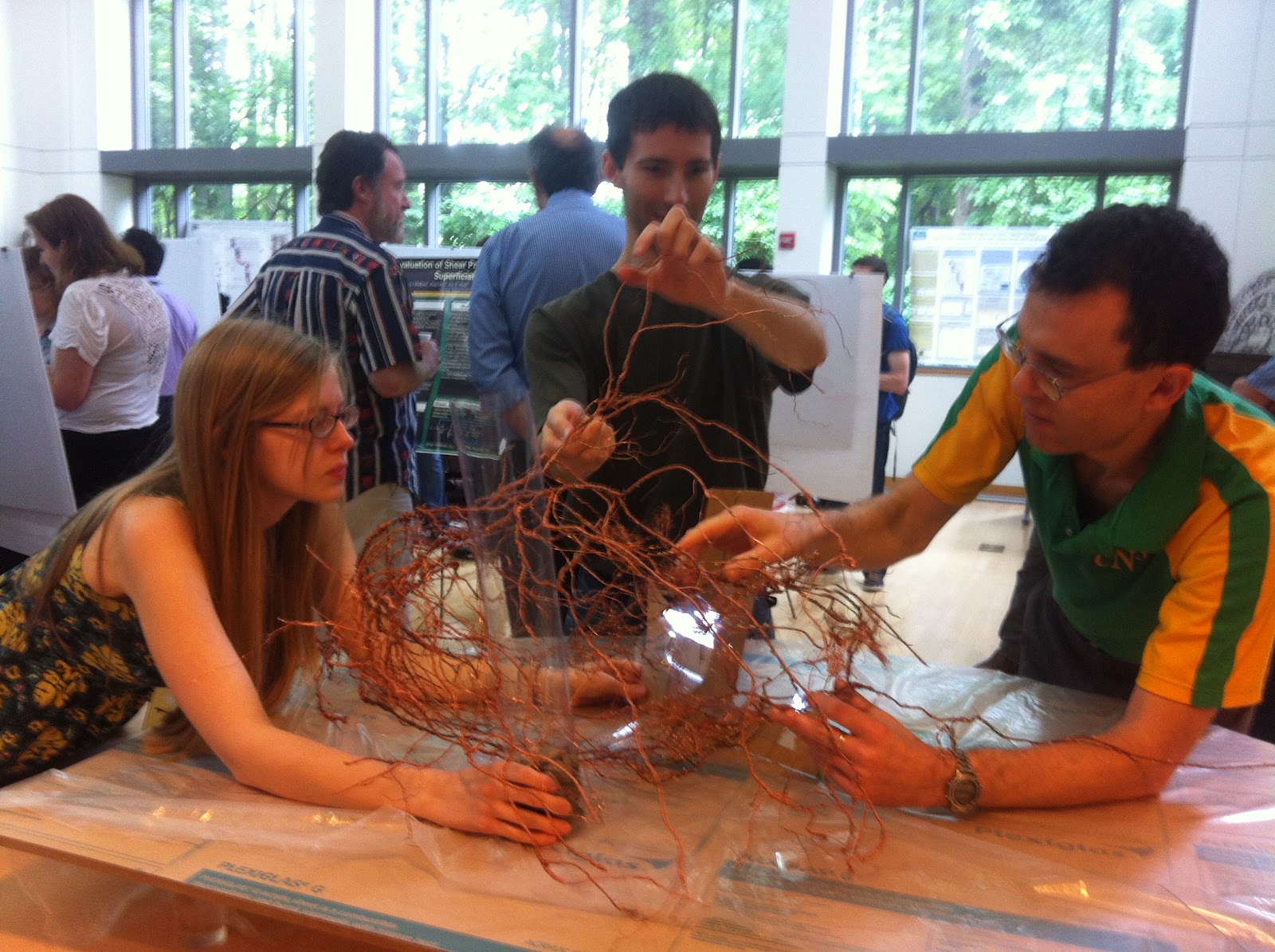 |
| Giorgio Ascoli constructs a very large hippocampal circuit |
The annual science retreat at Krasnow….
Tomorrow, Krasnow Institute faculty, postdocs and graduate students come together for our annual two day science retreat. We come from disparate fields ranging from theoretical physics to computational social science. We have wet lab experimentalists, in silico modelers, brain imagers and behavioral economists–among many others. Our students are pursuing PhD’s in neuroscience, bioscience, computational social science and psychology.
Tomorrow, we “walk the walk” of transdisciplinarity.
It’s very difficult to get into the technical details of disciplines that are different from our own, but it’s surely implicit in what advanced studies are all about. The potential payoffs for the difficult work are immense because–I believe– the big paradigm breaking discoveries, lie at the boundaries of disciplines.
I’ll be live-tweeting the retreat tomorrow with the hashtag #krasnowscience and as will, I imagine, some of our other social networking scientists and trainees. Hope you’ll follow us on twitter.
My TEDx talk on cognitive overload
How exactly are MIT and Ann Arbor going to make money on their MOOC’s?
MOOC of course stands for massively open on-line classes. Elite institutions like MIT and the University of Michigan are throwing some serious bucks that way and it’s time to speculate about their end-game. Read Jeff Selingo’s take on it here.
Commencement 2012
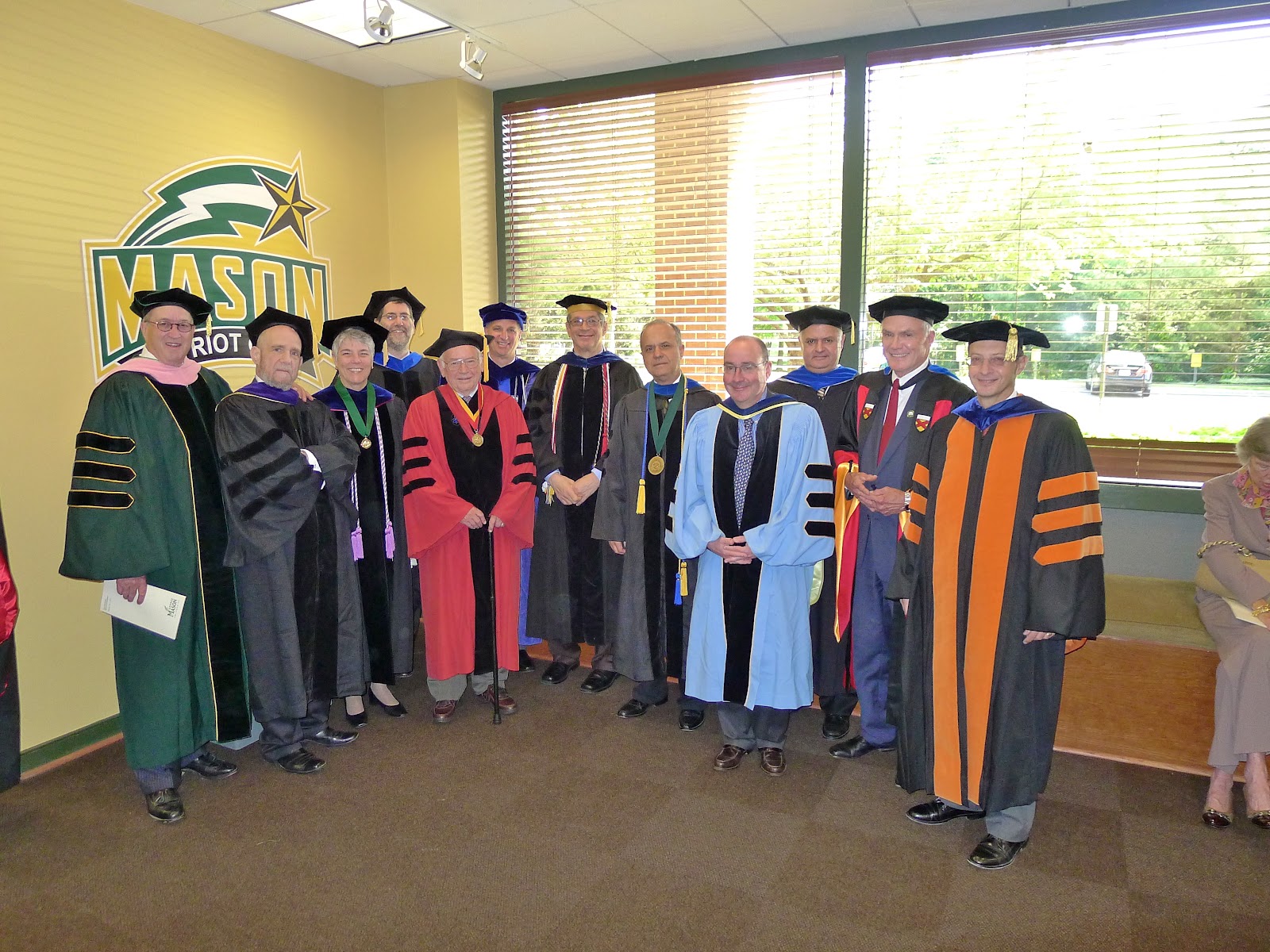 |
| Mason Deans and Provost 2012 |

