Thinking about efficiencies….

One odd thing about the scientific process itself: unlike industrialization, scientific productivity doesn’t really lend itself to the sort of efficiencies that drive many business texts. Which is not to say that convergent technological advances haven’t been hugely important in driving recent progress in science–particularly in science of the trans-disciplinary variety that we do at Krasnow. Rather that a central part of science success comes directly out of contemplative thinking about information/clues from the very edge of human knowledge. To be perfectly clear, a successful scientist needs to allot significant periods of time for quiet thinking.

For myself, one of my own successes in neuroscience came directly out of the realization from my thesis work that imaging metabolic rates in brains wasn’t going to be very useful for imaging learning and memory because those metabolic rates had very high between- and within-variabilities. I needed instead to image the activation of a molecule that was central to mnemonic function (think close to rate-determining) so that the experimental signal-to-noise could be improved upon. That quiet thinking led me to consider protein kinase C less than a decade after it had been discovered within the context of cancer.

But there are roles for efficiencies in science. The advent of new general purpose simulators for computational neuroscience combined with Moore’s law, make for in silico experiments that take minutes rather than weeks.

Robotics allows genome-wide analysis for a small fraction of the cost of Craig Venter’s initial success with his own DNA more than a decade ago.

There are also roles for efficiencies in the administrative support that we provide to scientists. One important consideration is the ever-increasing burden of regulations that, if not checked, can literally eat away at the time a scientist can devote to creating new knowledge. There is of course an important balance between compliance work done to protect society from scientific mistakes (of many types) and the scientific process itself (work of directed creativity). At this institute, we do our level best as administrators to shield our scientists from as much as possible of the regulational burden, by taking it on ourselves–but there are certain areas where that is not possible (such as certifying that a project has no conflict-of-interest).

A part of the life of the very best scientists is close to dreaming. New seemingly random pieces of data (and knowledge) are fitted up against conventional ideas to create novel “idea combinations” (hypotheses) which then can be tested at the bench. Dreaming has never been a good metaphor for efficiency, but it may well be pretty good for describing what it is to scientifically break open a new paradigm.
Tyler Cowen and qualia

Tyler blogs about qualia today here. Qualia are of course the subjective experiences that occur as part of our conscious selves when we see something like the color “red”. The argument is whether my subjective experience of red is the same as yours? This is an interesting question. It’s quite separate from the cognitive process of labeling things as “red”. It’s the experience of “redness”. As pointed out, my experience of “redness” might well correspond to your experience of “blueness”. It’s something inside our conscious selves that we can’t share. That in spite of natural selection and our visual color system (to say nothing of language) causing us to label red frequencies of light as “red”.

Experience is part of what David Chalmer’s calls the “hard problem” of explaining consciousness. You can read more about that here.

Our weather makes the Guardian…

The story of our “Derecho” storm is here. The Institute was up and running yesterday. We’re still waiting on power at our house in Arlington (not very far from the picture of the fallen tree in the Guardian piece). The chaos at gas stations yesterday was very Washington DC. We have an almost unique ability to panic at the weather….pathetic fallacy?

A Calm Week

This has been a quiet week here at George Mason–the campus has definitely entered the summer slows, with less traffic (both of the motorized and animal types). This in spite of the campus excitement from our sister institution to the south.

At Krasnow, I’ve taken advantage of the quiet to work on several projects that require reflection, while at the same time, touring laboratories to keep in touch with the various scientific programs at our institute. I’m continually amazed by the research at Krasnow–it’s both imaginative and demanding–exactly what we want at an institute for advanced study.

The weather has seen fit to mark the astronomical solstice by reverting to the normal summer Washington DC pattern of extreme heat and high humidity. It’s definitely a good time for air conditioning.

Next week however things change. I’ll be at the National Science Foundation early in the week for a workshop on convergent technologies and then out to Sandia National Labs midweek for a review of the cognitive sciences program finishing up with a quick meeting at the Santa Fe Institute to talk about future collaborations. If I’m lucky, I’ll get back before midnight on Friday.

I’m hoping to get some good blog posts in from the road to break things up.

Pickering Creek: A worthy cause….

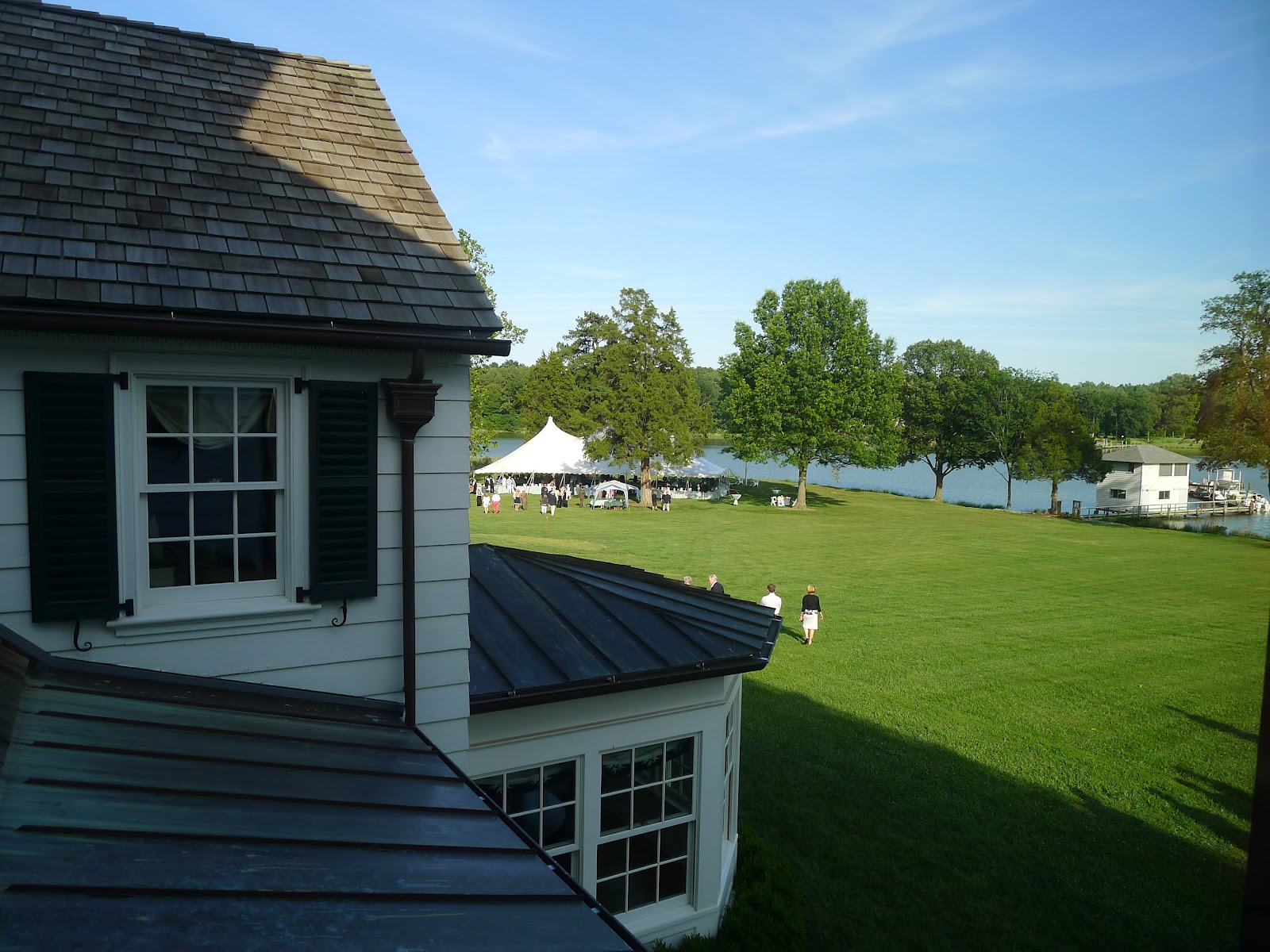
We helped celebrate the 30th birthday of a wonderful Eastern Shore cause, Pickering Creek, a sanctuary of Chesapeake Audubon Society with over 400 acres of forests, fields, and shoreline. The sanctuary provides wonderful educational opportunities for k-12 students from across the area.

But the house in the foreground is not Pickering Creek! It’s Lombardy Estate, not too far away, but  really one of the eastern shore’s gems. The birthday party was under the large tent, by the water on a day where the weather was absolutely perfect.

I’ll have a little biology with my scifi…

Zen Faulkes’ very entertaining commentary on the biology embedded in the new SciFi movie, Prometheus is here (hat tip to Andrew Sullivan). I also agree with him generally. Although I’d add this: another “watermark” for relatedness would be at the phenotype level: it would be very interesting if alien brains had neurons that conducted action potentials based on ionic conductances.

Neuroscience in China

Nature Magazine has an excellent report here. US National Academy of Science member Moo Ming Poo is leading the way at ION in Shanghai.

Money quote from Poo:

“It’s more exciting, exhilarating here [than in the US],” he says. “They need me. I feel it’s the best use of my life.”