
The decline and fall of the Wintel PC platform, here (Hat tip Jim Rutt).
Hydroid Marine Biology makes the New York Times…
Nathanial Rich’s delightful long piece on Turritopsis, here. It’s scientific eye candy for me–the intersection of immortality and marine biology.
And if you want to go beyond the New York Times, here is one of the key papers published in the The Biological Bulletin.
US Birthrate decline…
Hat tip to Tyler Cowen and Andrew Sullivan. Here’s the graph at the Washington Post. I agree that it’s a big deal (think demographic issues of Japan and Russia).
A lesson in perspective…
and lost of it that is. The story and lesson is here. Ambitious brilliant grad students to read twice.
Our own Adrianne Noe and Einstein’s Brain…
New guidelines for preclinical research….
NINDS director Story Landis leads a very long author list on this Perspective piece in Nature, here. The article is open-access, so there should be no difficulty in taking a look, even for our readers without subscription. Note particularly the guidelines proposed in Box 1.
The piece comes about as a result of a meeting held at NIH in June of 2012, the aim of which, was to improve the reproducibility of findings from animal studies, particularly those used in preclinical research. The conclusions, while pretty predictable, are entirely appropriate–as a journal editor, I face the continuous challenge of getting our authors to avoid some of the obvious traps (like pseudo-replicates).
Note that these guidelines are not intended for the exploratory research that often precedes the design and execution of hypothesis-testing experiments that could be published.
Dharmendra Modha’s IBM simulation: 10^14 synapses
Our global readers….
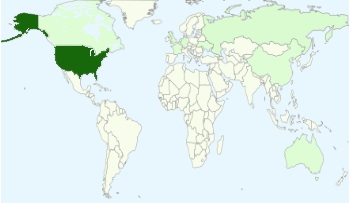
I’ve posted this map several years ago, but it’s been long enough to note some new trends: while most of Advanced Studies readers continue to be in the US, we’ve made real gains in China, Russia and Australia.
Interestingly our readers in Europe tend not to be from the Nordic countries or from the Eurozone’s economically-stressed southern rim.
For an interesting correlation, check out this global pie chart on shares of total world R&D, here.
I continue to be really gratified by Advanced Studies global audience over the years. It continues to be a labor of love on this end.
NIMH’s Tom Insel’s perspective on a decade of leadership…
From his blog, it’s here. It’s a long and serious post and well worth the read–there is insight into the real wonder of basic research and perspective on how research can translate to better treatments for the patient.
Robotic in vivo patch clamp–brought to you by MIT
Ed Yong’s long piece from Wired is here.
Money quote for my colleagues:
Boyden, 33, makes tools for brain hackers. From his lab at MIT, he is building technology that will vastly expand the range of experiments that other scientists can pull off. His latest invention is a classic example: a robot that patch-clamps as well as a human scientist, with none of the fatigue or variability. It works all day. It does not need lunch breaks. It has transformed a technique that had only been mastered by an elite few into something that anyone can do, and hundreds of labs are queuing up to buy or make an auto-patcher of their own.
 Discoverers and Discoveries