Some personal thoughts on Krasnow entering its third decade…
The Institute is now coming up on the 20th anniversary of the conference that set in place our scientific research program. It was held on May 24-26, 1993 here at George Mason University. The Conference was convened by the Institute’s founding director, Harold Morowitz, and was co-sponsored by the Santa Fe Institute. It was entitled: The Mind, the Brain and Complex Adaptive Systems. The speakers including the likes of Murray Gell-Mann, Herbert Simon, John Holland, Patricia Goldman-Rakic, Larry Squire and Daniel Dennett. As a result of that conference, the Institute’s unique focus at the intersection of neurobiology, cognitive psychology and computer science came to be and has led, over the years, to the vibrant trans-disciplinary mix of scientific inquiry that we have today.
From its early beginnings in converted retail space located in downtown Fairfax, the Krasnow Institute developed a seminar series centered loosely on Cognition. That series that still exists today. Most every Monday at 4PM, the scientific and teaching community that make up the Institute come together–along with the invited public–to hear invited speakers talk for roughly an hour about their science. Many of those speakers have been famous (several Nobel laureates), but there have been many also just at the beginning of their careers who have brought their passion for scientific inquiry to the Institute. Many exciting scientific findings saw the “first light of day” at the Krasnow podium.
In 1997 the Institute began to rapidly grow into its adolescent phase as it moved into the first part of the current 50,000 square foot facility on a wooded slope of George Mason University’s campus. With that move, came real wet laboratories and the chance to have experimental science become a significant part of the Institute’s activities. The new space created a virtuous circle of accretion–new talented investigators conducted and published research which lead to the recruitment of still more talented scientists. By the turn of the century, the Institute was bursting at the seams and plans began for a really significant set of laboratory expansions that would eventually lead, by the end of the decade to the the formidable physical plant that currently anchors Krasnow’s science and education programs.
The further growth of the Institute was really made possible by the full merger of Krasnow into George Mason University in 2002. By 2007, Krasnow had become a unique academic unit of George Mason, holding its own faculty in two departments, Molecular Neuroscience and Computational Social Sciences, in addition to playing a seminal role in the development of the University’s neuroscience programs and hosting the first doctoral program in computational social sciences within the United States. That an academic unit is embedded within an institute for advanced study is probably also close to unique.
Beyond the notion of integration between teaching and advanced studies, the Institute was also unusual in that it came to also house full voting faculty who were not members of either department, but had their primary appointments from across the University–the common thread that bound it all together was the commitment to reaching across disciplinary boundaries to work on the problem of cognition.
Two other scientific themes emerged. The first, was complexity science, recognizing that cognition and human behaviors are themselves emergent from complex adaptive systems. The culture of complexity science ran deep of course–the Santa Fe Institute had played an important role in getting the Institute started. The second theme was the role of computational modeling grounded firmly in experimentally-derived data. From computational modeling of signal transduction mechanisms underlying reward and addiction to large-scale models of economies and political societies, this approach has proven both fruitful and a way of differentiating the Institute from many of its sister centers across the globe.
The Institute also acquired a dedicated cadre of volunteers who brought their multitude of talents and accomplishments to the Krasnow Advisory Board. Led by Dr. Adrianne Noe, Director of the National Museum of Health and Medicine, that Board grew over time and now plays a critical role in the crafting of a vision for Krasnow’s third decade. The value of their contributions, both in terms of wisdom but also as manifest in generous philanthropic gifts has been central to the Institute’s success.
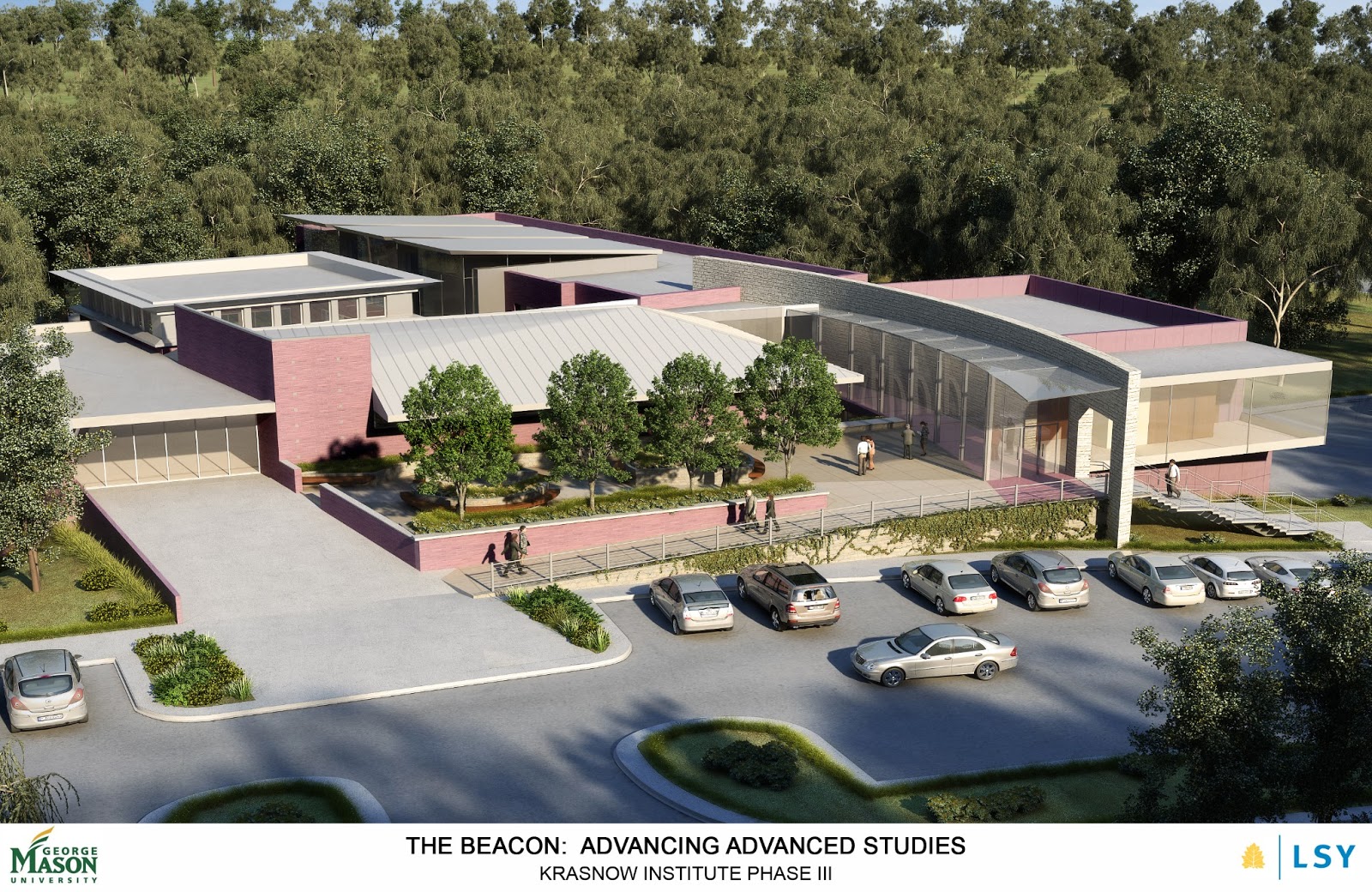
These are exciting times to be serving as Krasnow’s director. In addition to the Institute’s own visioning process, Krasnow will be playing an important role in the crafting of a new strategic plan for George Mason under its new President, Dr. Angel Cabrera. A major third decade goal for the Institute is a new expansion wing on the south-end of the current facility that will house the Institute’s departments, several of its centers and a new auditorium that will serve as a beacon for the entire campus.
The Institute for Advanced Study will continue to build upon its strengths, and energetically pursue new strategic opportunities in the years ahead. I’m really pleased at the progress that we’ve made, but even more excited about what lies ahead. Happy 20th!

 Discoverers and Discoveries