
Just in time to resume blogging. Having spent some quality time in some of the less metropolitan parts of the US, I’ll simply note this piece in today’s US edition of the Financial Times. My readers can draw their own conclusions.
Summer at the Krasnow Institute
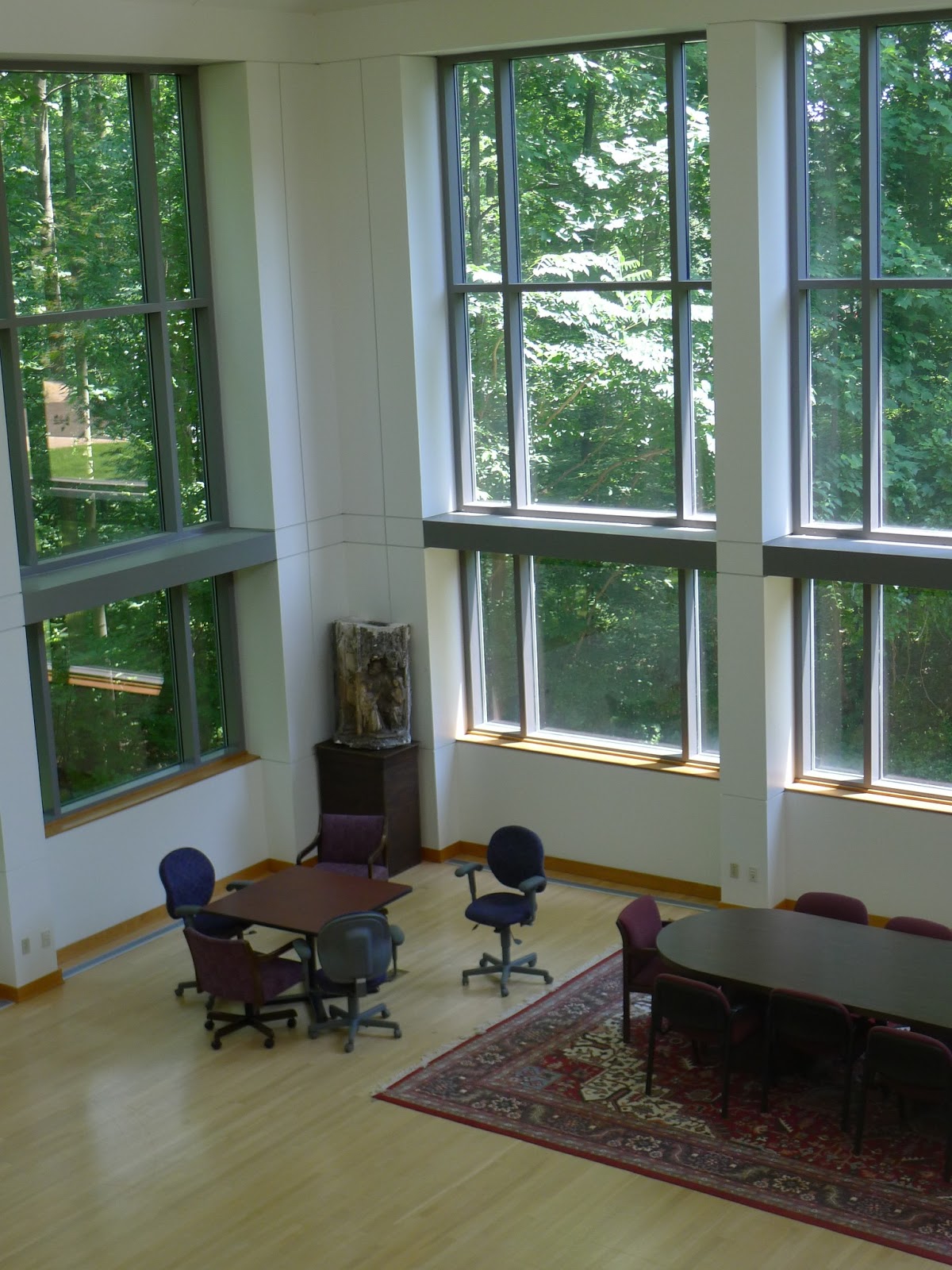
I just took this photo from the Institute mezzanine looking down towards the Great Room. The Institute’s “forest”, home to pileated woodpeckers, foxes and deer, lies in summer livery, green just beyond the windows.
It’s quiet here this time of year. Our doctoral students are still ubiquitous, but faculty are mostly on their summer travels, at scientific meetings, symposia and the like all over the world.
For me, this marks the end of my fifteenth year as director. I’ve watched a lot of changes, mostly all positive. The Institute has progressed through its adolescence and is now both stable and healthy. The challenge of course will be to keep our “fire in the mind”–to quote my friend George Johnson.
To me, that means continuing to take scientific risks, to insist on scientific excellence and to break down the barriers to gaining further knowledge, even when those barriers are formidable.
I’m lucky to serve with a brilliant scientific faculty, outstanding trainees and the best staff that an institute director could ever hope to have. At the same time, the University has transitioned to new leadership, it’s best days are still ahead of it and I’m as optimistic about the future as I’ve ever been.
Friday, I’m off to Alaska for some vacation time. I hope to read as little email as possible and to concentrate on the spectacular natural beauty of our planet–all too vulnerable, yet made all the more precious for that vulnerability.
A blog hiatus is therefore to be expected. We’ll be back around the 11th of July. Happy Summer!
Managing the US National Labs: a bipartisan call for reform
ScienceInsider has the story, here. The actual report is here [pdf].
Money quote from the Executive Summary: “The federal government must reform the labs from their 20th century atomic-energy roots to create 21st century engines of innovation. This report aims to lay the groundwork for reformby proposing a more flexible lab-management model that strengthens the labs’ ability to address national needs and produce a consistent flow of innovative ideas and technologies. The underlying philosophy of this report is not to just tinker around the edges but to build policy reforms that re-envision the lab system.”
Beyond Google Earth….the next big thing:
David Samuel’s long piece in Wired, here. The start-up in question, Skybox, aims to be to satellite imagery what Google is to search….the advantage over Google Earth: much more dynamic data streams and an off-the-shelf approach to the technology.
I’m wondering if my colleagues in our own Computational Social Science Department here at Krasnow might be able to use such data–I’m guessing the answer is definitely yes.
The NeuroX Brain Wars…
Point counter point on whether neuroscience is good for something. Gary Marcus in The New Yorker, here. The New York Times’ David Brooks here.
Marcus rightly points out that critiquing functional MRI brain scan data analysis is not the same thing as rejecting all of neuroscience–most of neuroscience (the parts not seen so much in the mass media) is knowledge obtained from a huge variety of robust and elegant methods, ranging from optogenetics to electrophysiology.
But it’s a good debate–perhaps it’ll prevent neuroscience from being oversold.
How sparse are engrams for concepts?
I missed this one when it came out earlier this year in Scientific American. One of the authors, Christof Koch is Chief Scientific Officer at the Allen Brain Institute, which collaborated with Krasnow on the DIADEM challenge.
The key point is that certain scientific questions can only be asked in a particular methodological context–in this case, epileptic surgical patients. I’m not sure I agree with the conclusion however–there is an awful lot of alternative evidence supporting the notion of widely distributed engrams. Koch would argue (I think) that the methods that support the distributed hypothesis are flawed. Functional brain imaging using MRI for example has both poor spatial and temporal resolution compared to the electrophysiological data from these patients.
But if functional brain imaging is flawed in this way, it’s also conservative–very sparse representations would be invisible. In fact, the representations that show us are widely distributed. See the work of Tom Mitchell and colleagues, here.
How bad is the sequester for NIH?
The Institute and digital reconstruction of neurons
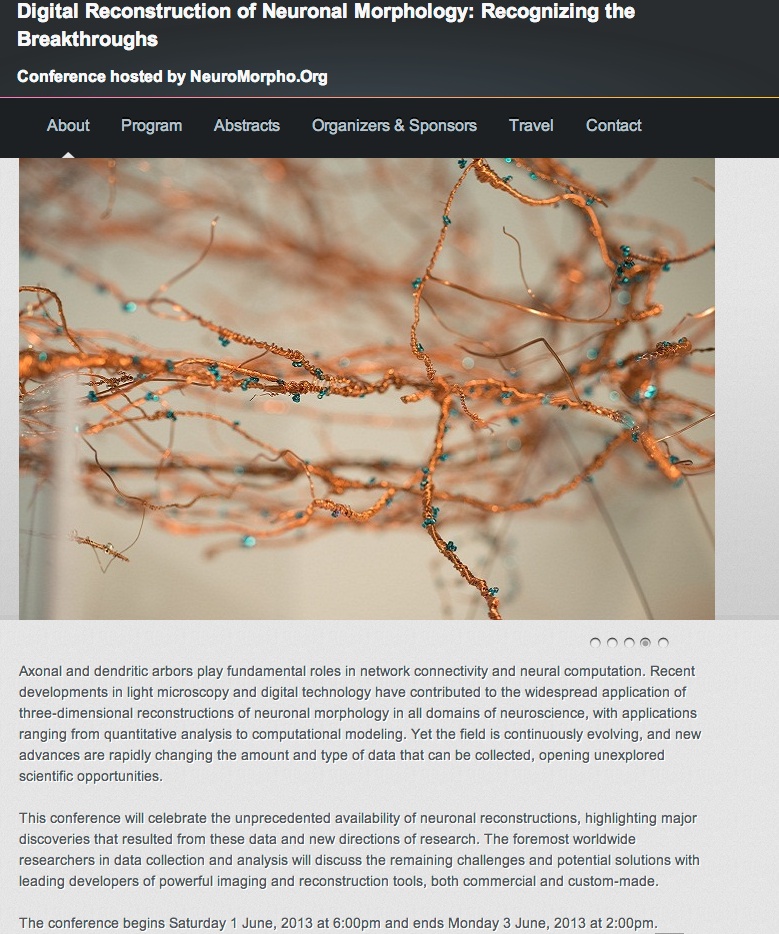 A terrific conference is winding up at the Krasnow Institute today, the web site is here. Organized by Krasnow’s own NeuroMorpho.org, under the visionary leadership of Giorgio Ascoli, with the sponsorship of Burroughs Wellcome Fund USA and MBF Bioscience, the conference has brought together some of the best and the brightest in the field. To my mind, this is the single most important event for scientists working in this arena since the DIADEM challenge event of several years ago.
Small conferences like this one are a key example of what Krasnow does really well for the global advanced studies community. For readers who may have heard about the White House BRAIN project, or the Connectome, all of those initiatives depend of advances in automated digital reconstruction of neurons.
Krasnow’s own Hippocampome Project is an example of how this type of data can be mined and harvested to yield new neurobiological knowledge, in this case, about the brain region most clearly identified with learning and memory in mammals (such as us).
Work politics…
Not the Dem/GOP variety. I mean the palace intrigue kind. There’s way too much of it. And I mean in general…it’s deeply embedded in every institution that I visit, at least here in the States.
This type of politics represents a real challenge because it distracts us from why we are really here. Essentially it eats productivity. It creates a constant need for workers to keep a weather eye out for political threats increasing cognitive load while decreasing the brain power that might be used for creativity, invention, problem-solving and other useful tasks.
Business schools should work towards some solutions to this problem. And so should organizational psychologists.
In the meantime, I head off to my Alma Mater for reunion tomorrow. I expect to find more of the same there, but perhaps will be happily surprised.
 Discoverers and Discoveries