Ready, set, go!

The academic year begins for me today–Mason holds its annual planning conference over the next several days. That’s always the sign that the freshman move-in is imminent, and with it, the return of faculty and the start of classes.

This year, I’m additionally taking on the interim-chair position at our Computational Social Sciences Department, while my colleague Rob Axtell is on sabbatical at Oxford. Kim Blackwell, vice-chair of Molecular Neurosciences will be serving in my stead as interim chair of my home department. Should be an interesting year!

Latest solar cycle….

Article is here. And the money quote is:

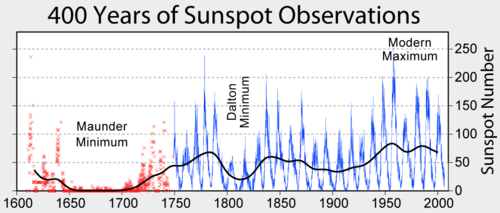
The current predicted and observed size makes this the smallest sunspot cycle since Cycle 14 which had a maximum of 64.2 in February of 1906.

From Wikipedia, here’s the longer time graph:
 As you can see the current predicted Maximum will be pretty low, comparable with a period from 1790 to 1820 known as the Dalton Minimum.

Hat tip to Ben Sandiland’s blog Plane Talking which I usually read for his very insightful civil aviation reporting.

More on advice on graduate school….

This time from Adam Kotsko, who is a professor at Shimer College, here. I don’t completely endorse this advice, but it well reflects the times we live in and I think Adam was quite crafty in his approach.

In the sciences, I don’t think there is remotely enough time to moonlight during grad school. Bench top experiments are somehow all consuming. Perhaps however this might be useful for students who are doing computer simulations only–although if you got your PhD in a computer sciences field, I can’t imagine you’d ever need to “hide” your over-education.

Publics in distress redux…

I’ve written about the difficult challenges that America’s public research universities are facing before, here and here. Tyler Cowen and I began a conversation over lunch last week that extended to email about what’s really going on with this phenomenon. His viewpoint (and Tyler jump in if I’ve got you wrong on this) is that the growth of income inequality combined with the hollowing out of the middle class has seriously eroded the potential tuition base for these institutions. I agreed, noting that the explosive growth in these flagship publics coincided with the GI Bill and the growth of the middle class following  the Second World War.

What’s odd is that the conventional wisdom on this matter is quite different: that the enormous growth in federal R&D (Vannevar Bush’s legacy) fueled the golden age following the War. This viewpoint holds that the economic engine for the public research institutions was embodied in the growth of the National Institutes of Health and the National Science Foundation as they created first “Individual-PI science” and second big program science (like the polar programs and the big telescopes).

What is certainly true for the flagships is they are being squeezed from both ends–their tuition base is eroding while the Federal R&D bonanza has gone into a slow macro-decline. Add to that, the race to the bottom in state support and the student debt crisis and you have a recipe for bad times ahead.

So what to do?

I think many research publics are looking for their IP portfolios to save them (as in the Wisconsin WARF model), but the recent revisions to US patent law are creating challenges for patent defensive maneuvers. In any case, such strategies present real public relations difficulties for universities.

Others that are land-rich (as UC Irvine was in the 1960’s) may rightly attempt to generate long term new revenue streams from real estate. Stanford’s famous shopping center was an early successful example of this strategy.

Or…the public flagships may simply slowly decline, ceding the cutting-edge research space to the privates like Harvard, Stanford and Caltech, while they lower tuition to $10K/year and use MOOCS to reach out ever more to new pools of students. This may indeed happen (first in Texas). I hope it doesn’t. To me the integral linkage between research and teaching is absolutely central to national competitiveness.

So let’s find some creative ways to save the public research universities and implement them quickly.

Proposed pandemic flu research at Wisconsin…

ScienceInsider has an excellent roundup of informed opinions here. I share the concerns of Harvard’s Marc Lipsitch:

 “The fact that the global population is being put at risk by such experiments, to an appreciable but unknown degree, without being informed, much less consenting, is an ethical problem that has not been faced squarely.”

The real issue here is of tail risk. Accidents do happen in labs. In this case, the potential consequences of such an accident would be extreme. In a sense, this reminds me of the first test of the atomic bomb in New Mexico–the scientists involved weren’t completely sure that the thing wouldn’t ignite the entire world’s atmosphere. I suppose they went ahead because the value proposition in terms of ending the War was very attractive to the ultimate decision makers.

Impact factor debate….

Michael White’s thoughtful piece on the use of Impact Factor on assessing scientists for promotion and tenure is here. The piece is in Pacific Standard, a magazine publication that I’m increasingly impressed by.

I’m a supporter of DORA for readers who are curious.

Those are the docks of the Woods Hole Oceanographic Institution as I arrived yesterday by ferry. My office here at the MBL is on the opposite side of the Knorr, the large research vessel in the foreground.

Tomorrow, at the MBL Society Meeting, we’ll learn perhaps a bit more about the new affiliation between MBL and the University of Chicago. Ultimately, I’m anticipating it’ll involve some significant transfer of resources to the marine lab in return for a significant degree of control from the University. In any case, it represents a monumental change for the 125 year old MBL.

My take on the economy here is that it’s still in recovery mode. While Martha’s Vineyard was extremely busy, the local businesses (with one key exception) seem to be struggling.