Non-discretionary personal spending…

Apparently we’re just like the federal government, our personal budgets are being squeezed by what amounts to non-discretionary outlays: health care and education. Patrick Appel in Andrew Sullivan’s Dish, here.

My own analogy with the non-discretionary side of the federal budget stems from two facts: health care is central to both and the mandatory expenditure nature squeezes cuts onto what’s left. In the case of the feds that includes R&D (like NIH and NSF). In the case of Mom and Pop, probably they are doing less retail shopping…and in fact that fits the latest data.

Public Intellectuals….

Carnegie Mellon’s Jeffrey Williams has an excellent piece on public intellectuals and Stefan Collini in particular, here. The context is the current higher education debate in the UK (also taking place here in the States).

The money quote:

It was a historically unique situation, he noted: “I’m lucky in my generation. If I had been born 15 or 20 years earlier, from my social background I certainly wouldn’t have had most of the opportunities that I have had.” And, given the cuts enacted in the Thatcher era, “if I’d been born 15 or 20 years later, certainly in Britain, I think the road would have been much rockier in the lack of jobs and declining working conditions in universities.”

Seniors (not the 22 year old kind) and academic tenure…

From George Mason’s provost, Peter Stearns, here. His points on academic freedom are well taken. I also salute his concerns about productivity and salary distortions.

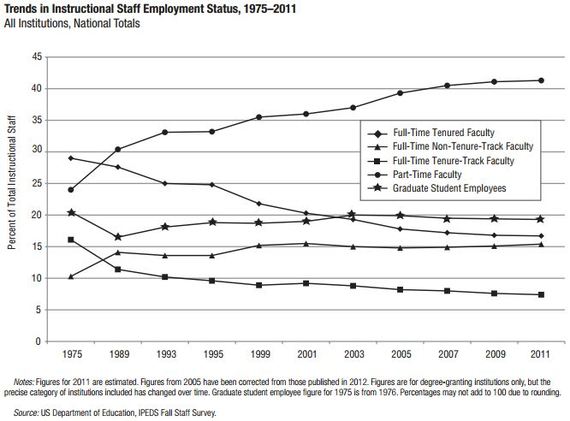
Now let’s look at the data:

De facto, tenure may be going the way of the dinosaurs. Specifically, institutions are using non-tenured faculty to handle increasing amounts of the teaching load. In fact, I would argue that as tenure faculty retire, they are being replaced by adjuncts or contract faculty members.

Where does this all lead?

The data show here suggest a low asymptote, where tenure is part of the compensation package for superstars while the bulk of the teaching will be increasingly handled by others.

Thoughts on the Obama higher ed plan

First, I’ve never been impressed with government ability to pick winners and losers (NIH and NSF are such successful agencies precisely because they emphasize peer review). Second, as Tyler Cowen pointed out, there will be colleges that game the system–just as they do with the US News ratings today. Third, in my opinion, the underlying problem is the macro-withdrawal of state support for the public institutions that used to be the core of affordable higher ed. This withdrawal is what has generated the large increases in tuition–this contrary to much of the conventional wisdom on this issue. The Obama higher ed plan without any substantive change in state support creates a zero-sum game for the colleges, but it’s not going to be able to magically solve the problem.

Finally, I can’t conceive that this plan will be able to make its way through the paralyzed Congress–at least now.

So I’m skeptical.

Stay tuned….

Management theory run amok…

Buzzword trajectories according to Google

From Judith Shulevitz in The New Republic, here. In her excellent piece she goes after the term “disruption” but she could have really gone after the whole genre.

Of course we have these issues with fads in neuroscience too. Cell assemblies led to pleasure centers led to LTP led to connectomics. But a crucial difference is that these neuroscience “fads” were actually related to real phenomena. I’m not so sure about the stuff of management theory….

Tyler Cowen on ersatz job ads…

The blogpost is here. If companies had really hired into the positions they had advertised, we’d be back at full employment–what gives? Two hypotheses in the post: wages are too low or companies are too picky. Another is that companies are hiring internally (i.e. the job ads are “wired” for a specific individual inside the organization).

What about that it’s all about PR? One thing that is very true in science: placing a bunch of job ads in Science and Nature Magazine is a sure way to get the buzz going–and in a good way. Is there actually an obligation to follow through?

Shiller on innovation….

Robert Shiller’s NYT column this morning is about the centrality of individual innovation to national success. It’s here. What makes the piece exceptional to me however is Shiller writing about his own trajectory which of course combined being a Yale economics professor with an entrepreneurial bent that led to the creation a very famous real estate index.

Even more interesting to me is that Shiller attributes the origin of his success outside the academy to the support of the National Science Foundation. Money quote:

Long before I started any commercial ventures of my own, I received some federal government support — in the form of National Science Foundation research grants, awarded to me decades ago as a young professor. They allowed me to do research, and though it was not directly related to my later business endeavors, the process developed my expertise and reinforced a sense of entrepreneurial opportunity.

I’m currently serving a term on the NSF’s Advisory Committee for the Social, Behavioral and Economic Sciences Directorate–that’s the piece of NSF that supports young economists, future Shillers of the world. Today’s column makes that service feel all the more useful.