
Eileen Pollack’s fine piece in today’s NYT magazine is here. I thank Avrama Blackwell for the link.
Ersatz peer review in fly-by-night journals….
John Bohannon’s science paper is here. This is a huge deal for science and for academic scholarship. As a journal editor myself (and my journal is over a century old), the value proposition that we offer is the quality of our peer review.
The government shutdown….
I haven’t written yet about this partly because, as a scientist, I’m so frustrated with the quite real effect on research, particularly at the NIH. But science has become truly global and, as a result, if its not done here in the States, it will get done elsewhere–although the results may then not accrue to advantage of the US.
I’m even more concerned about the debt ceiling issue. I’ve written about that issue before in the context of sequestration. I’ll simply reiterate that the brinksmanship is a very bad thing for the global economy.
Ultimately what I’m most worried about is the political dysfunction in governance at the federal level. This has manifested throughout the Obama Presidency in one form or another. Many others have written how the dysfunction we are seeing now is reminiscent of that seen before the American Civil War. That’s not a good precedent.
Family portrait-Krasnow Institute for Advanced Study
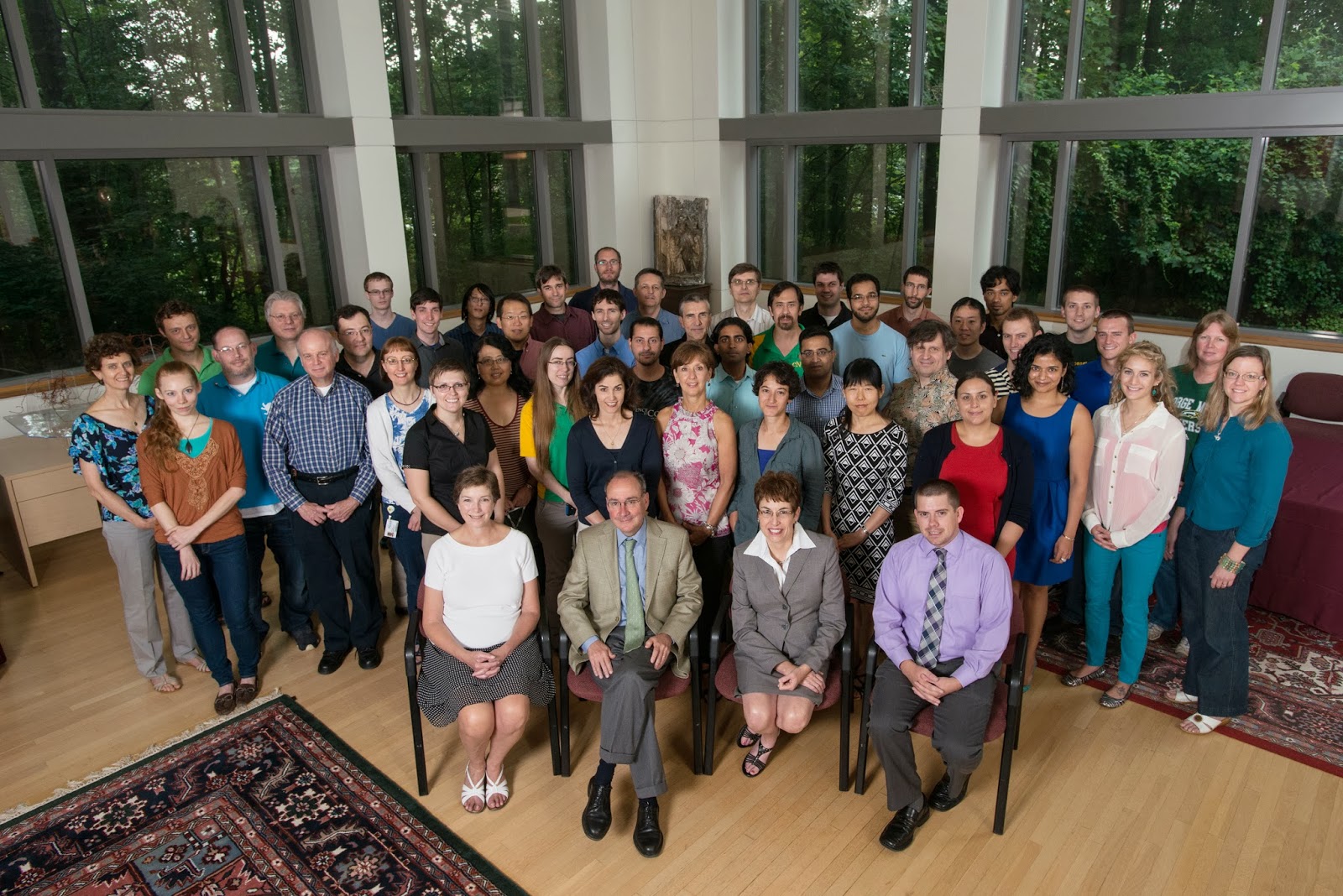 |
| This year’s group photo: George Mason’s Krasnow Institute for Advanced Study |
Two Cultures redux…
That’s CP Snow’s book, Two Cultures and its analysis of science versus the humanities. The lecture from which the book emerged took place in 1959. The battle still rages and the latest round can be found here. In the modern version its Steven Pinker versus Leon Wieseltier–enjoy!
Draft science bill–we aren’t going to like it….
There’s a bill being drafted by the House Science Committee and rumors are it’s going to be anathema to the science advocacy community, ScienceInsider has the story here. At stake may be peer review–both at NSF and other science agencies.
Stay tuned….
K-12 performance: more testing
From my college classmate Zeke Emanuel in The New Republic, here. Money quote:
Done properly, testing is not inert. Rather, it can be much more like the physical phenomena underlying the Heisenberg Uncertainty Principle. In the act of measuring students, you can actually affect how much knowledge they absorb and how well they retain it.
Zeke is raising a really important point. Learning outcomes are improved by the action of taking a test and getting the feedback of a grade. And increasing the frequency of testing actually improves those outcomes.
Mind and brain…
An excellent essay ultimately about consciousness and what neuroscience may reveal about it by Adam Zeman and Oliver Davies is here from the UK magazine, Standpoint.
Money quote:
Recent research, and the thinking that it has inspired, does not point to any simple reductive identity of mind and brain. An influential, and representative, theory of consciousness, Giulio Tononi’s theory of “integrated information”, suggests that all of nature has a – sometimes – hidden potential for mentality. The Canadian philosopher Evan Thompson has underlined the way in which the precursors of minds like ours can be glimpsed in even the simplest of organisms. Other contemporary philosophers, including Edinburgh’s Andy Clark, have emphasised that human minds are sustained by culture and community. The role of action and the body in forming and mediating consciousness has been a key theme in the work of the American neurologist Antonio Damasio, the Parisian psychologist Kevin O’Regan, the Berkeley philosopher Alva Noë and the Brighton-based psychiatrist Hugo Critchley. In the work of these thinkers, mind is understood to be “extended, embodied and embedded” – extended in its interactions with space and time, embodied through its dialogue with both the body and the brain, and embedded in human culture and society.
Read it all. Very worthwhile.
Krasnow Institute Strategic Planning…
The Institute is actively preparing a strategic plan as part of an overall planning effort by George Mason University. This is a very useful exercise for us because it allows us to prioritize where we are going to invest over the long term, keeping in mind a vision for what we want to become over that same long term.
It’s very different from the day-to-day activities of research and education–while the two are both activities that, be definition, reach into the long term, they are, in term of action, very much of the here-and-now variety.
Recently the Institute’s advisory board completed its own work on preparing a vision for Krasnow’s future. We’ll post it on-line on the Institute’s web site in the near future. That vision will serve as a starting point for our strategic plan. At the same time, I’ve been meeting with faculty, students and staff to get their ideas about a roadmap for the Institute’s future.
Finally, the Institute’s plan will show alignment with the University’s own long term goals which you can read about here.
But a plan doesn’t mean anything unless it drives action–and that will be the most important aspect of putting this all together. Our plan has to lead to a set of coherent actions (think resource allocation, investments, prioritization) that move the Institute in the right direction. If it does that, then the planning activity will be well worth our efforts.
Next steps on Alzheimer’s Research…
NIH is going to try amyloid-targeting drugs in at-risk healthy seniors, story here. It’s a reasonable approach which may, as the news piece points out, put the nail in the coffin for the amyloid hypothesis–perhaps the dominant theory for how Alzheimer’s happens.
 Discoverers and Discoveries