
At least on Acela, story here. I’ve had my own similar experiences over the years so I believe the author.
Space Travel Writ Large from the Economist…
It’s here. And roughly speaking it’s about how to design an interstellar ship (unmanned first) that would be practical….solutions seem to range broadly.
I’m a real believer in eventual human exploration of the entire solar system. Star Trek, not so much.
Oxford, then and now…
FT’s Simon Kuper remembers the old Oxford University, here. Spoiler alert: he thinks the current Oxford is a whole lot better.
The best tuition cap of all?
Hat tip to Steve Fiore, the idea from Robert Samuels is here. Money quote:
Rather than directly paying for public higher-education institutions, state and federal governments have often relied on tax deductions and credits to support individual students. But what this system has achieved is a tremendous subsidy for upper-middle-class and wealthy families, while lower-income students are forced to take out huge loans to pay for their education.
It’ll be interesting to see what the future of public higher ed really looks like. My guess is qualitatively different from what we have today.
iBiology goes live…
Website here. Brain child of Nobel Laureate Ron Vale and led by my friend and colleague, Dr. Sarah Goodwin. In a sense, doing for life sciences what Tyler Cowen and Alex Tabarrok have been doing for economics at Marginal Revolution University. The key is the modularity. I’ll be plugging some of iBiology’s content into my cellular neuroscience course next semester.
Using social media as a social "telescope"…
More on the replication problem in Science…from The Economist
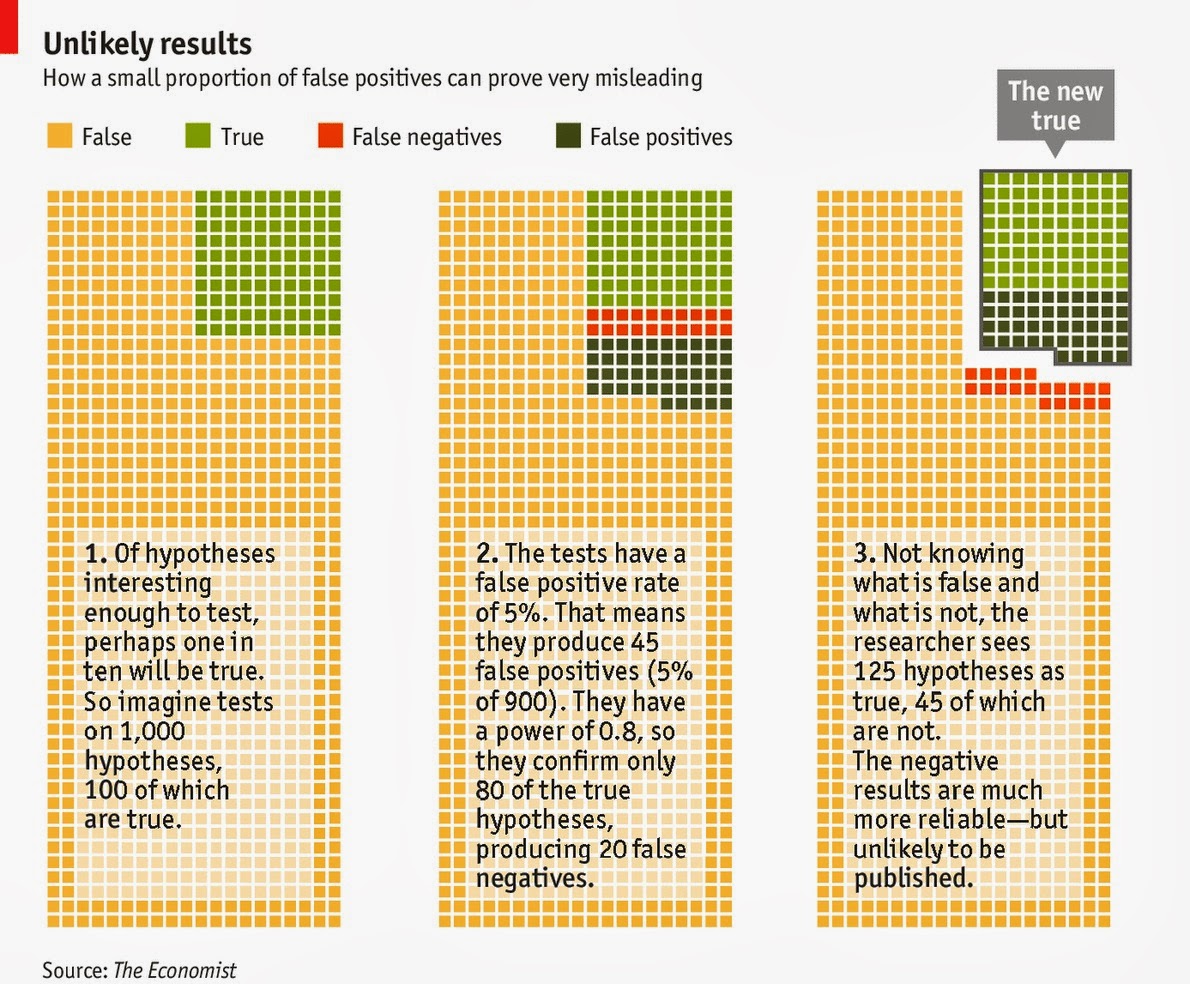
The article is here. The figure above demonstrates the non-fraud side of the problem. Central to the problem is the concept of statistical power. A lot of published science studies are statistically underpowered. Kudos to The Economist for publishing a serious and understandable piece about this problem.
Russian Science….
It is well known what happened to the excellent Russian scientific enterprise in the immediate aftermath of the Soviet Union’s demise in 1991. Brain Drain is a simple phrase which encapsulates the effects of cutting off sustained and predictable investment in scientific research. For a summary of how Russian science is slowly moving beyond what was surely a national scientific catastrophe, read here. For the perspective from the Chronicle of Higher Education, look here.
In the meantime, that famous downward trajectory is surely a cautionary tale for those of us here in the States, who have witnessed a slow atrophying public support for science.
Quite separately, but reflecting a similar decay in public understanding of how science investments are made to pay off practically, the recent shutdown cost American research dearly…..experiments that are interrupted are often irreparably lost.
The "Replication Issue" as written up in the Economist….
The article is here. Their money quote:
“Peer review should be tightened—or perhaps dispensed with altogether, in favour [sic] of post-publication evaluation in the form of appended comments. That system has worked well in recent years in physics and mathematics.”
The Replication Issue is a complicated one and is something that I am actively working on with colleagues around the country. I am most definitely not for getting rid of peer review. BUt the post-publications comments might be a good idea to add on.
On sexism and the mentor…
Many of us have been following the twitter controversy regarding Scientific American Blogs. What started out as bad, got a lot worse. Laura Helmuth at Slate has the complete story here. I’m appalled.
The notion of using a mentorship role to sexually harass is just wrong. Where we find it, we should call it out.
 Discoverers and Discoveries