
This is really good news for younger investigators, story here.
Reinventing biomedical research support in the United States….
The absolutely seminal article by Alberts, Kirschner, Tilghman and Varmus is here, published in PNAS. If you can’t get behind the firewall, read the news story here.
Short version: the labor economics of biomedical research needs to be rebalanced because it’s currently unsustainable. From a macro-standpoint, the number of doctoral students and postdocs need to be reduced and that smaller number need to be better supported.
I agree with all of the article’s recommendations. This is important stuff….
Where next in neuroimaging?
The perils of ocean acidification….
It’s making some fish make rash decisions, story here, original report in Nature Climate Change here. While this report may seem humorous to some readers, what’s going on with acidification of the oceans is deadly serious. It’s a result of increased carbon dioxide in sea water as a result of greenhouse gas emissions. We’re preparing a virtual symposium issue of The Biological Bulletin on the follow-on effects of acidification–they are incredibly complex and of potentially huge significance for the biosphere. Stay tuned…
Subprime rises from the dead….
Only not in real estate, this time it’s cars. GM cars to be specific. Gillian Tett’s column is here at the FT.
US to back out of ITER Fusion Project?
Science Magazine’s Adrian Cho has the story, here. This is a long complicated tale….when I was up on the Hill in the late 1970’s, fusion energy was in my portfolio. My own opinion is that if human’s are to thrive and eventually colonize space, we’re going to have to figure out how to do this.
The CDC report on autism spectrum disorder….
The report estimates that 1 in 68 children has autism spectrum disorder. The announcement is here. The actual report is here. There is a great deal of geographic heterogeneity in the data (Alabama 1/175, New Jersey 1/45) which I suspect has more to do with general differences in health care delivery rather than the environment.
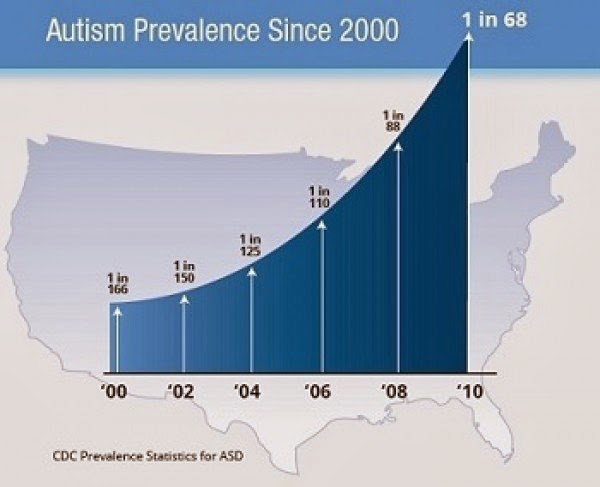
The change in the prevalence is indeed worrying. One has to wonder whether this is a real increase or rather represents increased awareness of autism among those doing the diagnosing. It would also be very interesting to see the global data if it exists. I guess the other question I would have is what percentage of those diagnosed are high functioning (as in Aspergers).
What I’ve been reading….
- Max Tegmark’s book on multiverses
- Simon Winder’s personal travelogue history of Habsburg Europe, Danubia
- Thomas Piketty’s new book on inequality, Capital in the 21st Century
- Gerald K. O’Neill’s 1976 book on space colonies, The High Frontier
Only in Singapore….
Assault with porridge, story in the Straights Times, here.
Data sharing continued….
I went to a very enjoyable workshop on the sharing of data in neuroscience last Friday at the American Association for the Advancement of Science HQ here in Washington. The keynoter was none other than our own Giorgio Ascoli who presented neuromorpho.org, an effort I have written about before.
Data sharing is not a simple story though. Producing new data is time consuming and expensive and the current incentives (authorship, grants, tenure) work against sharing. Michael White’s recent piece in Pacific Standard gets to these issues and additionally nails it on why sharing is in fact the right way to go…here.
 Discoverers and Discoveries