
Science Magazine’s Adrian Cho has the story, here. This is a long complicated tale….when I was up on the Hill in the late 1970’s, fusion energy was in my portfolio. My own opinion is that if human’s are to thrive and eventually colonize space, we’re going to have to figure out how to do this.
The CDC report on autism spectrum disorder….
The report estimates that 1 in 68 children has autism spectrum disorder. The announcement is here. The actual report is here. There is a great deal of geographic heterogeneity in the data (Alabama 1/175, New Jersey 1/45) which I suspect has more to do with general differences in health care delivery rather than the environment.
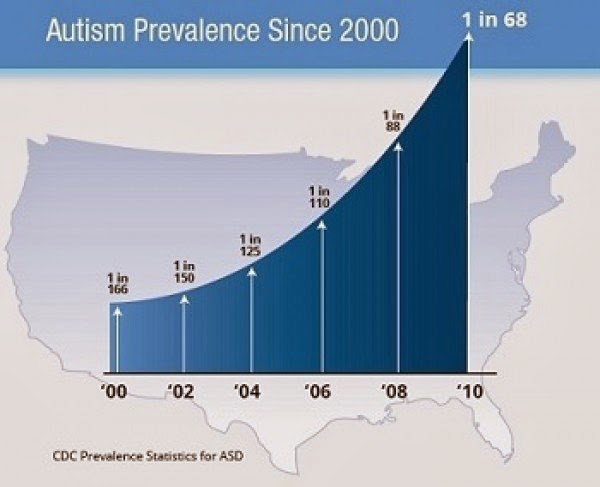
The change in the prevalence is indeed worrying. One has to wonder whether this is a real increase or rather represents increased awareness of autism among those doing the diagnosing. It would also be very interesting to see the global data if it exists. I guess the other question I would have is what percentage of those diagnosed are high functioning (as in Aspergers).
What I’ve been reading….
- Max Tegmark’s book on multiverses
- Simon Winder’s personal travelogue history of Habsburg Europe, Danubia
- Thomas Piketty’s new book on inequality, Capital in the 21st Century
- Gerald K. O’Neill’s 1976 book on space colonies, The High Frontier
Only in Singapore….
Assault with porridge, story in the Straights Times, here.
Data sharing continued….
I went to a very enjoyable workshop on the sharing of data in neuroscience last Friday at the American Association for the Advancement of Science HQ here in Washington. The keynoter was none other than our own Giorgio Ascoli who presented neuromorpho.org, an effort I have written about before.
Data sharing is not a simple story though. Producing new data is time consuming and expensive and the current incentives (authorship, grants, tenure) work against sharing. Michael White’s recent piece in Pacific Standard gets to these issues and additionally nails it on why sharing is in fact the right way to go…here.
It’s a big day for science: Big Bang inflation theory gets some strong evidence…..
Story from Nature here. This is the notion (now supported with good evidence) that in the fraction of a second following the Big Bang, the universe expanded exponentially (inflation). The evidence for that inflation comes from looking for perturbations in the polarization of the cosmic microwave background that themselves are evidence for gravitational waves. If it holds up, it’ll be an easy Nobel choice.
The neuroscience of art….
One of the many neuroX fields…all more or less dependent on fMRI data. Tom Bartlett’s piece in the Chronicle is here. Original article in New Atlantis by Roger Scruton is here. Scruton is a visiting professor at Oxford.
Money quote from Scruton:
But memetics possesses the very fault for which it purports to be a remedy: it is a spell with which the scientistic mind seeks to conjure away the things that pose a threat to it — which is also how we should view scientism in general. Scientism involves the use of scientific forms and categories in order to give the appearance of science to unscientific ways of thinking. It is a form of magic, a bid to reassemble the complex matter of human life, at the magician’s command, in a shape over which he can exert control. It is an attempt to subdue what it does not understand.
Faculty raises at publics larger than at privates….
Really good news for public universities like George Mason, story in the Chronicle is here. Median for publics was 2.2% versus 2.0% for privates (FY14 data).
Following the money….
The private money that is…going into science here in the US from very wealthy people, story here, thanks to Tyler Cowen for the link.
The question from my standpoint is–does that get us the best science? I’m not sure. My worry is that scientists taking big bucks from billionaires will tend to find they own the confirmation biases of their sponsors.
Making things or apps?
Liren Yu’s wonderful long piece on life in the Valley from today’s NYT Magazine is here. Personally, I’ve always gone long on companies that build things.
 Discoverers and Discoveries