Adult neurogenesis? Not so much in humans

This is a huge result, making NPR and published in Nature, here. Since the discovery of adult neurogenesis in rodent models, it has been assumed by many (but not all) that we humans did the same thing. The assumption was that we grow new neurons every day throughout our lives.

Aside: actually that assumption was contrary to what many of us were taught. Before the discovery of rodent adult neurogenesis, it was thought humans stopped producing new nerve cells with the onset of adulthood.

The latest findings indicate that in humans, the production of new neurons slows down by age 7 and is gone by age 13. That’s shocking. What was the selection pressure for loosing such a phenotype from rats and mice?

Teaching again…

I am now three weeks into the semester and surprisingly, it’s been fairly easy.  The routine of teaching, grading, seminar preparation and the like are relaxing, even enjoyable. My students are graduate level in the School of Public Policy at George Mason. Because we are in D.C., some of my students are as senior as I am. And, I am learning from all of them.

At the same time, I have started a book project and am busy shopping out an Op Ed about the  President’s science budget–which hasn’t been released yet. Although… there was a leak that made it to the Washington Post in the last day or so.

For fun, over Spring Break, I’ll be headed to Paris with my wife. We plan to take advantage of all the excellent advice that we have received from friends and even ex-colleagues at NSF. So enjoying life…

Graduate Tuition Support at NSF

One thing that I didn’t know, before I came to NSF in 2014 was that support for graduate student research assistants as part of regular research grants includes tuition support that is not capped. According to this NSF FAQ:

Tuition remission is generally treated as part of an organization’s fringe benefit rate or as a direct cost. NSF’s policy is that colleges and universities should budget tuition remission consistent with its established indirect cost rate methodology and negotiated rate agreement. If tuition remission is budgeted as a direct cost, it should be listed in the “Other” category of the Budget under “Other Direct Costs.

Note that there is nothing about a cap in the above guidance.

In contrast, NIH does cap tuition support for graduate research assistants at around $16K. Here is the relevant NIH policy:

Undergraduate and Predoctoral Trainees and Fellows:  For institutional training grants (T32, T34, T35, T90, TL1, TL4) and individual fellowships (F30, F31), an amount per predoctoral trainee equal to 60% of the level requested by the applicant institution, up to $16,000 per year, will be provided.

This difference between the two science agencies is trivial for a lot of cases, were graduate students are paying in-state tuition at a public university. You can find some of the relevant data from the College Board here. However, in the case of some of the private research universities, this can be a very large amount of money. Here is the relevant tuition information for Princeton. And here in the same for Boston University. Even for public institutions, the out-of-state tuition can be very large in comparison to $16K (Rackham graduate school, University of Michigan).

Taken to its logical conclusion, NSF risks becoming a tuition-support agency instead of a science agency as tuition costs continue to rise across the country. This makes no sense. NSF should cap tuition support just like NIH does.

The communications problem…

As in the communications problems of scientists as they try to explain the intellectual merit of their work to non-scientists in plain language. Here’s a terrific essay by Samuel Matlack on that problem within the context of physics. This is not some feel-good exercise. Unless and until scientists develop this knack, they will continue to be viewed with skepticism by the folks who hold the purse strings.

Chinese Super-Science

Robert Samuelson has an op ed piece in today’s WAPO on how China has become a science superpower. The piece was timed with the release of NSF’s Science Indicators annual report (currently unavailable due to the government shutdown). I was last in China six years ago and it was clear even then that the Chinese were aiming, not just to become a peer of the US, but to exceed it in all areas of science and technology. Since that visit, we have seen the Chinese leap forward in Astronomy (the largest radio telescope), quantum computing (the world’s only satellite-based quantum encryption system), biomedical research (clinical studies that have statistical power far beyond those in the west) and even ecology (with their distributed environmental sensor network).

At the same time, US investments in science and technology have been quite stagnant. For Fiscal Year 2018, President Trump proposed an 11% cut to the NSF. He proposed an even larger cut of 22% for the NIH. These proposed cuts follow years of essentially flat funding during the Obama administration.  From a GDP perspective it’s even worse! Countries like South Korea, Germany and Japan made larger investments in science relative to their economy size.

If this trend continues, China will become the essential nation from a science perspective. And the geo-political consequences of that could be dire. Leading in science historically has led to non-incremental advances that create strategic surprise (e.g. nuclear weapons, the Internet, lasers). Imagine a US President being told that our spy satellites have been hacked leaving us blind to missile launches. Or that the location of our nuclear submarines was now available in real time to our global competitors?

What can be done? For one thing, it’s useful to remember that in the process of creating a budget, the President proposes, but Congress disposes. It is essential to reach out to members of Congress and let them know how important science is to the security of this country. But even more importantly, it’s time to open the channels of communication between those who are skeptical of the value of science investment and science advocates (including practitioners). In a recent conversation with one of this country’s most prominent science advocates, it became clear to me that science has taken on a political label that is not helpful. Science should not be political. Otherwise, it will become just another special interest in the eyes of its stakeholders. And the future of science is too important for that fate.

Origin of Life and NSF

There are many interesting open scientific questions, but one of the most intriguing is how did life originate in the universe. This is the central question of astrobiology and this week three astronomers authored a commentary in Nature that argues, among other things, for NSF to “replace elements…of the Astronomy, Geophysics and Ecosystem Studies program…by one exoplanetary systems science program.” The lead author, Caleb Scharf is the director of astrobiology at Columbia University.

Origin of life biology goes far beyond the study of exoplanets, as the authors acknowledge. Fundamental questions in redox chemistry far from chemical equilibrium lead to the origins of metabolism, massively conserved across earth’s living forms. At the same time, the information flow from DNA to RNA and thence to proteins drives questions about the origin of the ribosome translation machinery. In 2015, while I was still heading up NSF BIO, we collaborated with NASA to fund an IDEAS lab to explore across these two threads (metabolism and RNA). These are two communities of thought that don’t often communicate.

But Scharf and his co-authors raise important points. There needs to be better cross-talk between astronomy, geosciences and life sciences if we are to make progress. I am not averse to supporting a reorganization of NSF programs in support of such trans disciplinary cross-pollination, but will just point out that it’s often easier to ignore bureaucratic boundaries than to redraw them.

Hawaii alert: it could have been worse

This weekend, residents of Hawaii woke up to an unpleasant text message from the authorities informing them of an inbound ballistic missile. As we now know, it was a false alarm although the 38 minutes that it took to get that news out to the folks who had received the alert were presumably anxious ones. The false alert was even more concerning than it might have been because of the already heightened tensions with North Korea. That country has, in fact, been launching nuclear capable ballistic missiles into the Pacific Ocean as part of its nuclear program. Initial root cause analysis has revealed that the Hawaiian alert problem was caused by the user interface—the test warning tab was adjacent to the warning tab on the pull-down menu, a trivial mistake.

What happened in Hawaii is only one of many such events, albeit scarier. When Air France Flight 447 went down in South Atlantic, the aircraft was flown intact and with engines running into the water because the pilots became confused as to the airspeed due to conflicting messages from its computer systems. A recent fatal Tesla accident occurred when during self-driving mode when the car’s computer became situationally unaware of its immediate environment. Increasingly, we are dependent upon the human-machine interface for our safety and well being. Yet, as with HAL in Kubrick’s 2001 A Space Odyssey, every contingency cannot be programmed for.

It doesn’t take much imagination to surmise that North Korea’s military command was made aware of the Hawaiian nuclear alert shortly after it was received by millions across Oahu and the rest of the islands that make up the State. Given the paranoia of the regime, it’s relatively easy to see how they might have interpreted the alert, not as an error, but as a US false flag operation to justify a premptive strike on the regime. In such a situation, where the North Koreans believed that they must “use or loose”, they well might have attacked with catastrophic results to all.

With more of our technologies become AI-enabled, the potential for common mishaps will go down (e.g. self-driving cars will get in fewer fender-benders) yet the potential for long-tail “black swan” events can’t be discounted. Returning to the events in Hawaii, it has always been too easy to lauch nuclear weapons. In the U.S. there is a single-point of potential failure—the President. That individual alone has the authority to cause a launch without any checks or balances from Congress. With AI increasingly entering the picture, the information stream that might lead to a failed decision, flows through the black box of machine learning and opaque algorithms. Where the consequences are high, it is high time that neither machine nor human can easily commit to catastrophic error by means of trivial mistake.

Tracking investments in graduate education

During my time leading the Biological Sciences Directorate at NSF, I learned that the agency spends around a billion dollars a year on graduate education—the training that is required after the undergraduate degree to turn an aspiring scientist into a true discoverer. Of that money, roughly 15% is spent on NSF’s flagship graduate research fellowships—a fantastic program that’s been around since the 1950’s and has played a central role in the early careers of many of the US science superstars. These are folks who have gone on to win Nobel prizes and the like. Winning these fellowships involves an intense competition of ideas and is peer-reviewed by the science community. I’m pleased that NSF tracks the career trajectory of these trainees pretty carefully. There is hard evidence that the graduate research fellowship program works.

Another 5% of the total is spent on trainee grants—the current version of these are the National Research Traineeships. These are training awards that go to universities which then award the support to graduate students that they select. I was trained under such a program (although it was NIH funded) when I was at the University of Michigan training in neuroscience. These are excellent funding programs and once again those folks who are supported in this way are tracked pretty carefully (I still get contacted regularly by the NIH asking what I’m up to).

But the vast majority, 75%, of what the NSF invests in graduate education is untracked. These embedded in the dollars that go to research grants of scientists at US universities who then hire graduate student research assistants to actually do the work. We don’t know what happens to these trainees. There simply is no easy way at getting at the data.

In strikes me as unwise to make such a large investment without getting feedback on how things are going. In particular, I am concerned that those graduate students are being inadequately mentored in some pretty substantive ways. For example, I fear that they are too often treated as an extra pair of hands rather than a future professional colleague. Time spent teaching these students about career options or how to effectively teach undergraduate students is time away from the laboratory bench.

There are ways of tracking such students. One such mechanism is the orcid id system. There are others. If all students supported by the NSF were required to be registered in such a system, then it would be possible to track their career easily (as long as they stayed in science). But success on that front requires one other thing: that journal publishers and data repository sites require that a person’s id be attached as meta-data to every single piece of scientific data from the results of a single bench top experiment or a field observation all the way to a finished journal article.

This is not impossible. I think it is important to move this direction because it will allow for evidence based decisions about how to optimize NSF’s graduate student support in the future.

About that photo…

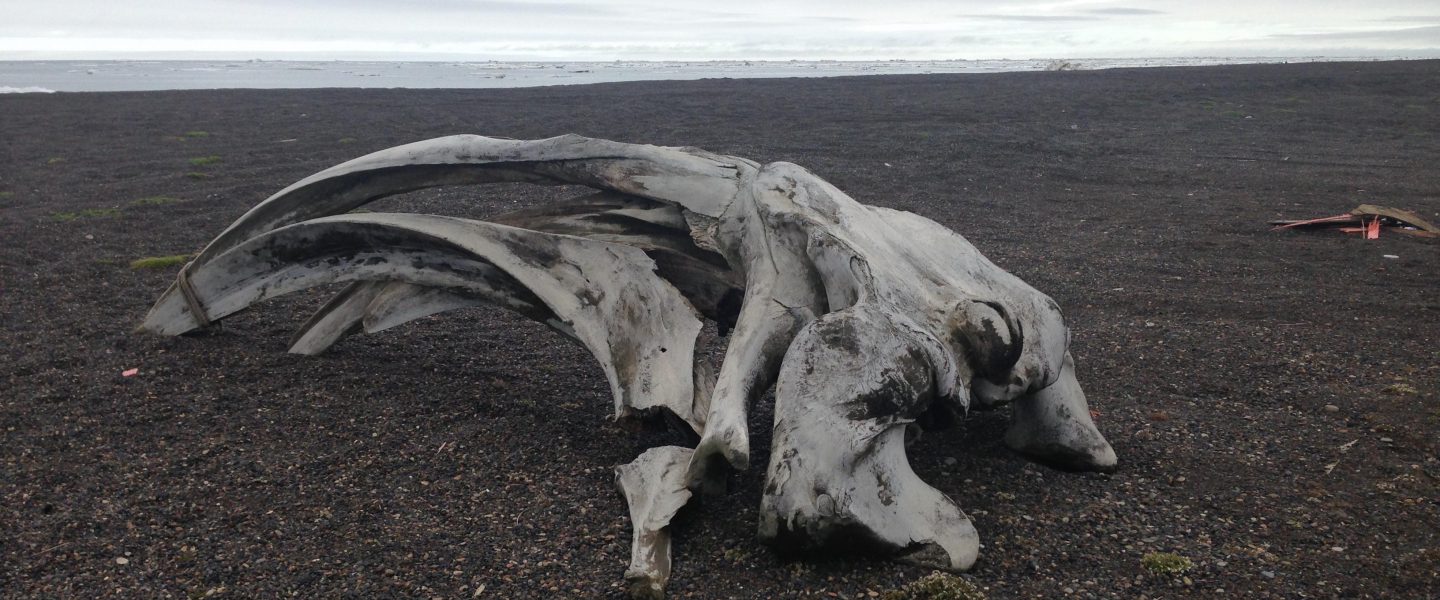
The one at the top of this page. I took that photo on the edge of the Arctic Ocean in Barrow Alaska. In the foreground is a whale skull. It’s a stark scene and in a sense a perfect visual metaphor for the uncertain times we live in. You’ll notice a complete absence of sea ice. With a good dry suit, I could have gone surfing. This was not always the case. While Climate.gov is still live, you can see quantitatively how drastically the environment has changed in Barrow here.

Much of the tundra in Alaska is permafrost. That includes communities such as Barrow. And that permafrost is now rapidly thawing. So Barrow’s future is quite uncertain. Look at my photo one more time. Real enough, right?