Tragedy at Virginia Tech

Our hearts go out to students and faculty at Virginia Tech where tragedy struck today. The loss of life is horrific. I just received word from the director of our sister institute, VBI, that all of their folks are OK.

All of us at Krasnow send our condolences to colleagues, friends and relatives at Tech.

Jim

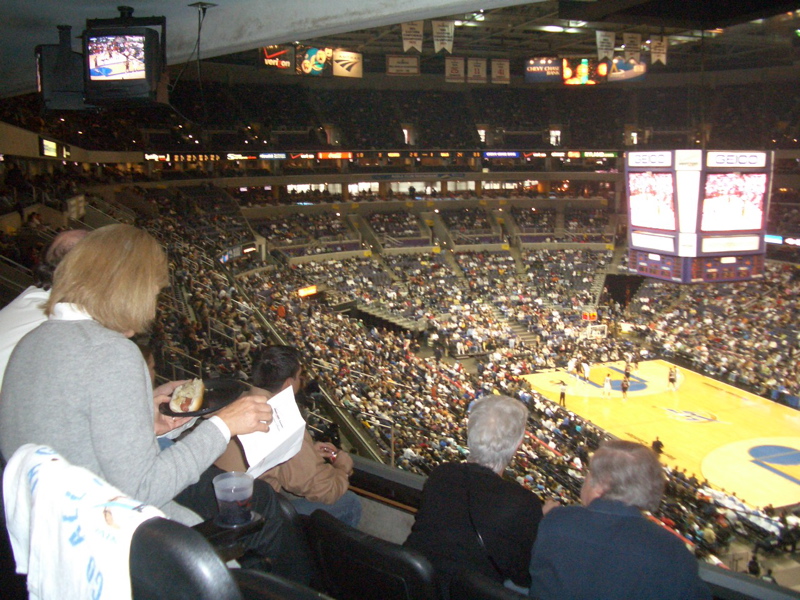
Krasnow supporters watch the Wizards


A delightful afternoon as friends of the Krasnow Institute enjoyed the Verizon Executive Box to watch the Wizards play the Bulls. Outside the Verizon Center the winds were howling as a Nor’easter roared through the Washington area. But inside, we got into the game as the play-off bound Wizards lost to the Chicago Bulls.

Molecular Neuroscience and Social Complexity

I noticed the other day that the original Institute for Advanced Study acts in some ways as a university with four academic units or schools. As the Krasnow Institute for Advanced Study is an academic unit now of George Mason University, it then shouldn’t be too surprising that we’ll be standing up two new departments within the Institute in time for the next academic year. These will be a department of molecular neuroscience (which I will initially chair in addition to continuing to serve as institute director) and a department of social complexity (which Claudio Cioffi has agreed to chair). Of course there will continue to be Krasnow PI’s from other academic units and collaborative threads to the rest of Mason in addition to our sister institutions around the world. The two new departments will play key, but not sole roles in the two interdisciplinary doctoral programs: social complexity and neuroscience.

My vision is that the Institute will remain first and foremost, a center for research excellence, reaching across disciplinary divides, while at the same time playing an ever increasing role in graduate education at the intersection of neuroscience, cognitive psychology and computer sciences–all within the context of complex adaptive systems.

And yet more construction

It certainly now looks like the next phase of the Krasnow Expansion (Phase II) will happen. This will double the 13,000 sq. foot addition that we are taking delivery of in the next month or so. That would have the Institute topping off at about 50,000 sq. feet which seems just about right. I’ll have more details as they become available.

Jim

The Writer’s Room

I had lunch at my club in Washington today (the discussion covered everything from neuroscience to nuclear weapons detection) with one of my favorite board members. This afternoon I’ve been ensconced in a small room at the very top of the old mansion (under the rafters but with a great view overlooking Massachusetts Avenue). It’s been the perfect place to work on a number of projects all of which are coming due at approximately the same time–hence the paucity of writing here over the past week. I’m taking a break however to consider the room itself: the walls are covered with member book covers, a letter from Mark Twain and some doodles made my President Theodore Roosevelt. There is an excellent network connection and my cell phone works quite well this high up….all in all, a wonderful place to get writing done on a Thursday afternoon.

Jim

Do we spend too much time on university policies?

All universities have policies. They cover all sorts of things germane to science ranging from regulating direct charges to grants all the way to scientific misconduct. I spend a fair amount of my time as a university administrator, thinking about these policies. Concretely, it seems that there is a fair amount of my time that is spent on university committees working on the language of these documents so that they both comply with relevant laws and protect the interests of George Mason.

At the same time, it seems as if there certainly was a time when there were less of these policies. When my father was a professor, the laboratory he ran was subject to much less regulation. And yet, it managed to produce good science, avoid breaking the law and even educate students. My concern, as an administrator, is that we may be, by creating policies to cover everything, creating too great a bureaucratic burden for working scientists. A good colleague of mine, thinks just the opposite: well written policies actually protect the PI, but laying out the “red lines” and removing the ambiguities inherent in both doing sponsored research and managing people.

At one level, the policy explosion simply reflects the way our society has changed writ large: there are many more laws…and many lawyers.

Jim

Seeing Red Revisited

I’ve previously blogged about Nicholas Humphrey’s book “Seeing Red” here. In the link above Paul Broks brilliantly dives into the hard question of consciousness.

Money quote:

Evolution then takes the animal to another level at which it comes to care about the world just beyond its body, so that, for example, it becomes sensitive to the chemical and air pressure signals of the proximity of predator or prey. This requires quite another style of information processing. “When the question is ‘What is happening to me?’ the answer that is wanted is qualitative, present-tense, transient, and subjective. When the question is ‘What is happening out there in the world?’ the answer that is wanted is quantitative, analytical, permanent, and objective.” The old sensory channels continue to provide a body-centred picture of what the stimulation is doing to the animal, but a second system is set up “to provide a more neutral, abstract, body-independent representation of the outside world.” This is the prototype of perception. At this stage the animal is still responding to stimulation with overt bodily activity, but eventually it achieves a degree of independence and is no longer bound by rigid stimulus-response rules. It still needs to know what’s going on in the world, so the old sensory systems stay in service, and it still learns about what is happening to it by monitoring the command signals for its own responses. But now it can issue virtual commands which don’t result in overt action. In other words, it no longer wriggles. Rather than going all the way out to the surface of the body, the commands are short-circuited, reaching only to a point on the incoming sensory pathway. Over evolutionary time the target of the command retreats further from the periphery until “the whole process becomes closed off from the outside world in an internal loop within the brain.” Sensory activity has become “privatised.”

Complexity and Social Networks Blog

Krasnow’s own Center for Social Complexity web link can be found here.

But I bring your attention to the Complexity and Social Networks Blog at Harvard (click the link above) edited by David Lazer. It’s good to see this field taking off. This afternoon, I’m attending the regular 3PM Friday tea at our own center.

Jim

WSJ on US News and World Report Rankings

The word on the street is that university presidents may be thinking of collectively refusing to provide data to US News and World Report used for the famed college rankings.

The Wall Street Journal thinks we should have a larger market of metrics besides the US News and World Report rankings of higher education. They quote my George Mason colleague, Tyler Cowan as being skeptical the supposedly “scientific” rankings tell us anything new.

From Tyler quoted in the linked WSJ piece: “there is really no difference at all between a school ranked 24 and one ranked 36.”

Yesterday I had a related conversation with a director of media relations at a very elite liberal arts college about the notion of brand identity among the top schools in the rankings. If there is no difference between number 1 and number 2, then why do alumni get so bent out of shape by a trend-line headed in the wrong direction. My thought is that the rankings (and hence the institution’s brand identity) are picking up information from the market (the market place of students, the market place of ideas) regarding underlying academic quality. So when things move “south” with the rankings, the assumption is that something real and substantive must be changing. A bit different perspective from Tyler’s.

Jim