
Dale Purves’ group at Duke has a very interesting new perspective on where human music gets its constraints from. I wonder if that counts hip hop?
Jim
Dale Purves’ group at Duke has a very interesting new perspective on where human music gets its constraints from. I wonder if that counts hip hop?
Jim
The Chronicle of Higher Education has a really important piece in the current issue that lays out a very solid case against the objectivity of the famed US News and World Report rankings.
Money quote:
So it appears that public universities have a hard time competing because of the other categories, based on quantitative data used by U.S. News. A closer look reveals that almost every one of those measures favors private institutions over public ones:
Six-year graduation rates. Most public colleges must, according to their missions, take less-qualified students. Private institutions graduate 64 percent of students, compared with 54 percent for public colleges, according to 2006 federal data.
Alumni-giving rate. Private institutions have typically been raising money for longer periods than have public ones. In 2006, 17.5 percent of graduates of private research universities contributed to their alma mater, compared with 11 percent of graduates of public research institutions, according to the Voluntary Support of Education survey.
Student-faculty ratio. There were 15.4 students per faculty member at public four-year institutions in 2005, compared with 12.5 students per faculty member at private institutions, according to the National Center for Education Statistics.
Acceptance rate. Because of their public mission, many state institutions must accept higher proportions of applicants. Berkeley and the University of California at Los Angeles accepted 27 percent of applicants in 2006, the lowest rates among public institutions, according to U.S. News data. But 14 private institutions had lower rates.
There is an interesting move afoot to break the near monopoly that U.S. News has on the rankings. Strap in for some interesting times in higher education.
Jim
Our last talk yesterday was from Nobel Prize winning economist Vernon Smith, the founder of experimental economics. The link is to a very interesting piece in Scientific American on a variation of the famous Prisoner’s Dilemma game.
Money quote:
If I were to play this game, I would say to myself: “Forget game-theoretic logic. I will play a large number (perhaps 95), and I know my opponent will play something similar and both of us will ignore the rational argument that the next smaller number would be better than whatever number we choose.� What is interesting is that this rejection of formal rationality and logic has a kind of meta-rationality attached to it. If both players follow this meta-rational course, both will do well. The idea of behavior generated by rationally rejecting rational behavior is a hard one to formalize. But in it lies the step that will have to be taken in the future to solve the paradoxes of rationality that plague game theory and are codified in Traveler’s Dilemma.
Jim
The last two days of the Decade of the Mind have been amazing. The
quality of the talks was spectacular. I learned a tremendous amount from
all of the speakers. The podcasts are going to be shortly available at
the decade web site (http://krasnow.gmu.edu/decade). I highly recommend
them. Going forward, there will be a manifesto authored by the speakers
and I'll have more on that subject later.
In the meantime, my academic summer begins this morning. I intend to
read journal papers and work on my own manuscripts most of the day.
Jim
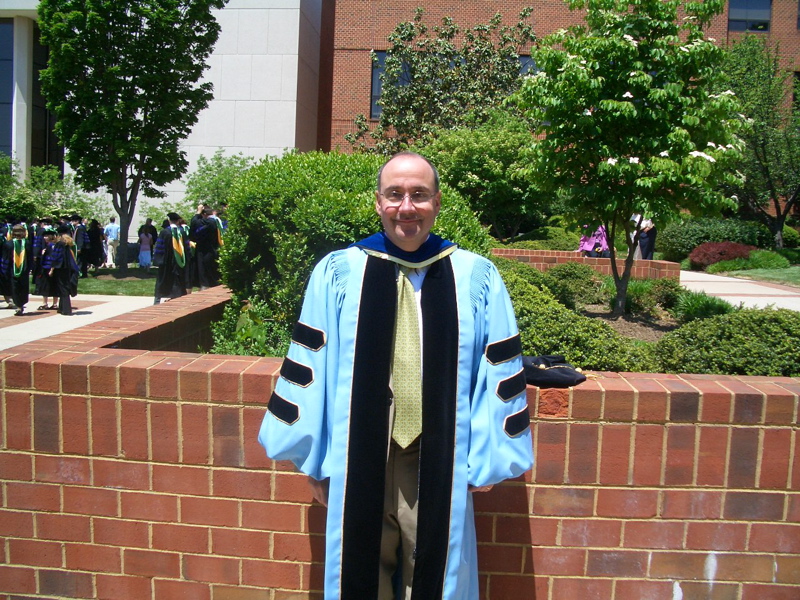
Governor Tim Kaine gave the speech. And some 6000 students got their diploma. And it was beautiful weather. Academic regalia is quite the sight!
Jim
Here’s another take on the tenure process from another academic blog, this one in physics.
Jim
This has been an extremely important year for the Krasnow Institute. But it also was a significant mile marker for me as I come to the end of my first term as Krasnow Director and prepare to commence my second term (which will end in May of 2012). My wife was remarking to me the other evening that I’m one of the few people she knows who really loves their job…and she was right. I’ve enjoyed just about every moment of my first term and I’m particularly grateful to the scientific community of the Institute for their support and enthusiasm towards our common goals.
For the Institute, this year marked the beginning of a new chapter at Mason as a full academic unit (holding our own faculty lines), the addition of 13,000 new square feet of labs and the opening of our MRI brain imaging center. Those are substantive changes for Krasnow. I’m confident that they are merely the prelude for a period of immense scientific productivity.
Our Decade of the Mind symposium next week is more or less contemporaneous with the University’s commencement exercises this year. It’s appropriate. The Decade of the Mind symposium marks the end a decade in the beautiful Krasnow Institute facility as well as the beginning of a new national enterprise to crack the mysteries of human higher cognition and perhaps consciousness.
We look forward to the end of a very successful academic year.
Jim
Today I’m going to write about some fundamental changes in the delivery of medical care that either are presently, or soon will change medical education.
Basically, these changes fall into three categories: 1) evidence-based medicine/computer medical record, 2) machine-assisted medicine and 3) individualized therapies. Let’s take them one at a time.
The advent of the computer medical record combined with advanced database query languages has facilitated the primacy of evidence-based medical care. The notion is that every aspect of a particular treatment for a patient is informed by the global evidence for that individual’s particular problem. This is quite different from the notion of individualized medicine, but just as powerful. Rather than simply relying on education and personal experience to treat patients, physicians will be constantly querying the “global” database about what the evidence says for treatment.
In the area of machine-assisted medicine, I am referring not only to the fabulous surgical robots that right now are changing medical outcomes (particularly in the cardiovascular and brain areas), but also to the advent of nanotechnologies whereby very small machines may deliver drugs at the location of a problem in the body using the circulatory system as the access pathway. I believe that machine-assisted medicine will require a sophistication in concepts of biomedical engineering as a new component of medical education.
Finally to individualized medicine. Here progress in genomics and proteomics will now allow medicine to move from a “one-size fits all” type of modality to one where the therapy is, as dependent upon an individuals biological “profile” as it is on the disease entity. Medical students of the future will need to acquire skills that are as focused on what makes a patient unique as opposed to the usual skill of learning what makes a patient like others (who have a particular differential diagnosis).
Food for thought about future medical education.
Jim
Just a reminder that the Krasnow “Decade of the Mind” symposium is next Monday and Tuesday. There are still some tickets available at the link above. Speakers include:
George Bekey • John Holland • Nancy Kanwisher
Mortimer Mishkin • Dharmendra Modha
Marcus Raichle • Gordon Shepherd
So I suppose the first question is why is the director of an Institute for Advanced Study so interested in George Mason starting a medical school?
The short answer is that neuroscience (my own field) ultimately is tied closely to understanding the phenomenon of human mind, and the many brain diseases that affect it. Thus, the notion of translational neuroscience (that is bringing the fruits of brain research to the patient bed-side) is extremely important to me. Growing neuroscience writ large at Mason implies having the kind of educational and research opportunities that are inherent to the medical education environment.
At another level, I look at the empirical data and can’t help but notice that universities with medical schools operate at a research scale qualitatively larger than those without. This university (and the region) needs top-flight Mason research to grow. Medical education at Mason will act as a catalyst for such growth. Indeed, as I’ve mentioned before, biomedical research can be an economic engine for the region.
That said, there are many reasons for not “cloning” the existing medical school models. For one thing, there is an on-going revolution in medical education timed with the recent 100th anniversary of the famous Flexner Report. That revolution, loosely called “Flexner II“, is a wave we need to catch. So we need to be looking at extremely innovative models such as those at Case-Western/Cleveland Clinic and Mayo, rather than the legacy programs.
Another reason for being innovative in our approach is that it will differentiate us from existing medical programs, around the Commonwealth and the United States. Mason has tremendous strength at innovative approaches. We can leverage this asset.
Finally, the region (i.e. the National Capital Region) has specific medical needs that are different from other areas of the country. As a potential terrorist target, the Washington area, needs more critical care physicians in addition to doctors with an advanced understanding of infectious disease, and if we’re smart, we can tailor our nascent program to those needs. Such shaping of our program can leverage our existing National Center for Biodefense.
It used to be that institutions of higher education with medical schools also owned their hospitals. But with the massive changes in the business model for medical care, this often doesn’t make sense. So Mason’s medical program will need clinical partners. Such partners would gain greatly from the research prestige and success already present at Mason, in such areas as cancer biology, proteomics and of course neuroscience.
In the next blog entry, I’ll write about evidence-based medicine, nanotechnology, medical robotics and how they might change the medical student curriculum.
Jim
 Discoverers and Discoveries