
I try to stress this regularly to our PI’s: if you don’t go fishing, you can be sure you wont catch any fish.
Over the next academic year, I’ll be meeting individually with all of our PI’s to discuss their grants strategies.
Jim
I try to stress this regularly to our PI’s: if you don’t go fishing, you can be sure you wont catch any fish.
Over the next academic year, I’ll be meeting individually with all of our PI’s to discuss their grants strategies.
Jim
I took a quick walk through the new building again today. The new labs
are ready to go and I'm expecting the first of our new faculty members
to arrive this evening at Dulles Airport.
I'm off to a meeting at the Law School and then fighting the get-away
traffic west. I'll be in our Wintergreen retreat this evening (if the
highway deities are willing).
Jim
Two important items relevant to the Institute made today’s on-line edition of the Chronicle of Higher Education. In the first, the House version of the DOD appropriation’s bill would cap overhead reimbursements at 20% on competitive research grants. This is a very big deal since the typical overhead reimbursement rate is currently around 50% for US Research Universities.
The second item concerns the migration of Vernon’s Smith’s experimental economic group–which is moving to Chapman University (a non-PHD granting private institution in Orange County California)–minus our own Kevin McCabe, who is quoted extensively in the interview. Kevin heads up our Neuroeconomics Center. I am delighted that he is staying at George Mason–and of course, our Brain Imaging Center is a key tool to his work, that simply wouldn’t be available at Chapman.
Jim
The Chronicle of Higher Education’s afternoon edition reports that SCIENCE has decided to pull out of the J-Stor archive since its own content (back to 1880) is now on-line. I’m not so sure that’s a wise move though. J-Stor’s value lies in a scholar’s ability to search across journals.
Jim
The new wing passed its final fire alarm test. With that, the certificate of occupancy should be issued in Richmond, and we can begin to do science in the new space.
Meanwhile….my colleague and fellow blogger Tyler Cowan has written a new book, Discover Your Inner Economist. It’s gotten great reviews and seems like a great explanation for Tyler’s unique ability to live life really well. Tyler’s blog can be found here.
Jim
It’s the end of July and already around DC the first leaves are beginning to show evidence of Fall color changes. At this time of year, those early reminders of the impending semester are always a bit disconcerting. I’ll be off to Woods Hole next week to focus on The Biological Bulletin. Shortly after I return, Mason’s administration will have its annual planning conference retreat and following a quick trip to Iowa for a meeting of The Great Apes Trust scientific advisory board, I’ll be returning to a new semester and even some teaching responsibilities.
Summer does indeed fly by in academia.
This Fall, Krasnow will welcome two new PI’s, two new doctoral cohorts (for Neuroscience and Social Complexity) and open our new building wing with its state-of-the-art labs. I’m really excited. At the same time, we’ll be going into the planning process for the next wing of the building, new searches and the next “Decade of the Mind” events (which I’ll have more to report on here soon).
I’ll end by reporting that, in spite of climatic reputations, the weather in Salzburg was considerably hotter than it’s been in Washington since I’ve returned–is it due to Climate Change?
Jim
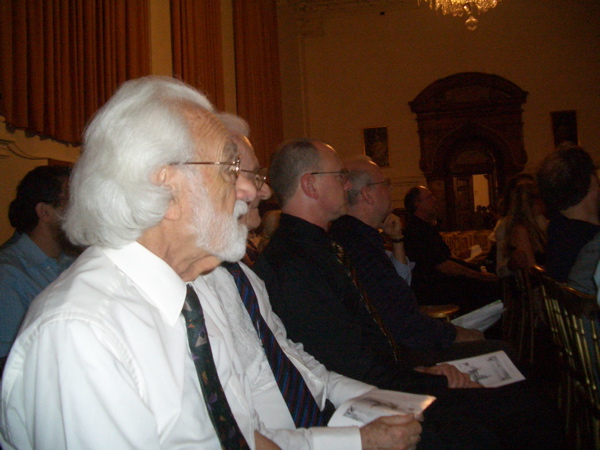
Here is a photo of one of the pioneers of modern integrative neuroscience, Karl Pribram at the meeting. The meeting participants were feted by a chamber music concert in the famous Residenz Palace in the Center of the City. Of course the music was entirely Mozart. Two people to his right is my graduate student, Mike Cloud.
Jim
I am back from a very enjoyable conference in Salzburg which I’ll soon describe at some length. Central Europe is suffering from a terrible heat wave and without the ubiquitous air conditioning that we have here in Washington D.C., sleeping in the evening was pretty rough. Nevertheless, the company and talks more than made up for it.
So I’m back for two weeks or so, before heading off to Wood Hole. I’ll try to upload some photos later today.
Jim
I’ll be at a meeting in Salzburg next week and for once, I’m just taking my blackberry–no computer, so I expect blogging will be light. I’ll try to take some good pictures for posting when I return. I’m also going to ask one of my graduate students, Mike Cloud, to guest blog–he is giving his first poster. I bet he’ll have some interesting impressions.
In the meantime, our new PI’s Rob Cressman and Ted Dumas are getting set to move into Krasnow. Rob is an assistant professor in the Physics Department. Ted is an assistant professor in my own Molecular Neuroscience Department. I’m very excited about their joining us.
We also have a new office manager starting when I get back, Stacey Sexton. I know we’ll all welcome her to the Krasnow scientific community.
Have a nice weekend (and week).
Jim
One of the most difficult tasks for academic administrators (particularly those in the biosciences) is the challenge of properly mentoring junior faculty members. The crux of course is the tenure clock and the generally accepted metrics for promotion–grants and publications. The other complication lies in the fact that junior faculty members act to build favorable impressions with their academic leaders (and senior colleagues) and that these actions may take away (or at least compete) for the crucial time and energy that must be devoted to scholarship.
So the problem then becomes one of trying to focus the junior faculty member’s energies in what will be best for them (in terms of that tenure clock) rather than necessarily what is best for the academic unit.
This is one of the rare cases, where a good academic leader will put the unit’s interests as secondary to that of the individual faculty member.
But the issue becomes more nuanced when a junior faculty member is providing a crucial service function to the unit (for example teaching an introductory course). Here the complexity that arises is the weighing of the loss to the unit (course not taught) against the loss to the faculty member (not enough time to pursue scholarship).
From an ethical standpoint, I think the proper action remains the same: counsel the junior faculty member to focus of his or her scholarship. At the same time, it sure becomes a painful mentoring moment.
Jim
 Discoverers and Discoveries