Advisory Board meeting

We had a very productive advisory board meeting yesterday. There was a very extensive discussion of branding, and how crucial it the notion of “institute for advanced study” is to our identity–most folks intuitively have a feel for what that phrase means. And of course it ties us to the Institute for Advanced Study at Princeton–the one that hosted the likes of Einstein. Additionally there was discussion of the “Decade of the Mind”, both within the context of brand, but also from the standpoint of what it will take to persuade decision-makers to move forward with the proposed federal investment.

The best part of the meeting however, was when three of our new PI’s gave short talks on their work and responded to Q&A. The enthusiasm of our board was very palpable. We have very very talented scientists here.

Jim

Searches for new faculty

Sat in on the search for a new faculty position in Molecular Neuroscience today. The pool is really both large and excellent. It was very difficult to even think about making a first cut! On Thursday, at the Institute’s Advisory Board meeting, I’ll be working to secure the resources to ensure future robust faculty growth at Krasnow both in the neuroscience area, but also in our newly formed department of social complexity.

Jim

Making Andrew Sullivan’s Blog

On the subject of neuroarchitecture…

According to [Jim] Olds, [a neuroscientist at George Mason University], not every design firm is sold on the idea that architecture affects people on a neurological level. Still, he notes that what he calls ‘neuromarketting’ is a growing and well funded field that could well expand into mainstream architecture.

“Well, neuromarketting is a big field and it’s highly funded… And brain scanning is now replacing the focus group as a way to do marketing and certainly product placement in a retail space is an extremely important component of marketing,” said Olds.

Hmmm….I don’t agree with Andrew on everything, but this is good to see.

Jim

Loudoun Academy of Science

I had the pleasure and honor yesterday evening to attend and speak at the “Coating Ceremony” at Loudoun County’s Academy of Science High School. Loudoun County, home to Washington’s Dulles Airport and the Janelia Farm complex of Howard Hughes Medical Institute is one of the fastest growing places in the US. The academy of science idea for a high school is a variation of the magnet school concept but one that I think can be particularly powerful. In particular, the school’s director George Wolf, seeks to have high school students designing their own experiments and subsequently carrying them out, as distinct from the more common concept of “farming” science high school students out to mentor laboratories. I really think this is an excellent idea. The Academy is also conducting a very interesting collaboration exercise with a high school in Singapore. The research, into high school science education, is supported by the National Science Foundation. As I understand it, students at the Academy of Science will be paired up with students in Singapore and collaborate over the net to do their science.

Jim

Scientific truth and consensus

Financial Times columnist John Kay has a column in today’s paper that really clearly states the difference between science and scientific consensus (often used to generate science based policy decisions). It’s a good read, if a bit controversial.

Taken out of the climate change debate and placed instead in the field of neuroscience, I think it’s pretty spot on. Fifty years ago there was a consensus that each neuron had one single neurotransmitter. That’s one example of many, where consensus was scientifically wrong.

Jim

Nobel Prize in Physiology and Medicine

Gene targeting was the method they developed (in mouse)….Congrats to Drs. Mario Cappechi of the University of Utah, Oliver Smithies of UNC and Sir Martin Evans at Cardiff!

And by the way–it’s a technique that is being used here at the Krasnow Institute for Advanced Study.

Jim

What really dark skies are like

The sky was perfect for observing last night here in Wintergreen
Virginia. The comparison with the skies of Washington DC is
startling: instead of perhaps 20-40 stars visible (Washington) you
can see perhaps 6000 with the naked eye up here. Through my telescope
I got an incredible view of the Andromeda Galaxy: millions upon
millions of stars.

Tomorrow, Columbus Day, there are no classes for Mason's
students….but it's a regular work day for the administration. So be
it. I have a pile of work waiting for me when I get back.

Jim

A bit of amateur astronomy


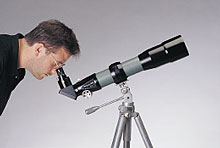
I’m in my Wintergreen house for the Columbus Day weekend. If I get lucky this evening, I’ll be able to do a bit of amateur astronomy with my TeleVue-85 refractor, a small jewel of an instrument which travels well and doesn’t require a lot of adjustments. That’s not me by the way, it’s from the advertising material. But my instrument looks just like that.

When we built this house, we put in a small observatory deck facing south, opposite the main view of the house which looks north up the Shenandoah Valley. With its height (above the trees) and southern view, this will be optimal for Fall and Winter observing.

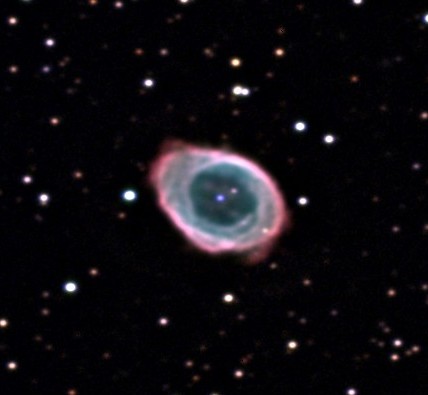
Tonight, if it stays clear, I’ll take a look at M57, the ring nebula in Lyra–one of my favorite sights.

Jim

Oprah’s Soul Series on XM -Radio

I’m getting a lot of requests for more information about the experience of being interviewed by Oprah yesterday evening for her Soul Series on XM-Radio. We did it out of the studios of WGMU in the Johnson Center here at Mason, but with the ISDN line it really felt as if the two of us were just having a friendly conversation in the same studio.

The first thing I need to say is that Oprah is an extremely personable interviewer. She put me pretty much instantly at ease with her combination of humor and warmness, and then we pretty much jumped into a discussion of just what modern neuroscience can offer us as to insight into the human mind, using Joel Achenbach’s article in the Washington Post as a starting point.

We talked about the difference between human intelligence and animal intelligence (we both came to the consensus that our dogs don’t spend a lot of time reflecting on either their soul or their place in the universe). I spent some time talking about what non-invasive brain imaging has gotten us….and what it hasn’t (i.e. we can’t read off the neural code).

Talking about meditation, I think she was surprised to learn that the Dalai Lama had been the star plenary guest at a recent Society for Neuroscience meeting held in Washington. Neuroscience certainly is interested in altered mental states.

The interview then turned to the “Decade of the Mind” project itself. My strong sense is that she understood why we belief that this proposed investment is necessary and supported it.

We also talked about my favorite brain structure, the hippocampus–how it is not only beautiful from a structural standpoint, but also what the clues from patients who have lesions to their hippocampi say about the laying down of episodic memories.

She asked me if it’s just a neuroscientist “thing” to find the hippocampus beautiful or would any person agree. Of course you can guess how I answered.

Finally I got to spend some time talking about the role of intuition in the life of an experimental science–how intuition at the laboratory bench can lead to that “Ah Ha” moment of discovery.

Jim

Strategic planning at universities

I’ve been through a few of them by now. Today’s Chronicle on-line has an interesting take on them that’s actually quite positive….

“To be useful, the plan must give an honest assessment of where an institution is and where it wants to go, planning experts say. It must also include specific, honest budget numbers.”

This is at odds with the camp that views “stretch goals” as the key method of strategic plans to take an institution up to the next level.

Jim