Big Tobacco Grant Money Drying Up?

A confusing story from the Chronicle suggests that Philip Morris is getting out of the extramural grant business. But towards the end of the piece it gets nuanced….

How the decision will affect many academic research projects was unclear, but one antitobacco crusader, Stanton Glantz, a bioengineer at the University of California at San Francisco, pointed out that tobacco money was not going away.

He cited the $6-million Philip Morris grant won by Edythe D. London, the researcher at the university’s Los Angeles campus whose home was flooded by animal-rights extremists in October and who was the target of a firebomb attack this month. Her grant was not awarded through the external-research program, Mr. Glantz told the magazine.

The question about these grant dollars is of course the same as taking money from the big drug companies: are they paying for a specific result?

Jim

Flu strikes blogger

Yes, the wonders of viral biology. I’ve been struck down for the past
few days, but also filled with respect. Max Delbruck worked on a really
wonderful organism.
If…problematical for us humans.

Jim

The Ice Storm Cometh


Another ice storm here in the Washington DC area. The last one, about a week ago produced complete chaos in the largest freeway interchange–so the rumor is this time they are ready with those trucks they use at airports to deice jets. Hmmm. I think I’ll stick with the surface streets.

More interestingly, NIH is out with a new plan to peer review grants. You can see the Chronicle’s take on it here. One questions how a new peer review plan can put a dent in what amounts to a slow collapse of research funding at the agency.

Jim

National Geographic on Animal Minds

In the spirit of the “Decade of the Mind” initiative that we are so invested in, here’s a very cool article in this month’s National Geographic on animal minds by Virginia Morell. Irene Pepperberg’s work is prominently mentioned.

I’ll remind readers that the third Decade of the Mind event will focus on how mind emerges in animals in May of this year at the Great Ape Trust.

Jim

Wikipedia versus its competitors

I’m very interested in the phenomenon of Wikipedia. Many times when Wikipedia comes up as a topic, I find that people are mystified by its democratic approach to editorial control. And of course competitors such as Scholarpedia view this characteristic as the antithesis of true peer review.

However, for many topics where I am able to spot check Wikipedia (in my own areas of expertise) more often than not, Wikipedia is close to spot on. That is articles are detailed, well referenced and cogent. And of course Wikipedia is huge. It’s got a head start (understatement) on its competition.

The question of course is: can I trust Wikipedia to give me close to accurate information in areas outside my expertise?

Jim

Our colleagues at the Great Ape Trust in the news

Krasnow alum, Rob Shumaker at the center of the story:

Dr. Rob Shumaker, director of orangutan research, signed the document on behalf of Great Ape Trust in January after he and one of his scientific colleagues, Dr. Serge Wich, traveled to the Indonesian island of Sumatra. Wich is one of three co-directors of orangutan research at Ketambe Research Center, the longest-running field study site for orangutans in Sumatra. Ketambe is located entirely in the Gunung Leuser National Park, and is therefore part of the government-protected Sumatran Rainforest World Heritage Site and the Leuser Ecosystem. About 90 percent of 6,700 critically endangered Sumatran orangutans (Pongo abelii) are found in the Leuser Ecosystem.

New faculty member for the Fall: Nadine Kabbani Ph.D.

It’s a pleasure to announce that Dr. Nadine Kabbani will join the Department of Molecular Neuroscience here at the Krasnow Institute for Advanced Study for the Fall term 2008. Dr. Kabbani comes to Mason from the Institute Pasteur in Paris where she was a post-doctoral fellow in the laboratory of Dr. Jean Pierre Changeux. Her research has focused on the proteomic profiling of nicotinic receptor complexes in the brain using mass spectrometry.

Previously Dr. Kabbani was in the laboratory of Dr. Patricia Goldman-Rakic at Yale University. She received her Ph.D. from Penn State University under Dr. Robert Levenson in 2003.

And Dr. Kabbani is coming home. Because she received her B.A. in Biology and Psychology right here at George Mason University.

Welcome back Nadine!

Jim

Mason makes the Sunday NY Times

The subject matter is the current explosion of international campuses for American universities. Mason is an important case study in the piece.

Money quote:

While the Persian Gulf campus of N.Y.U. is on the horizon, George Mason University is up and running — though not at full speed — in Ras al Khaymah, another one of the emirates.

George Mason, a public university in Fairfax, Va., arrived in the gulf in 2005 with a tiny language program intended to help students achieve college-level English skills and meet the university’s admission standards for the degree programs that were beginning the next year.

George Mason expected to have 200 undergraduates in 2006, and grow from there. But it enrolled nowhere near that many, then or now. It had just 57 degree students — 3 in biology, 27 in business and 27 in engineering — at the start of this academic year, joined by a few more students and programs this semester.

The project, an hour north of Dubai’s skyscrapers and 7,000 miles from Virginia, is still finding its way. “I will freely confess that it’s all been more complicated than I expected,” said Peter Stearns, George Mason’s provost.

The Ras al Khaymah campus has had a succession of deans. Simple tasks like ordering books take months, in part because of government censors. Local licensing, still not complete, has been far more rigorous than expected. And it has not been easy to find interested students with the SAT scores and English skills that George Mason requires for admissions.

“I’m optimistic, but if you look at it as a business, you can only take losses for so long,” said Dr. Abul R. Hasan, the academic dean, who is from the South Dakota School of Mines and Technology. “Our goal is to have 2,000 students five years from now. What makes it difficult is that if you’re giving the George Mason degree, you cannot lower your standards.”

Pre-Super Bowl Basketball


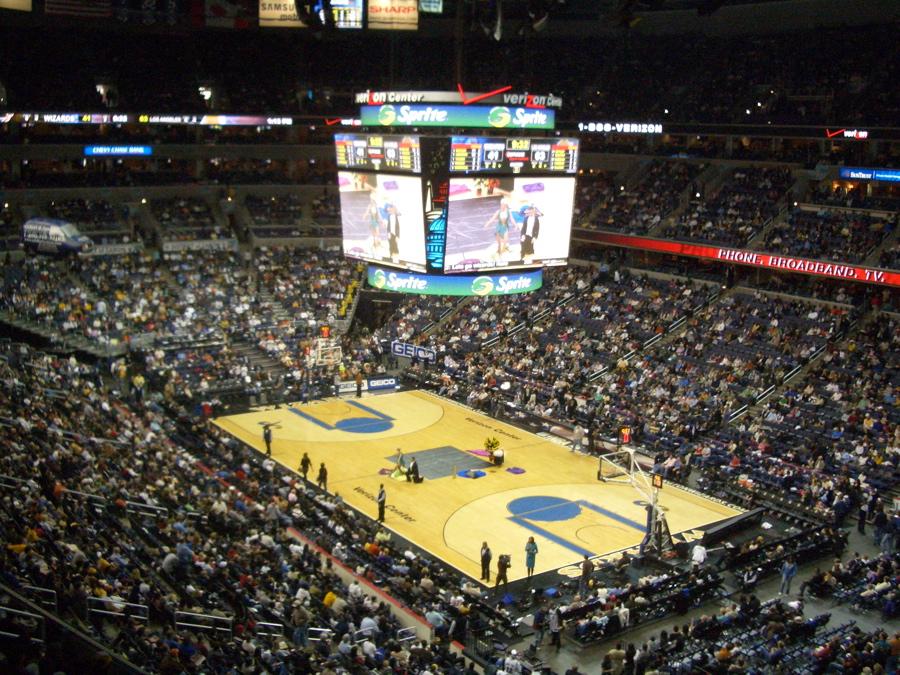
Yesterday afternoon, friends of the Krasnow Institute for Advanced Study celebrated the Super bowl early as they watched the Los Angeles Lakers blow out the Washington Wizards from a Verizon Box at the sold-out Washington Verizon Center. Among those attending the “friend raising event” were Len and Ginger Pomata, Bill Nitze, who have been instrumental in advancing the science of the Institute through their gifts.