Putting together a hippocampal function course

The current project is preparing a course for both undergraduates and doctoral students in neuroscience for next semester on the function of the hippocampus. For many in the field, this is an already answered question–the hippocampus is the biological substrate for human episodic memory. Others see it still as the neuronal seat of the so-called cognitive map. I’m not so sure. For all the experimental data collected on this beautiful brain structure over the years, the problem of biological function remains tantalizingly unclear.

Phenomena such as place cells, adult neurogenesis, theta phase precision, sequence learning and London Taxi Driver hypersized-hippocampi all are clues, but the detective story remains just that….a story.
Augustine Commission Report

Well the Augustine Commission Report on manned space flight is out and initial reports suggest a change in course for NASA may be in the offing. Specifically, the Shuttle may not retire as per schedule and the planned Ares launcher program may be in trouble.

Read about it here.

Along the GW Parkway in the Fall

I drove home this evening along the George Washington Parkway which parallels the Potomac River opposite the city’s monumental core. The maple trees have achieved peak Fall color (as we say on the East U.S. coast referring to the change from green to orange/red) and were actually reflected in the River. I had the top down on the car and it was simply beautiful.

I worry that those of us who are lucky enough to live in beautiful places often become so focused on the task at hand, the local crisis, getting ahead, that we neglect that sensory festival that some people travel thousands of miles to see as tourists. That’s a shame. It’s a splendid way to engage one’s nervous system.
I stopped in the local fish store to purchase some fresh trout fillets and some calamari salad. The owner, wearing his trademark vintage Detroit Tiger baseball cap, instructed me carefully on how to prepare my fish–he always does. I always follow his directions and it, to date, has worked out pretty well.
Jim

The Problems with European Union Science Support

From ScienceInsider, an excellent look at proposed changes to the way the European Research Council administers research grants here.

Money quote:

A key target in the panel’s harshly worded review, published in July, was the managerial dichotomy at the ERC. A Scientific Council, made up of volunteers and chaired by Imperial College London biologist Fotis Kafatos, sets the ERC’s scientific agenda. But day-to-day-management is in the hands of civil servants at the Executive Agency in Brussels, which is controlled by the European Commission. The two clash frequently.

Cellular imaging at Krasnow


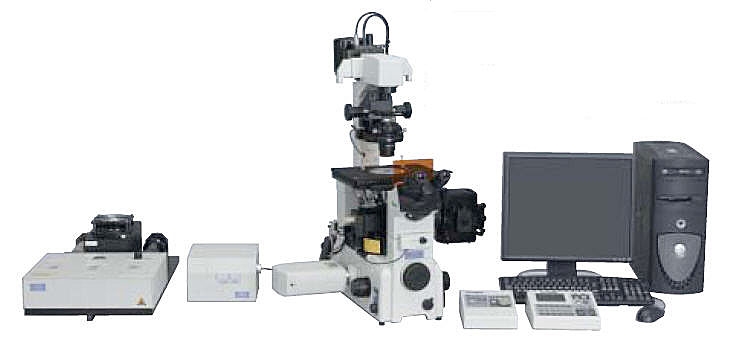
I’m pleased to report that we’ve taken delivery of our Nikon C1 confocal microscope and that very shortly we’ll be opening a cellular imaging core at the Institute to complement our MRI facility.

So what’s the deal with confocal microscopy? The short version goes like this: biological specimens, especially living tissue ones, are thick. Classical microscopes have a problem with this and internal organelles get blurred out. With confocal microscopy, we can get around that problem and look into the sample with all the detail of the cell’s three-dimensional structure preserved. Used in consort with our ability to molecularly engineer biological components of the cell to fluoresce, this becomes an incredibly powerful tool for our neuroscientists who work at the neuronal or cellular level.

Fish are smart!

From today’s NY Times (and with good timing with the on-going Society for Neuroscience meeting in Chicago)–this piece by Sean Carroll.

My thesis advisor, Bernard Agranoff, became famous studying the goldfish brain. Now I know why.

Here’s the money quote:

A series of studies has recently revealed that reef fish are surprisingly adaptable. Freshly caught wild fish quickly learn new tasks and can learn to discriminate among colors, patterns and shapes, including those they have never encountered. These studies suggest that learning and interpreting new stimuli play important roles in the lives of reef fish.