Many of you will have noticed the very striking work of Steven Sacklarian (1889-1983) that is on display around the Institute. Information about this important artist is here. I hope that our science community and visitors will enjoy the new paintings. To me, many of them bring to mind the cellular processes that make up biology.
First, hang all the lawyers: Cold Spring Harbor edition
Cold Spring Harbor Laboratory is apparently going after the law firm that handles their intellectual property–the Lab alleges that portions of one patent application were lifted from another, much to the embarrassment of the Institution. Click on the link above.
Gravity as an emergent property of information in the Universe
Money quote:
A few month’s ago, Erik Verlinde at the the University of Amsterdam put forward one such idea which has taken the world of physics by storm. Verlinde suggested that gravity is merely a manifestation of entropy in the Universe. His idea is based on the second law of thermodynamics, that entropy always increases over time. It suggests that differences in entropy between parts of the Universe generates a force that redistributes matter in a way that maximises entropy. This is the force we call gravity.
Back from Palm Beach

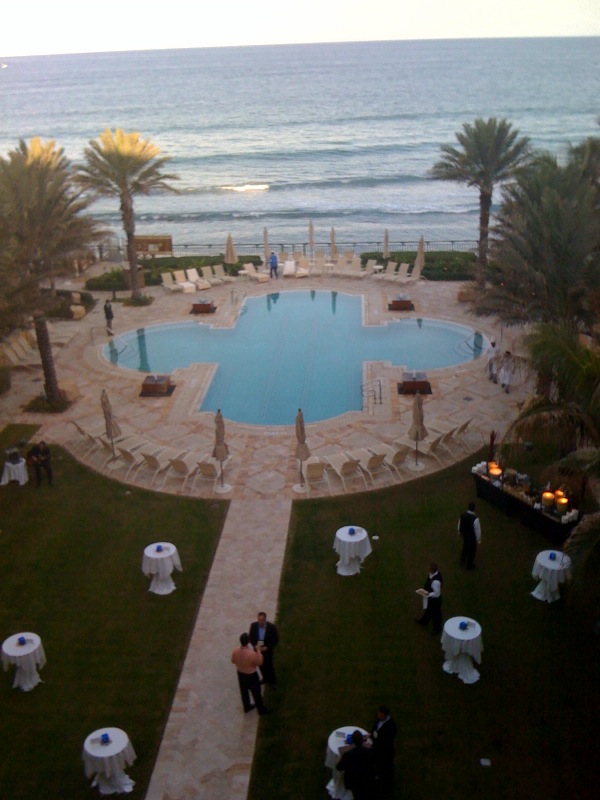
I’m back from Palm Beach and the lifeguard stand yesterday morning was flying a flag that apparently indicates “dangerous marine wildlife”. Obviously my first thoughts (it was near perfect surfing conditions, off-shore breeze and a nice curl) were of large great white sharks cruising just behind the break. But then I started thinking about how the Marine Park’s here in Florida have had their own dangerous marine wildlife conditions–seems to me that an Orca confined within a tank is a recipe for disaster.
But then walking along the beach, and noticing the very dangerous remnants of a Portuguese Man’O War jellyfish, I was satisfied that I’d found the real danger in an invertebrate with a serious attitude (as far as stinging is concerned).
But then I learned later, in fact I’d been right originally–it was the sharks.
I may be the editor of The Biological Bulletin, but I’ve got a lot to learn about marine biology!
Jim
Talking about a theory for neuroscience
I’m giving a talk this evening for the Philosophical Society of Washington–the abstract is here. One of the issues that jumps out whenever I give one of these talks is how neuroscience, unlike disciplines such as physics or chemistry, lacks a general theory that provides a framework or skeleton for both old knowledge and more importantly new discoveries.
As a discipline, we in neuroscience, are very good at amassing and organizing (and even sharing) data. But a general theory (analogous to say quantum mechanics or relativity)–that we are lacking. Instead we have a multitude of nascent bounded theories for various levels of organization within the brain. Hence, we have some idea of how individual neurons signal one another, how groups of neurons may act together to store memories and create perceptions, how brain diseases affect this or that brain region, and how drugs may act to ameliorate brain conditions (or sometimes create addiction). But what we lack, is a general theory of how the brain’s organization and dynamics lead to the phenomena we generally associate with brain: consciousness, creativity, deception and the like.
So that could be a very exciting thing for a discipline (i.e. the most exciting times are yet to come) or very frustrating.
I’m going to argue this evening, that perhaps we can see the vague outlines of what such a general theory might look like.
I’ll post more on this soon.
Jim
How People Behave in a Disaster
Click on the link above–a very interesting finding about crowd behavior on the Titanic versus the Lusitania.
ARPA-E–brought to you by Secretary Chu’s Department of Energy
The Department of Energy’s version of DARPA had its first major event at National Harbor (Suburban Washington DC). Read about it here.
National Competitiveness
Tom Friedman, I feel sometimes over simplifies things, but in today’s opinion piece in the NY Times, he gets it spot on.
Kudos to Pat White
My former FASEB colleague and friend Pat White has been appointed the new legislative director at NIH. This is great news for the NIH and its many friends and stakeholders. Congratulations Pat.
What the hippocampus actually does
I’ve always been attracted to a theory that, as far as I can tell, was first put forward by Tyler and DiScenna in 1986 in Behavior Neuroscience. The notion was that the hippocampus indexes cortical module associations rather than episodes. Experimental results which appear to reveal mnemonic associations in the hippocampus actually do so because of the “indexed” cortical modules (think columns) which do actually collectively (think cell assemblies) correlate with episodic memory.
The theory has been modified and amplified by many in the field over time. The conventional wisdom was that while the theory was attractive, its fatal flaw was the lack of neuroanatomical evidence for reciprocal connections between neocortex and the hippocampus. In fact, the hippocampus does receive information from the entire neocortex, but unlike the thalamus or striatum, the mapping consists of a convergent stream where many different cortical areas flow information towards the entorhinal cortex which then dumps that combined flow into the hippocampus in a reciprocal fashion (i.e. the output of the hippocampus is also the entorhinal cortex). This makes the Tyler and DiScenna’s original idea difficult to conceptualize, but not impossible.
If the hippocampus was facilitating the formation of neocortical cell assemblies in some way that acted like an index, how might such a mechanism work given the serial (rather than parallel) connectivity between the hippocampus and the neocortex via the entorhinal cortex?
I invite ideas for how this might work from loyal readers.
Jim