
Stanley Fish on Plagiarism
I’m not usually an avid reader of Stanley Fish’s columns in the New York Times, but this one on academic plagiarism really hits the mark for me.
Money quote:
And if there should emerge a powerful philosophical argument saying there’s no such thing as originality, its emergence needn’t alter or even bother for a second a practice that can only get started if originality is assumed as a baseline. It may be (to offer another example), as I have argued elsewhere, that there’s no such thing as free speech, but if you want to have a free speech regime because you believe that it is essential to the maintenance of democracy, just forget what Stanley Fish said — after all it’s just a theoretical argument — and get down to it as lawyers and judges in fact do all the time without the benefit or hindrance of any metaphysical rap. Everyday disciplinary practices do not rest on a foundation of philosophy or theory; they rest on a foundation of themselves; no theory or philosophy can either prop them up or topple them. As long as the practice is ongoing and flourishing its conventions will command respect and allegiance and flouting them will have negative consequences.
Stability at NSF
Science Insider has the details here. Cora Marrett will be deputy director at NSF.
Back from New England
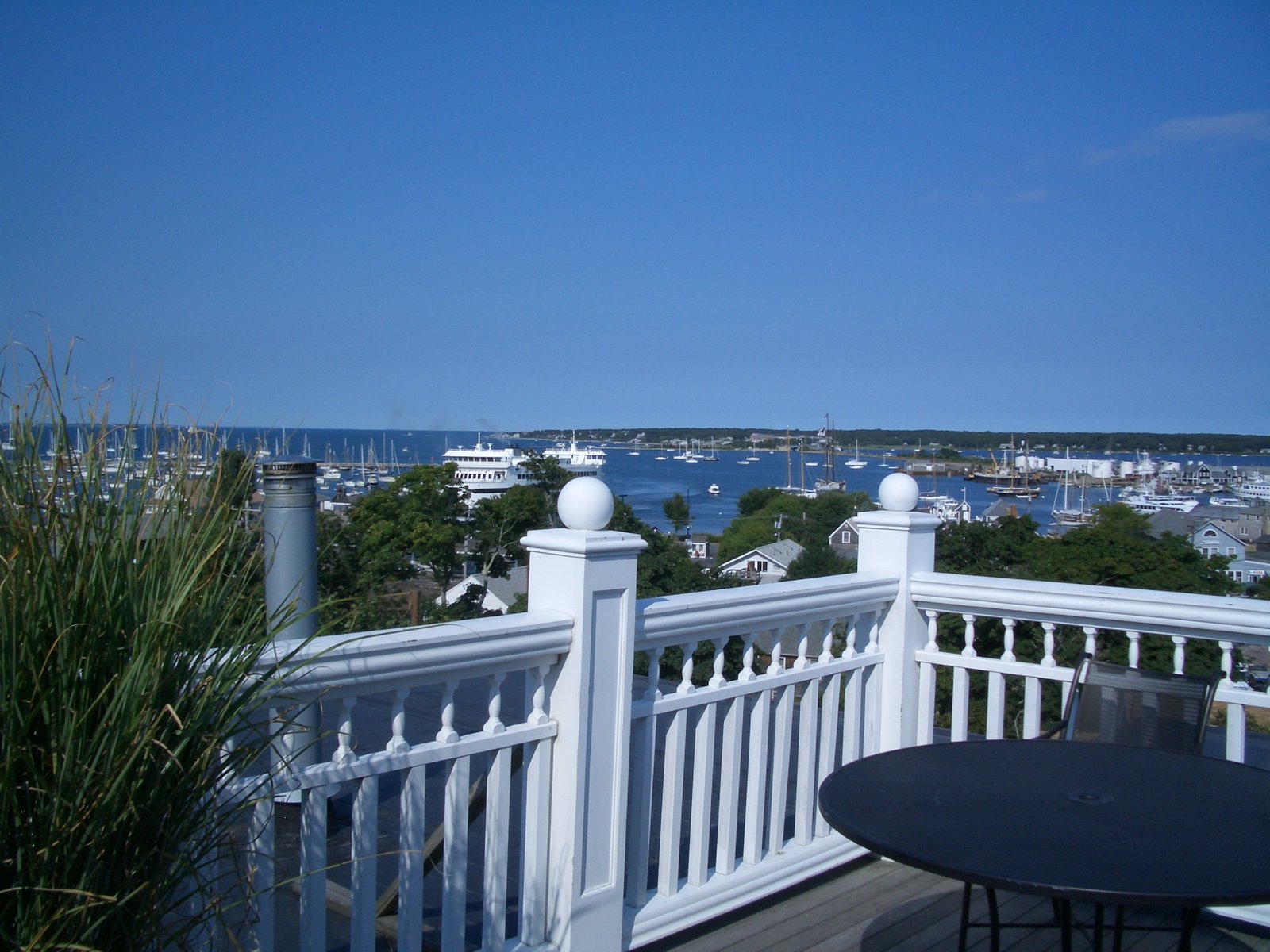
It was a great time in New England this past week. My niece got married in Watertown. We attended the MBL gala to support Woods Hole’s scientific gem, spent some time on the cupola roof of the Mansion House in Vineyardhaven (that’s the image), and came back to the MBL to attend the annual Corporation meeting.
Yesterday, I woke up early–around 4:30 and enjoyed a walk through town that was virtually quiet except for the stirrings of folks getting their boats ready for fishing. Otherwise, nothing but the ducks on Eel Pond and me. But by 5, the Pie In The Sky bakery was humming with activity, the coffee was brewed and I was on my way to Boston by 5:15.

Rapid Transit on Martha’s Vineyard
Not. Well, let me amend that. Not really as bad as I’ve seen it in the past (think the Clinton era). People are using their cars less and using the bus more–a good thing. Tomorrow, back to MBL and science.
Mount Sinai admitting medical students without Organic Chemistry or the MCAT
From today’s NY Times on line, here.
Money quote:
The students apply in their sophomore or junior years in college and agree to major in humanities or social science, rather than the hard sciences. If they are admitted, they are required to take only basic biology and chemistry, at a level many students accomplish through Advanced Placement courses in high school.
They forgo organic chemistry, physics and calculus — though they get abbreviated organic chemistry and physics courses during a summer boot camp run by Mount Sinai. They are exempt from the MCAT. Instead, they are admitted into the program based on their high school SAT scores, two personal essays, their high school and early college grades and interviews.
Heading Past Third Base on Summer
We’re only about four weeks out from the beginning of the Fall semester here at George Mason. Already, you can feel the campus gearing up. Today at Academic Council we went over the University’s QEP (Quality Enhancement Plan) to substantially increase undergraduate participation in scholarship and creativity over the next years. This is quite exciting to me because of how clearly valuable undergraduate research experiences are to the success of future scientists. Both at NIH and at the MBL, I got to see this first hand. Good science is inherently a creative endeavor. And when one experiences creative science during the undergraduate years, science becomes a passion.
In the meantime, I’m headed to Woods Hole next week. What’s not to love about that?
Kudos to Dharmendra Modha
Hold The Week: June 19 2011 Krasnow Institute Decision-Maker Short Courses
We’re moving briskly ahead with our plans to offer two short courses for decision makers–one track will cover neuropolicy, the other computational social sciences–we’ll hold them here in the Washington D.C. area, probably here on the George Mason University campus.
The faculty will be world-class, as will the attendees.
Tyler Cowen weighs in on the tenure debate
Link is above. Money quote:
With the pro-tenure arguments, you might wonder how higher education is supposed to differ from other sectors of the economy. I believe it is this: given that higher education is in part about signaling and certification, socialization and networking of students, “warm glow” of the donors, and research superstars, the later-period shirking of the typical laggard doesn’t hurt actual productivity nearly as much as the schools themselves might like to think.
 Discoverers and Discoveries