Thanks to the Organizers of DOM VI

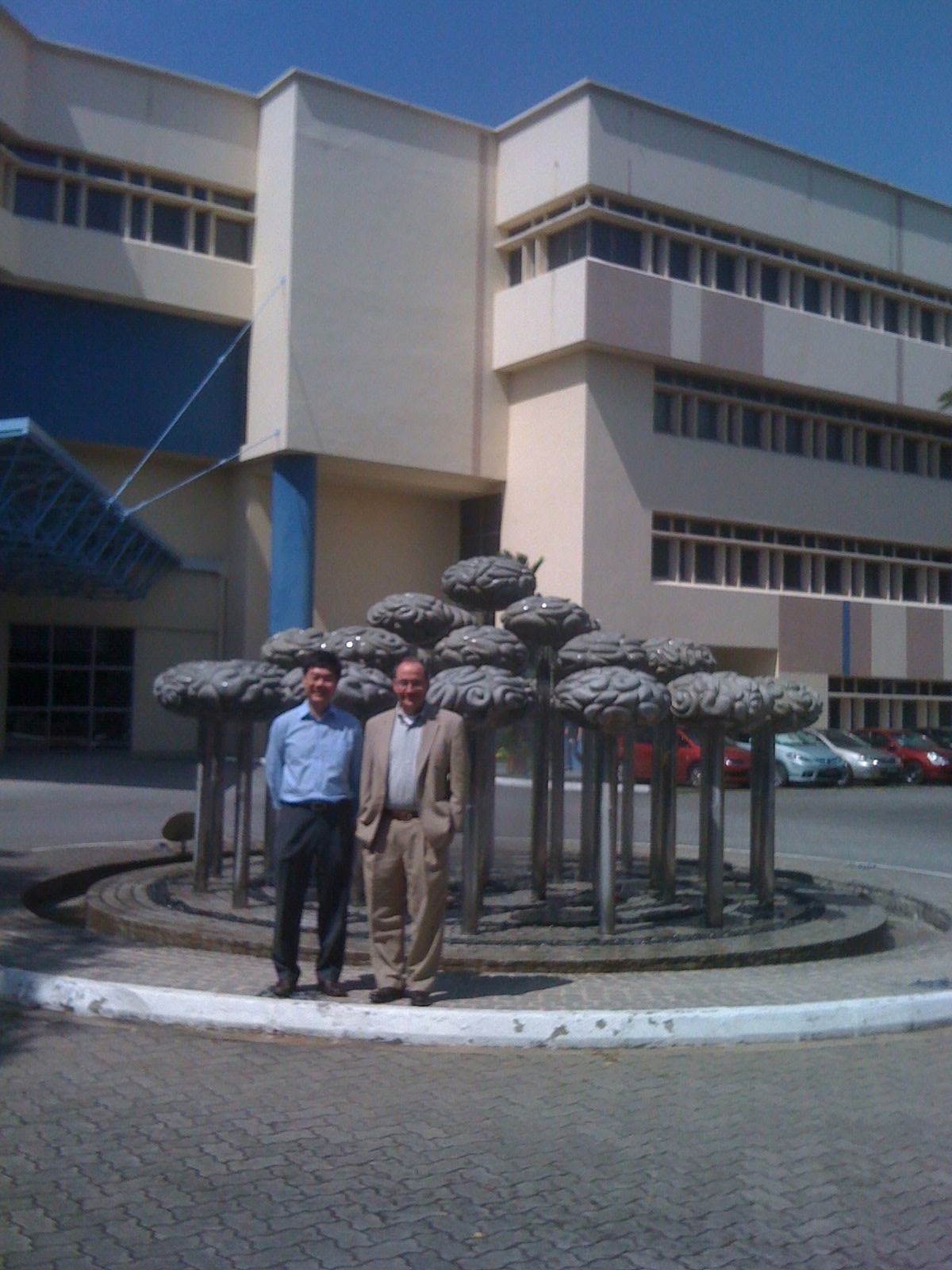
DOM VI is now history–it was a terrific scientific conclave with some absolutely incredible talks. A short blog post then to thank the organizers– in particular Kenneth Kwok –for their superb pulling it all together. Here Ken and I are posed in front of one of Singapore’s iconic science locations, brain sculptures make the photo.

I’m back in DC after a mind-boggling 18 hr, 10,000 mile non-stop to New York directly over the Pacific Ocean.

Live Blogging from DOM 6

Kenichiro  Mongi from Sony showed the following viral video from TED on human leadership behavior:

Right now John Weng from Michigan State is telling us about his view that there are 5 chunks of a brain-mind model: development,  architecture, area, space and time. His mantra: you need a deep understanding of  computer to understand the brain. Hmmm.

Does the brain have a Von Neumann Architecture: DOM VI Update

Yesterday’s talks had an underlying debate about the very nature of the brain, namely does it have a Von Neumann architecture, has it evolved to compute or did it evolve to be something more of a Rube Goldberg machine? Pushing the latter view was Duke’s Dale Purves, the former position was taken by Rutger’s Randy Gallistel with Stanford’s Jay McClelland coming down somewhere in the middle.

Central to the debate was the question of whether there is a biological substrate for the required read/write addressable memory in the brain (in species ranging from ants to humans).

My own view is that the CA3 field of mammalian hippocampus at least offers the possibility of serving as the biological substrate as evidenced by its circuitry, the plasticity of its synapses and the possibility of mechanisms other than pure spike time dependent plasticity providing the ability to address specific synapses.

My former Mason colleague Maria Kozhevnikov (now at the National University of Singapore and Harvard Medical School) gave a wonderful talk on performance differences produced by immersing human subjects in immersed 3-D environments.

I had the honor of opening up DOM VI with an overview of the initiative.

Singapore Bling (Decade of the Mind VI)

I’m up at 4AM again. Jet lag for me goes away as a step function. I’m at a plateau right now. Up at 4 and really sleepy by around 9PM. Today (Sunday) we’ll dialog with some of the principals in combination a tour and dinner. We’re gathering in the late afternoon for a tour of the Peranakan Museum (the culture before the British got here–descendants of the Chinese and South-Asian communities that formed a hybrid culture) and then a festive dinner at a restaurant near by.
Yesterday I took in the full Orchard Road shopping experience. Imagine an eastern asian version of Rodeo Drive and Fifth Avenue rolled into a single massive tree-line boulevard. Or for those loyal readers from the Washington Area, Imagine malls like Tysons –except they are like the iceberg that the Titanic hit–the part above ground is dwarfed by what’s below the street level. At one of the most iconic of these shopping palaces (Ion) you’ll not only find access to the MRT (Singapore’s version of Metro) but also stores like Marks and Spencer, Burrberry and oddly enough for my Ann Arbor friends, a version of Borders Books that harkens back to the glory days.
And of course the food courts, which go on and on and forever and for which my colleague Tyler Cowen has provided much better reviews than I ever can (I believe his next book is on the economics of food!).
I ended up spending some money on some gifts; the Singapore dollars is right now at about .77 of the US dollar, so even though it’s absolutely not true, my neuroeconomic brain was making feel like the country was on-sale.
Our Hotel, Traders, is proximal to the leafy quiet neighborhood at the end of Orchard Road near the Botanical Gardens. It’s also quite near the U.S. Embassy (it looks impregnable by the way). So it’s not surprising really that the hotel is connected to a much smaller Mall which caters to the ex-pat scene. There is a clone of Whole Foods that was filled with people who could easily have been teleported from the one I usually go to in Clarendon. I have to say the prices, on average, were a bit better–although that could still be cognitive dissonance of using the Singapore dollar.
We’re near the equator. The last place this hot that I visited, Curacao, was also very near the equator. I suspect I mentioned that in a 2005 blog entry. So as I’m hearing about crisp Fall weather from the States, I’m a bit envious.
Tomorrow I’ll kick off the conference with an overview of the Decade of the Mind Project and where I hope it can go, both within the US and internationally. Then we’ll hear talks from Dale Purves, Randy Galistel and Maria Kozhevnikov. With luck (and wi-fi), I’ll be live blogging.

Blogging from Singapore

So I’m in Singapore a few days early, to get over the jet-lag (I’m a believer in Melatonin) and for some scientific meetings tomorrow. The Decade of the Mind Conference doesn’t begin until Sunday. In the meantime some observations: the non-stop from Newark to Singapore didn’t go over the Pole. Instead it took a route that led across the Atlantic, Northern Europe, Russia, Afghanistan, Pakistan, India, The Bay of Bengal and on in to the Island State. We took the most interesting circuitous route across both Afghanistan and Pakistan with intricate direction turns–makes one think there might be some concerns about where commercial jets can safely go–or not. And there was some very exciting turbulence over the Indian Ocean as we got close. But all told, it was a great flight and definitely the fastest way to East Asia from the US east coast.

The food here–so far–is great. I had an amazing fish curry for breakfast.

Great news on the Chilean miners. We got the text messages of the successful rescue on the plane.

To DOM6 via the North Pole

I’ll be off to Decade of the Mind 6, which is in Singapore on Tuesday. To get there I’ll be taking the longest non-stop route in the world, Singapore Airlines Flight 21 from Newark over the Pole, Russia, China and down into South East Asia. No time over the Pacific. I’ll try to get some good blog posts out from the meeting. My colleague Tyler Cowen, gave me special coaching in the foodie department, so I’ll be ready.

University of Michigan–where’s the recession?

I am in Ann Arbor for some meetings. It was gorgeous weather yesterday and the general well-being of both town and gown left me wondering where the Great Recession was. Now here’s the interesting piece of data: when I was going to graduate school here in during the heart of the 1980’s recession, I was completely unaware of what was going on with the rest of the national economy. This may be because I was too busy in the lab developing autoradiograms. But part of it, I suspect, was that Ann Arbor is in fact, strangely an island. On the way in from the airport, there were in fact many billboards offering help from foreclosure and the like. But the devastation seemed to stop at the city-line. Downtown having dinner at the West End Grill last evening, the streets seemed busy, shoppers seemed to be buying, the restaurant (in my opinion one of Ann Arbor’s best) was full.

So how does Ann Arbor manage this? Why does the U (as the University is often called here) appear to be in such rude health?

Final caution: I’m not so sanguine about the football team.