
In The New Yorker, king of the moderate political pundits, the New York Times David Brooks explains most what’s meaningful in human life using popular neuroscience here. It’s a decent piece, but I’m more comfortable with David sticking to the News Hour.
Educated is being multilingual….
From today’s on-line version of the Straits Times here. Money quote:
The number of Singaporeans proficient in two or more languages jumped from 56 per cent ten years ago to 71 per cent in 2010.
The use of English at home is also more prevalent, especially among the younger age groups. Among residents aged five to 14 years old, English was the home language for 52 per cent of Chinese and 50 per cent of Indians. Twenty-six per cent of Malays in the same age group now speak English at home, a spike from 9.4 per cent in 2000.
The Largeness of Science
Today was a rare occasion when I sat down, not with Science or Nature, but rather with Discover and the Scientific American. What struck me was the enormity of the modern science enterprise. I like to think that sitting in the director’s chair at an institute for advanced study, I’d have a pretty good feel for at least the feature landscape of science, but while this may be true for the intersection of neurobiology, cognitive psychology and computer science, I’m astounded by what’s going on entirely outside that rather broad purview–in fields such ranging from cosmology down to microbiology.
So my question is: how does a person deeply interested in science (writ large) keep up? This is a challenge not only for folks like myself, but true as well for the bench-top principle investigator. A few years ago, our university took out a site subscription to the Faculty of 1000–which amounts to a sort of expert crowdsourcing of the literature. I valued that a great deal. It seems to be headed in the right direction.
I also acknowledge that Wikipedia (at least in my own narrow expertise of molecular neuroscience) is usually pretty good as far as getting the facts right. Which leaves me hopeful that it might be as good in other fields for which I’m not qualified to make that judgment.
Graduate life at the Krasnow Institute…..
Here’s a wonderful video of one of our graduate students stars….Rebekah Evans. She is a doctoral student in our neuroscience program and works under Professor Avrama Blackwell of our Molecular Neuroscience Department.
Plutocracy Now!
Chrystia Freeland’s new piece in the Atlantic is here. I remain agnostic about all things economic (except for our own economists at Krasnow) but this is an extremely well-written piece and certainly captures the current ethos.
I’ve been an avid reader of Freeland’s work from her Financial Times days. She’s currently at Reuters.
Autism Spectrum Disorder and Vaccines
Today’s major science news of course is that The British Medical Journal, after an exhaustive review, concluded that the 1998 paper linking autism to vaccines was in fact fraud. ScienceInsider has the news here.
This is a neuroscience story with tremendous legs. It is a spectacular illustration of how policy and neuroscience can intersect with disastrous results.
Money quote:
His report is another strike against the already-retracted research, which was led by Wakefield. A 2002 study failed to replicate the findings; the British General Medical Council spent 2.5 years investigating and a year ago concluded that Wakefield’s conduct was “dishonest” and “misleading.” The Lancet retracted the paper, and Wakefield lost his license to practice medicine in the United Kingdom.
Institute Expansion Project
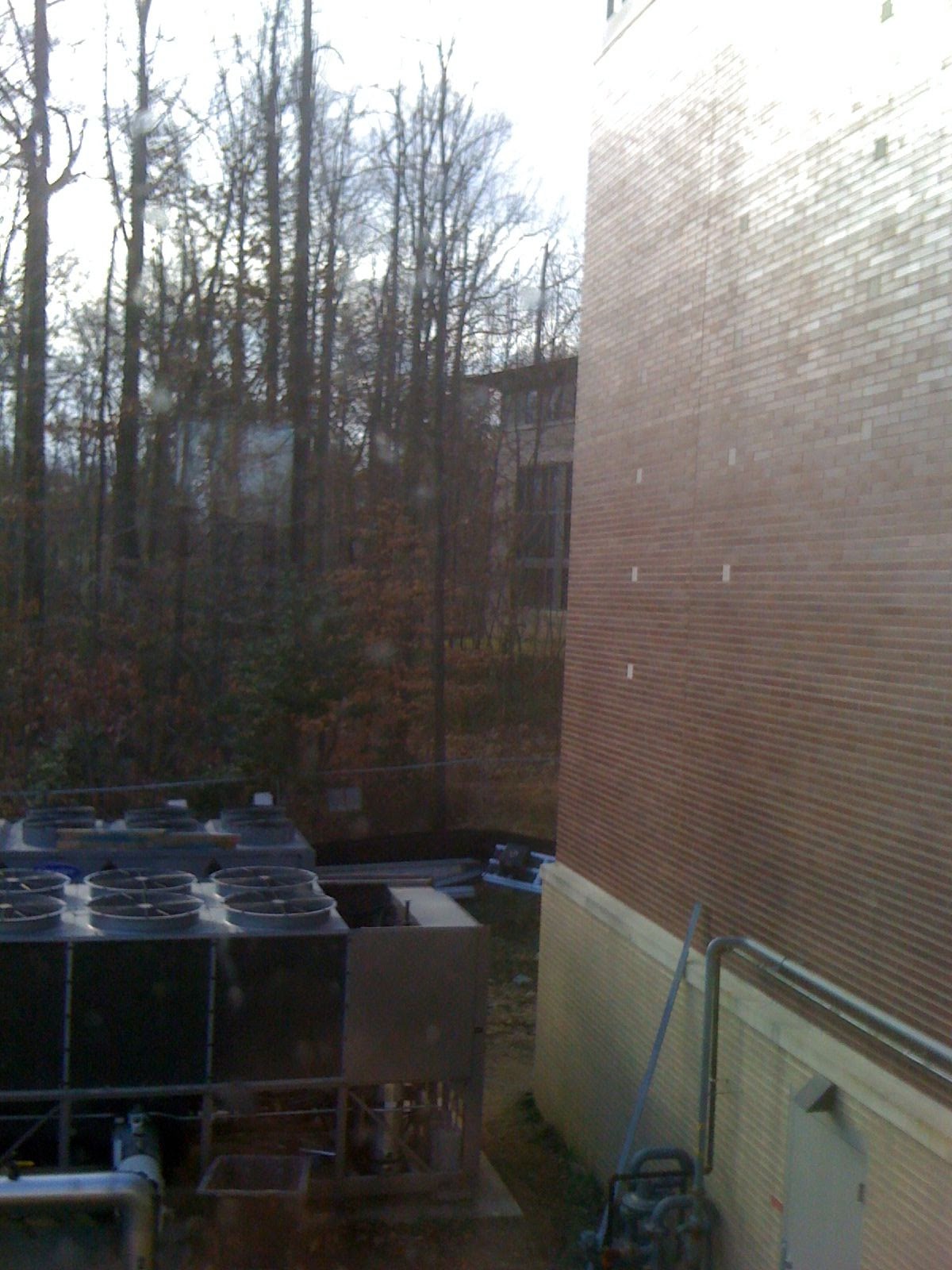
Here’s a photo from within the new expansion project looking south. In the foreground is Phase I and the new chillers. In the background you can make out the signature two story windows of the Great Room. Our trees are still bare. They’ll be greening up when we take delivery in the Spring.
Phase I and Phase II together make up a larger massing than the original Krasnow Institute facility. Together, they’ll have approximately 30,000 square feet of wet-labs and associated support lab/shared instrumentation space on three floors.
In total, the Institute will encompass nearly 55,000 square feet with over 100 associated scientists, trainees and staff. We still have a center and one of our academic departments in a satellite facility on the Mason campus. Eventually, we’ll bring those folks in also, with a Phase III addition on the south side of the original building.
Krasnow’s mission continues to center on the intersection of neuroscience, cognitive psychology and computer sciences. We conduct convergent research and we train new scientists to do the same.
Life without the Net
We’ve spent the past two days back at work here at Krasnow, but without Internet services due to the massive construction projects here on campus. So it was an interesting time. Nicholas Carr would be perhaps disturbed to know that I didn’t feel any smarter. On the other hand, I did find myself making extensive use of my Iphone, so perhaps it wasn’t a fair N of One experiment.
Neuroplasticity
Happy 2011! From today’s NY Times, Oliver Sacks on real-life examples of rapid neuroplasticity is here.
He is talking about functional (i.e. phenomenological) brain plasticity as reflected in his patients. What is remarkable about modern neuroscience is the growing scaffolding from molecular changes through neuronal morphological dynamics and onto cell assembly dynamics that reflects the budding of a theory for how the phenomenon happens. That’s the good news from neuroscience.
What use the PhD?
There’s been a lot of Sturm and Drang lately about getting your doctorate–at least in the humanities. Now The Economist weighs in here –and not just about the humanities. The correspondent (The Economist contains no bylines) apparently got hers in the life sciences and is none too thrilled.
There are several major trends converging here, among them: the role of tenure, the role of postdoc, the role of graduate students in research and teaching and finally the market outside academia for persons with doctorates. The key element is that things are changing rapidly (as this piece implies) and that what the future holds for the academic research enterprise isn’t entirely clear.
That said, my own view of the majority of our doctoral students is that they are a bright, fairly fulfilled bunch. They work very hard, but they convey a sense of optimism about their own futures. Of course, this may be an advantageous strategy for graduate students within eyesight/earshot of their institute director.

