Watson

So, as with Chess, the IBM artifact can now beat humans at the famous TV game Jeopardy. John Markoff’s story in the NY Times is here. Computer supremacy in Chess didn’t change the world and neither will this “triumph”. What we’re seeing is a natural evolution in machine learning algorithms and a manifestation of Moore’s Law.

Kurweil believes that this is a progression to what he calls “The Singularity”–where things become sharply non-linear and our machines may (if all doesn’t go well) decide to consume us.

The more I learn about neuroscience, and about how different our human brain architecture is from that of a digital computer, the more skeptical I become of that perspective.
Brooks on Cowen: Valuing wealth

David Brooks NY Times column on my colleague Tyler Cowen’s new e-book, The Great Stagnation, seems spot on–here.

The questions are twofold:
1) What is our brain’s definition of wealth–and does it change over time or between individuals?
2) How does our brain value wealth against other things (e.g. health, knowledge, richness of experience etc.)?

These questions are central to the new field of neuroeconomics.

Science budget battles

The relevant interactive chart is here. My take home is that the NIH budget is relatively preserved even under the House plans for a continuing resolution (CR). NSF also seems to emerge from the President’s blueprint relatively OK.

That said, I am much more pessimistic about the longer term picture. Science R&D is the part of the budget termed discretionary by Congress–and until there’s a serious plan (that includes so-called mandatory spending–i.e. like Medicaid and Medicare) then discretionary spending is going to have to take the big hits in order to produce any significant results in the deficit.

Peter Stearns on public and private higher ed here in Virginia

Mason’s Provost, Peter Stearns,  has a very interesting blogpost on the increasingly ambiguous boundary between public and private institutions here.

The key point is that private non-profit institutions are often viewed as tremendous assets by states (Harvard immediately jumps to mind). Note that in Massachusetts, the flagship public, UMass Amherst, has often struggled.

We certainly live in interesting times….

Russian Billionaires and their Toys

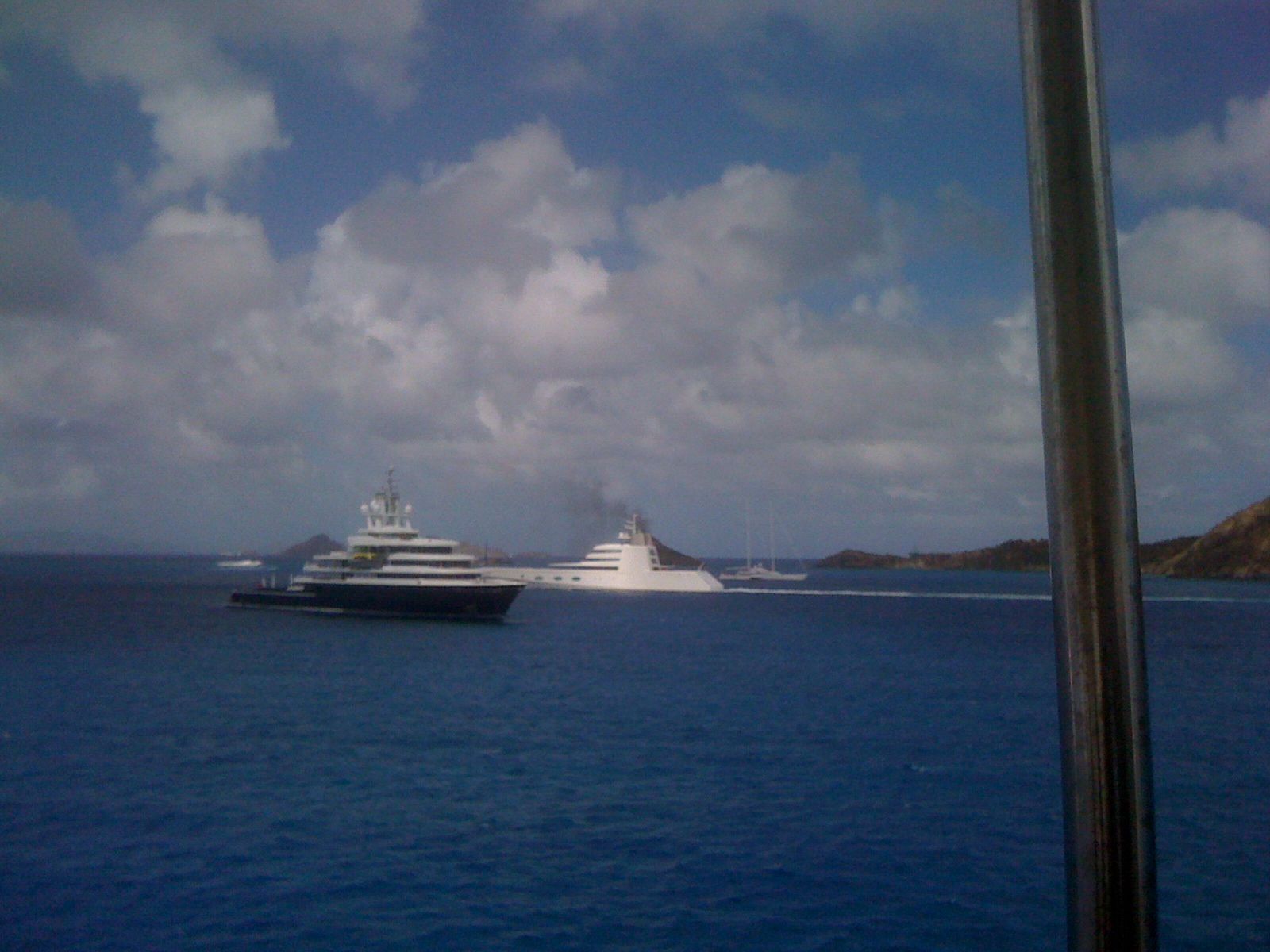
I’m back…flew in from St. Kitts last night. I’m enclosing a picture from St. Barthes though. These are two of the six boats owned by the same Russian Billionaire. The one that appears to be a submarine is particularly stunning. It covered the distance from where I took the picture to over the horizon is what appeared to be 20 minutes.

As for me, I’d rather have a two-photon microscope.

Thanks to patient and loyal readers for their patience. Now back the world of science….

Onto the Caribbean….

We dodged the proverbial bullet here in Washington DC as the monster blizzard does what it has to do to vast swaths of the rest of the US. The upshot is that I’ll be able to leave town tomorrow for a week’s vacation. Email access will be minimal, but if I happen onto any blog-worthy ideas, I’ll probably manage to post them at some point.

Speaking directly

Today I spent a while on the phone with our public relations folks trying to put into words a concept that really, on reflection, was quite simple: the Krasnow Institute for Advanced Study is a national scientific gem and that’s evidenced everywhere, from our Nobel laureate scientific DNA to the way we win our scientific respect: competitively with the likes of Harvard, Yale and Caltech–not by our Washington connections.

Sometimes it’s better to just say what you have to say directly and not beat around the bush.