
It’s here. Stuart puts out some excellent data on NSF EAGER and RAPID awards–the non-peer reviewed mechanisms for a program officer taking a bet on a high risk project. Bottom line: it’s under utilized and the reason may be embedded in the agency’s culture and history. Well worth the read.
Category: Uncategorized
Another COVID lesson: don’t forget to invest in Bioinformatics…
I read the other day that the US excess deaths rate is back down to where it was before the pandemic. We’ve really turned the corner and that’s why it’s critical to begin pinpointing the lessons from the past three years that will help us manage the next pandemic better. One of them has been floating under the radar: bioinformatics. To my mind, investing in bioinformatics research and infrastructure could help strengthen defenses against future threats.
So what might we invest in? For one, advanced DNA sequencing and computational epidemiology allow earlier identification of outbreaks before widespread escalation. Bioinformatics enables tracking of pathogen spread and evolution in near real-time to inform containment plans. Simulation models can evaluate intervention scenarios and quantify outcomes.
For another, bioinformatics can accelerate development of medical countermeasures needed to combat novel pathogens. For vaccines, computational genomics and immunoinformatics enable rapid design of candidates based on the genomic profile and evolution of the pathogen. Researchers can construct customized mRNA and DNA vaccines within days once the genetic code is available. High-throughput in silico screening also allows existing drug libraries to be scanned for molecules with potential antiviral properties that could be repurposed. Promising hits can undergo rapid in vitro confirmation. Beyond repurposing existing drugs, bioinformatics can identify molecular targets for designing new broad-spectrum antiviral drugs. As the pandemic spread, researchers leveraged bioinformatics to adjust RT-PCR diagnostic assays to detect the emerging SARS-CoV-2 virus. Going forward, integrative analytics of disparate datasets along with artificial intelligence modeling may provide critical epidemiological insights for contingency planning against future threats. Overall, bioinformatics provides a valuable toolkit for developing tailored diagnostics, treatments, and vaccines in response to novel pathogens.
And…Large Language Models married to bioinformatics and in-silico modeling of molecular dynamics may have the potential to accelerate progress. Already, we are hearing of such transformer models trained on genes instead of words.
Bioinformatics is clearly only a piece of the pie. Robust traditional public health systems remain essential. However, bioinformatics infrastructure offers complementary capabilities to help monitor, model, and respond to outbreaks. Supporting bioinformatics R&D and next-generation sequencing infrastructure could provide valuable capabilities. As policy is developed, the potential of bioinformatics could be considered as part of a comprehensive biopreparedness strategy.
NSF versus NIH on COVID response
From the son of my colleague Alex, here. This is very gratifying to see quantified and speaks to one of NSF’s great competitive advantages: agility.
Lessons Learned from the US Covid Response
I went to a Chatham House Rules lunch today at AEI and joined with fellow DC Swampians to talk about what we’ve learned from the whole of government response to COVID here in the US. It’s a worthy topic and I think the collective experience was sufficient to provide some decent consensus on what might have been done better. At the center of the conversation was the issue of trust in science. Surrounding that donut-hole (perfect metaphor) was a human capital problem–we don’t train folks to manage crises of this scale.
Another reason for Mason grad students to register for my Fall course on managing large-scale US government crises (self-recommending as Tyler would say).
Research Impact Bonds Idea: Hokum
Michael Hill is head of grants management at the Swiss National Science Foundation. His idea for research impact bonds as a novel funding mechanism is in Nature, here. The idea is to take on a challenge/prize set out by the funding agency and have investors take on the risk by holding a ‘bond’ that pays out their principal plus interest if the project succeeds. I think it’s bunk. The most important scientific advances are not based on ‘moonshot’ frameworks. They are quite often the results of a benchtop ‘accident’ that reveals something entirely unanticipated.
And, in the case of something like LIGO and gravitational waves, what kind of investor would take on that risk in the first place (rigorously determining a movement in space-time less than the diameter of a proton)? You’re right: only the NSF–which essentially went double or nothing on $500M to achieve success. Not the kind of stuff that can be financialized.
To his credit, Hill acknowledges a lot of my critique. But I’d go further: if science can be financialized with a bond-like framework, then let the private sector have at–as in Bell Labs. We call that applied science.
The Three Body Problem in Nuclear Arms Control
From this morning’s NYT, here. A nice quote from my former boss:
France A. Córdova, an astrophysicist and past director of the National Science Foundation, said the study of three-body phenomena in the natural sciences could nonetheless help reveal the military risks. “Things are changing very rapidly,” she said. “Anything that helps in understanding that is great.”
William J Broad New York Times, June 27, 2023
One of President Obama’s favorite science fiction novels was “The Three Body Problem” by Liu Cixin. So of course, I read it, and that’s how I learned about the complexity science side of three newtonian bodies interacting with one another (in the case of the novel it’s triple-star system). But I hadn’t thought about the issue in terms of nuclear arms control (China, Russia and the US). Broad’s idea here is that while things were relatively simple with the diad of the Cold War, nuclear deterrence will become less manageable as China builds out its ICBM force. To my mind, the whole premise is kind of moot, because we haven’t had a diad for some time. France, India, Pakistan, Israel and North Korea come to mind right away. The point is: (which the article notes correctly) it isn’t the size of the missile force. Rather it’s the existence of the force itself. Nuclear weapons geopolitics has been multipolar for some time.
However, the idea that complexity science may have something profound to tell us about geopolitics *is* quite interesting. Within that framing, should we think of the relevant agents as Westphalian nation states (as in the game Diplomacy)? Or going along with Thomas Carlyle, are the agents the human leaders of those states?
Christof and David’s bet…
My old friend, Christof Koch had to pay off his bet to David Chalmers with a case of wine because we haven’t yet figured out the neurobiological substrate of human consciousness (the hard problem variety), but I think there’s something bigger going on with the field right now–namely the question of whether ChatGTP’42’ will be deemed sentient (no more fired employees Google) and it will be revealed that consciousness is an emergent or even an epiphenomenon of complexity. Meaning, we still won’t understand it as a reductionist would want to. That’ll be a big problem for Popperian science.
RIP Donnie McKethan

Donnie McKethan passed away on June 19, 2023. His Sunday afternoon radio show on WPFW, The American Songbook was beloved in the DMV for over 20 years. With the advent of the Internet, he had listeners all around the world. Donnie got a lot of us through the pandemic with his musical programming and his knowledge of the canon was encyclopedic. And … he loved hot and humid weather, so it’s appropriate that he was from Washington DC. WPFW will be honoring him with a special musical tribute all day on Tuesday July 4. RIP.
What was the Krasnow Institute?
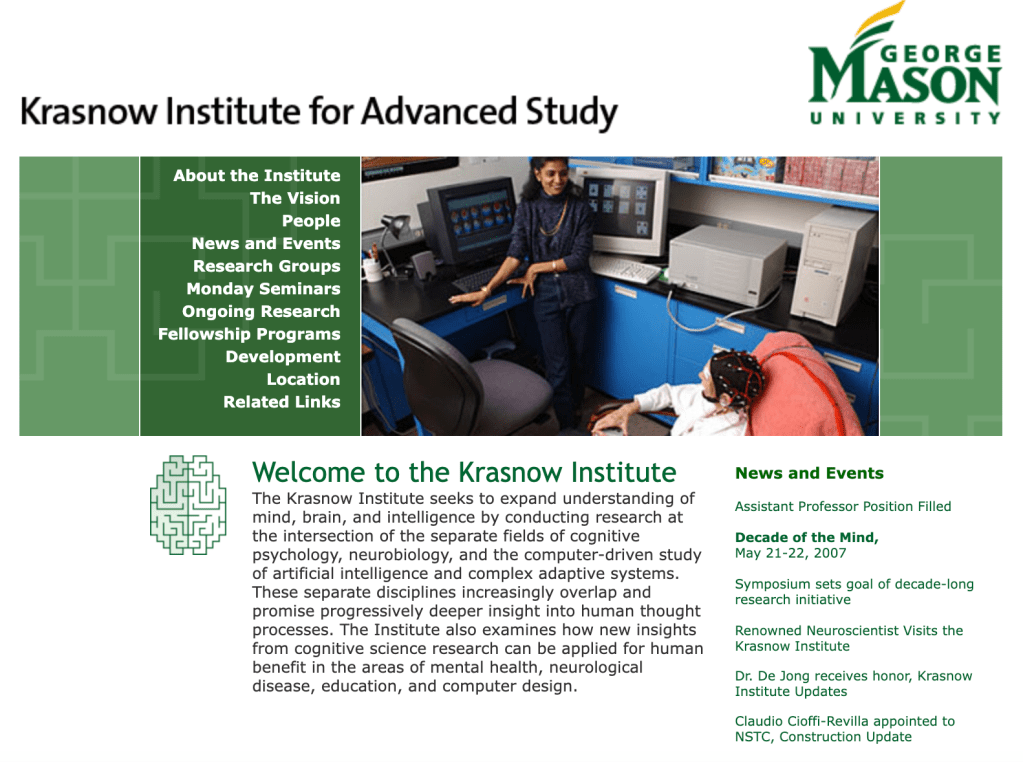
Via, the Wayback Machine, here’s the homepage from circa 2008. Often called, SFI East, the Institute was a product of private east coast money and west coast intellect. Its founders included the likes of Murray Gell-Mann. For a while, it was also a small-ish academic unit of George Mason University offering degrees in computational social science and neuroscience. It’s first Director, Harold Morowitz, was a pioneer in biophysics at Yale University who later became a Robinson Professor of Natural Philosophy at Mason.
The Institute is no more, it was killed off while I was in government, by the short-sightedness of former leadership of the University who are now long gone. But the gorgeous building is still there along with its art and glass-cubed great room surrounded by forest. It’s worth seeing if you are in the neighborhood.
If you look closely at the homepage, you’ll notice a bullet for the “Decade of the Mind” back in 2007. That Decade of the Mind became something called The BRAIN Initiative. Good ideas have a way of living beyond the lifetimes of their inventors.
The Research Analog to Honors Colleges
There exists at some large public R1 universities an ‘entity’, let’s call it a quasi-academic unit, that seeks to bring the essence of a small liberal arts college education into the big campus milieu. This often includes a residential housing offering combined with small seminar-style classes given by full-time instructional faculty. If we call the entity an honors college, that captures both the academic competitiveness aspect that goes with the instruction and the idea of something like a real academic unit with its own decanal head. The term varies–at my institution, it is in fact, the Honors College–but the name varies. At Michigan, it’s the Residential College. The generic term is a living-learning community, but you get the idea. From a business standpoint, it’s a smart segmentation of the overall product, reminiscent of economy-plus seats on your favorite airline.
What if R1’s pursued something similar, but in the research rather than instructional domain? Imagine something like a mini-Caltech or -Rockefeller inside a Big Ten. Principal investigators inside the ‘thing’ might have an entirely different deal, more akin to HHMI extramural investigators. Darn, they might even have their own Janelia Farm lab building. Maybe they’d even have a residential option somewhat like University of Chicago’s MBL.
The idea is the same sort of business segmentation as the honors college, and it might add value. Faculty might even self-select to belong to the research-living community.
You think it’d never fly? People rail at airlines the segment everything in the flying experience to separate charges, but they do fly them. The segmentation adds value.
 Discoverers and Discoveries